Contact Us


Aluminum Alloy Impeller CNC Precision Machining | High-Performance Components for Demanding Applications
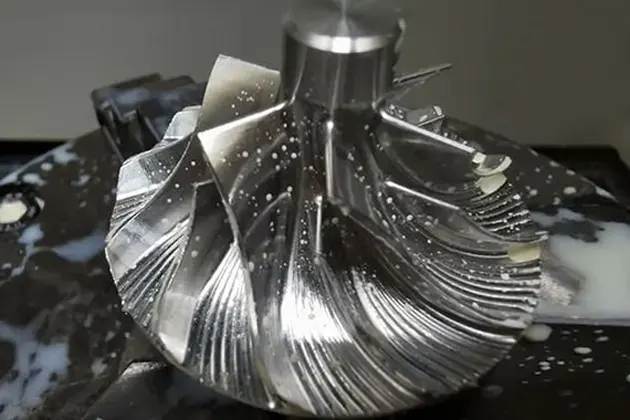
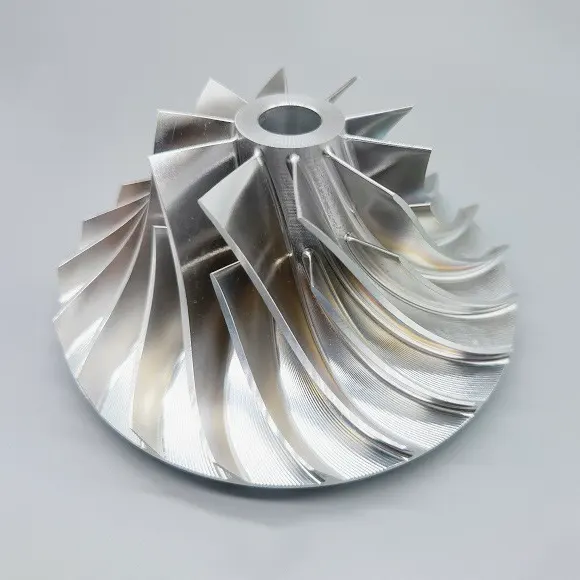
Aluminum alloys provide an optimal combination of lightweight and strength, making them perfect for impellers in industries such as aerospace, automotive, and energy. Through advanced 5-axis CNC machining, we achieve tight tolerances and exceptional precision, ensuring our impellers deliver outstanding performance even under high-speed and high-pressure conditions.
- Machines: 3-axis, 4-axis, 5-axis, 3+2
- Accuracy: ±0.005 mm
- Surface Roughness: Up to Ra 1.6
- Materials: Aluminum Alloy
- Production Capabilities: Prototyping, Low-volume, High-volume
 Get Free Quote


Custom CNC Impeller Machining Services
At KT, we are committed to delivering top-tier quality, powered by cutting-edge technology, to be your trusted partner for all CNC impeller machining needs. From concept to implementation, we focus on creating complex and precision-driven impellers that enhance efficiency and performance across industries.
We understand that each impeller project requires the highest precision and the utmost attention to detail. Our state-of-the-art facilities are equipped with advanced CNC machinery, operated under the supervision of a skilled engineering team with decades of experience. Whether you need custom impellers for aerospace, industrial equipment, or any other specialized field, we can turn your ideas into tangible solutions.
Quality is our priority. We adhere to strict manufacturing standards to ensure that every impeller leaving our facility not only meets but exceeds your expectations. We work closely with our clients to fully understand their unique needs and provide solutions that optimize their projects.
5-Axis CNC Machining for Impellers
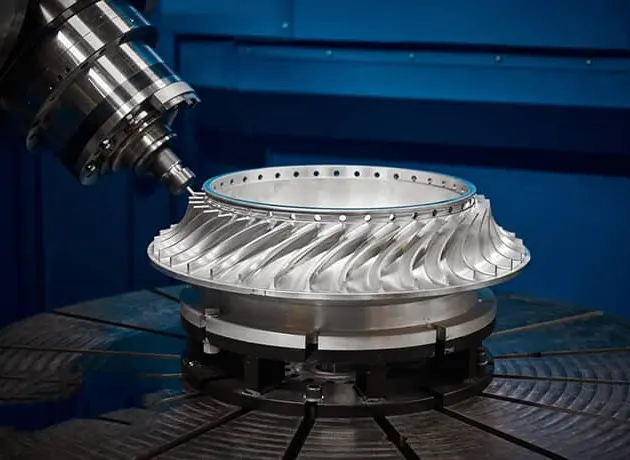
Using 5-axis CNC machining offers an excellent solution for manufacturing complex surfaces and irregular components, especially those with specific mathematical equations and high precision requirements, such as the intricate blades of impellers. A 5-axis CNC machine can manipulate cutting tools along five different axes: X, Y, Z, plus two additional rotational axes (A and B). This allows the machine to approach the workpiece from various angles and directions, making it particularly advantageous when processing complex profiles like impellers. Compared to traditional methods, this approach offers higher flexibility, efficiency, and precision in manufacturing complex impeller geometries, as most (if not all) of the work can be completed in a single setup, eliminating delays associated with part loading/unloading and significantly reducing human errors.
CNC Machining Process for Impellers
- Design & Modeling: The process starts with Computer-Aided Design (CAD) software, where a 3D model of the impeller is created. Engineers define the impeller's dimensions, blade profiles, and other essential attributes.
- Material Selection: Impellers are usually made from materials like stainless steel, aluminum, bronze, or various alloys based on the intended application. The material is selected based on strength, corrosion resistance, and temperature tolerance.
- Material Preparation: The selected material is shaped into a form suitable for machining. This may involve casting or other metalworking methods to generate an initial shape close to the final impeller.
- CNC Machining: The pre-formed impeller blank is placed into the CNC machine, where cutting tools remove excess material to shape the impeller's blades, hub, and other features.
- Balancing: Achieving balance is critical in reducing vibration and ensuring smooth operation. After machining, the impeller undergoes balancing checks, and additional material may be removed from specific areas to achieve the desired balance.
- Finishing: Based on the intended application, the impeller may undergo polishing, deburring, and surface treatments to improve efficiency and longevity.
- Quality Control: The impeller undergoes a thorough quality control evaluation to ensure it meets the required dimensions, tolerances, and balance specifications.
- Assembly: After passing the quality control evaluation, the impeller can be integrated into the relevant pump, turbine, or compressor as part of a larger system.
Material Selection for Impellers
Impellers should have excellent mechanical properties, including high strength at both room and elevated temperatures, plasticity, and toughness. The material needs to provide:
- High vibration damping capability
- Excellent structural stability
- Effective resistance to corrosion and erosion
- Superior processability
- Sufficient mechanical performance at high temperatures
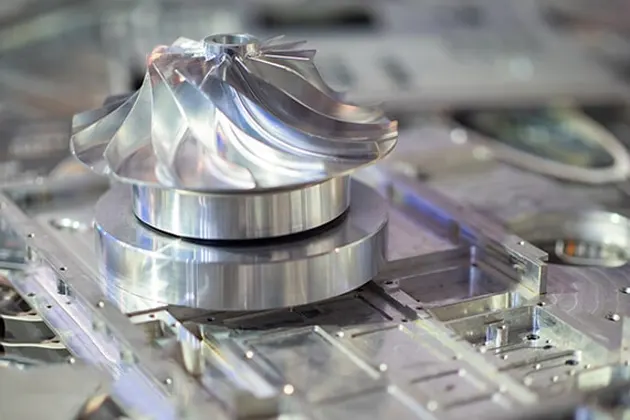
Impellers used in aerospace engines require a balance between strength and minimized weight, with LD5 aluminum alloy being a commonly selected material due to its availability and manufacturability.
Why Choose Us?
Technical Specifications
| Parameter | Value |
| Processing Type | CNC Precision Machining (3-axis, 4-axis, 5-axis, 3+2) |
| Surface Roughness | Up to Ra 1.6 |
| Materials Processed | Aluminum (6061, 7075) |
| Tolerance | ±0.005 mm |
| Surface Finishes | Anodizing, Polishing, Electroplating, Sandblasting |
| Machining Equipment | 3-axis, 5-axis, 3+2 CNC Machines |
| Production Volume | Prototyping, Low-volume, High-volume |
Applications of Impellers
We specialize in manufacturing impellers for various high-performance applications such as:
- Aerospace Engines: Impellers used in turbine engines and other critical systems.
- Automotive Turbochargers: High-performance impellers designed for automotive turbocharger systems.
- Marine Propellers: Impellers for marine propulsion systems.
- Air Compressors & Centrifugal Fans: Impellers used in air compressors and fans.
- Centrifugal Pumps: Impellers designed for high-efficiency fluid transport systems.