Contact Us
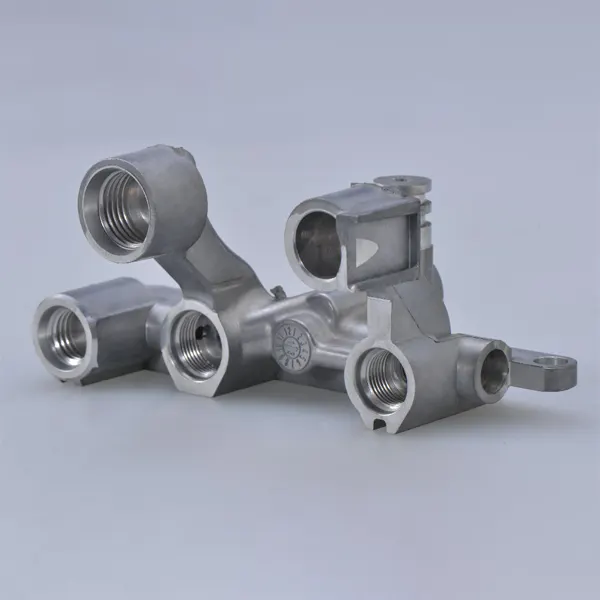


Aluminum Alloy Fluid Control Manifold
Structural die casting is an exceptional manufacturing process for producing high-strength, lightweight components with intricate designs—exactly like this automotive fluid control manifold. Combining the process’s signature precision and material efficiency, this multi-port manifold consolidates complex fluid paths into a single robust part. It perfectly demonstrates how structural die casting balances lightweighting with structural integrity, delivering the reliability required for critical automotive fluid systems.
Quick Info
- Material: Aluminum Alloy (A380 / A356)
- Surface Treatment: Deburring, passivation, fluid-compatible coating
- Key Features: Multi-port threaded connections, complex internal fluid passages, high-pressure sealing surfaces, precision mounting points
- Tolerance: ±0.02–0.05 mm (threaded ports & sealing surfaces)
- Lead Time: 7–12 days for tooling & first samples
 Get Free Quote


At KT, we specialize in manufacturing structural die cast components for high-demand industries like automotive, aerospace, and construction. Structural die casting is defined by its focus on structural integrity and mechanical performance, making it ideal for critical applications where strength, reliability, and lightweight design are non-negotiable. We combine advanced simulation, precision tooling, and rigorous quality control to deliver parts that meet the strictest standards for durability and precision.
🛠️ Structural Die Casting Manufacturing Workflow
- Part Requirements Definition: The process begins with a thorough review of the manifold’s specific needs, including its complex geometry, threaded port specifications, and pressure-resistance requirements. Defining critical dimensions and material performance targets ensures all subsequent steps align with the component’s functional goals.
- Alloy Selection: Aluminum alloys (A380 / A356) are chosen for their exceptional strength-to-weight ratio, corrosion resistance, and castability. These alloys provide the ideal balance of lightweight construction and mechanical performance required for fluid system components.
- Mold Concept & Design: A precision-engineered mold is created, accounting for the manifold’s complex geometry, draft angles, and ejector pin positions. This design ensures complete material flow into all cavities, including the intricate internal passages, to produce accurate, defect-free parts.
- Mold Filling & Solidification Simulation: Advanced simulation software is used to optimize the mold design, ensuring uniform material flow, reducing porosity and shrinkage defects, and minimizing the risk of cold shuts. This step is critical for ensuring the manifold’s structural integrity and leak-tight performance.
- Vacuum-Assisted Die Casting: The mold is evacuated to eliminate gas-related defects, a key advantage of structural die casting. Molten aluminum is then injected under high pressure, filling every cavity—including the complex internal passages—to form a dense, near-net-shape part with minimal porosity.
- Controlled Part Cooling: Strategically placed cooling channels in the mold ensure uniform, controlled cooling, preventing warping or cracking. This step is essential for maintaining dimensional stability and the manifold’s structural integrity.
- Ejection & Trimming: After solidification, the part is smoothly ejected using a mold release agent. Excess material like gates and flash is precisely trimmed, bringing the manifold to its final dimensions and eliminating potential leak paths.
- Heat Treatment: The manifold undergoes a tailored heat treatment process to enhance its mechanical properties, including strength and hardness. This step ensures the material’s internal structure is optimized to withstand high fluid pressures and cyclic loads.
- Precision CNC Machining: Critical features like threaded ports, sealing surfaces, and mounting bores are machined to tight tolerances, ensuring leak-tight connections and perfect alignment with other system components.
- Straightening & Final QC: Precision straightening corrects any minor dimensional deviations from casting, ensuring the manifold meets strict tolerance requirements. Comprehensive quality control follows, including CMM dimensional checks, pressure/leak testing, and surface defect inspection.
📋 Specification Table
| Item | Specification |
|---|---|
| Process | Structural Die Casting (Vacuum HPDC) + CNC Machining + Heat Treatment |
| Material | Die Cast Aluminum Alloy (A380 / A356) |
| Key Features | Multi-port threaded connections, complex internal fluid passages, high-pressure sealing surfaces, precision mounting points |
| Tolerance | ±0.02–0.05 mm (threaded ports & sealing surfaces) |
| Surface Treatment | Deburring, passivation, fluid-compatible coating |
| Typical Lead Time | 7–12 working days |
✅ Core Advantages of Structural Die Casting
- Material Efficiency & SustainabilityStructural die casting uses only the required amount of metal, minimizing waste. This sustainable approach aligns with modern manufacturing goals while keeping production costs low.
- High Precision & Tight TolerancesThe process produces parts with exceptional dimensional accuracy, even for complex geometries. This eliminates the need for extensive secondary machining and ensures perfect assembly fit.
- Cost-Effective Mass ProductionStructural die casting is highly efficient for large production runs, with unit costs decreasing as volume increases. This makes it ideal for automotive and industrial applications requiring high volumes of consistent, reliable parts.
- Excellent Surface FinishThe process naturally produces smooth, high-quality surfaces, reducing the need for secondary finishing operations and improving corrosion resistance.
- Superior Structural IntegrityWith controlled cooling, vacuum assistance, and heat treatment, structural die cast parts like this manifold offer exceptional strength, durability, and resistance to fatigue and pressure.
🎯 Applications of Structural Die Cast Components
- Automotive: Engine brackets, transmission components, fluid control manifolds, and structural elements
- Aerospace: High-strength, lightweight aircraft structural parts
- Construction: Structural connectors, brackets, and fasteners for infrastructure
- Industrial: Hydraulic and pneumatic control units, fluid distribution manifolds