Contact Us
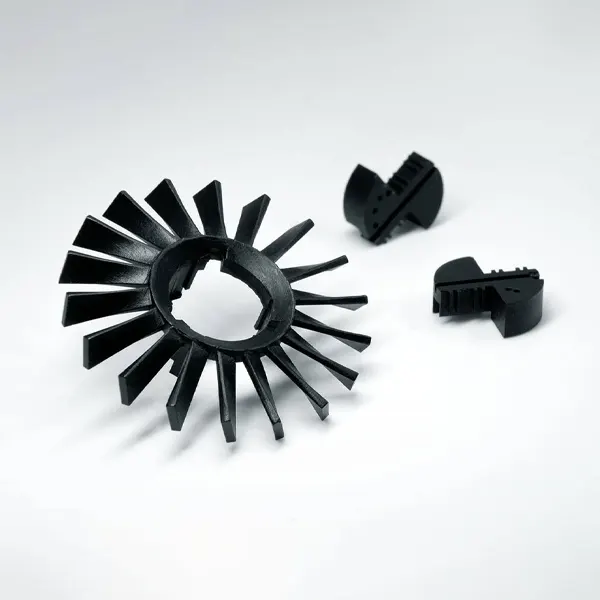


Rapid Tooling for Injection Molded Plastic Components
Rapid tooling bridges the gap between prototyping and mass production, enabling the creation of functional plastic parts in final-grade materials at low to medium volumes. This case demonstrates the process using a heat-dissipating fan component and custom plastic inserts, produced via rapid tooling injection molding. It’s the ideal solution for validating product characteristics, testing functional performance, and launching small-batch production runs efficiently.
- Process: Rapid Tooling (Epoxy Resin Mold) + Injection Molding
- Materials: ABS, PMMA, PE, PP, PA6, PA66, PC
- Cycle Time: 1–5 minutes per part
- Key Features: Final-grade material, functional geometry, low-cost tooling, fast lead times
- Applications: Product validation, functional testing, small-batch production
 Get Free Quote


At KT, we specialize in rapid tooling solutions designed to bring your plastic component designs to life quickly and cost-effectively. Our rapid tooling process is ideal for small to medium production runs, allowing you to test end-product characteristics, validate fit and function, and launch initial market volumes without the high upfront costs of traditional hard tooling.
We work with a wide range of thermoplastics, from engineering-grade ABS and PC to PA6/PA66, ensuring you get parts with the same material properties as mass-produced components. Our focus is on speed, quality, and flexibility to support your product development cycle.
🛠️ Rapid Tooling Production Workflow
- High-Quality Stereolithography (SLA) Pattern: The process begins with a precise SLA 3D-printed pattern of the part, featuring a high-quality surface finish. This pattern serves as the master model for creating the mold cavity.
- Mold Design & Parting Line Definition: Parting lines are defined based on the part geometry, taking into account undercuts and ejection requirements. This ensures the mold can be easily opened and parts can be cleanly demolded.
- Epoxy Resin Mold Casting: The master pattern is cast in two steps using a special metal-blended epoxy resin. The resin cures to a rigid, metal-like material that provides the structural integrity required for repeated injection cycles.
- Model Removal & Mold Finishing: The original SLA pattern is removed from the cured epoxy mold. The mold is then surface finished as needed to ensure smooth cavity walls and accurate feature replication.
- Thermoplastic Injection Molding: The rapid tool is mounted on a piston injection molding machine. Common thermoplastics (ABS, PC, PA, etc.) are injected into the mold under controlled pressure and temperature.
- Manual Demolding & Cycle Repeat: Parts are manually demolded after each cycle. Typical cycle times range from 1 to 5 minutes, depending on the material and part complexity. The mold can produce consistent parts for runs of 100–2000 pieces.
📋 Specification Table
| Item | Specification |
|---|---|
| Process | Rapid Tooling (Epoxy Resin Mold) + Injection Molding |
| Materials | ABS, PMMA, PE, PP, PA6, PA66, PC, and other thermoplastics |
| Max Part Size | ~150 × 100 × 100 mm |
| Typical Volume | 100–2000 pieces |
| Cycle Time | 1–5 minutes |
| Key Benefits | Low-cost tooling, fast lead times, final-grade materials, functional parts |
| Ideal Use Cases | Functional testing, design validation, small-batch production |
✅ Core Advantages
- Final-Grade Materials for Real-World Testing: Unlike 3D-printed prototypes, rapid tooling produces parts in production-grade thermoplastics, allowing you to test mechanical properties, heat resistance, chemical compatibility, and long-term durability under real operating conditions.
- Fast & Cost-Effective Tooling: Epoxy resin molds can be produced in days, not weeks, with significantly lower upfront costs than traditional steel molds. This drastically reduces lead times and initial investment, making it ideal for early-stage product development.
- Ideal for Small to Medium Volumes: The process is perfectly suited for runs of 100 to 2000 pieces. It fills the gap between low-volume 3D printing and high-volume hard tooling, supporting pilot production, market testing, and spare parts manufacturing.
- Functional Complex Geometry: The process supports small, simple to moderately complex parts with few or no undercuts, replicating features like ribs, bosses, and holes with good accuracy. This makes it possible to produce functional components like the heat-dissipating fan and custom inserts shown here.
- Reduced Risk Before Mass Production: By validating the design, material, and manufacturing process with rapid tooling, you can identify and correct issues early, avoiding costly changes to permanent tooling later. This de-risks your product launch and speeds up time-to-market.
🎯 Applications
- Functional testing of plastic components
- Pre-production validation and design verification
- Small-batch pilot production runs
- Spare parts and low-volume replacement components
- Custom consumer and industrial plastic parts