Contact Us
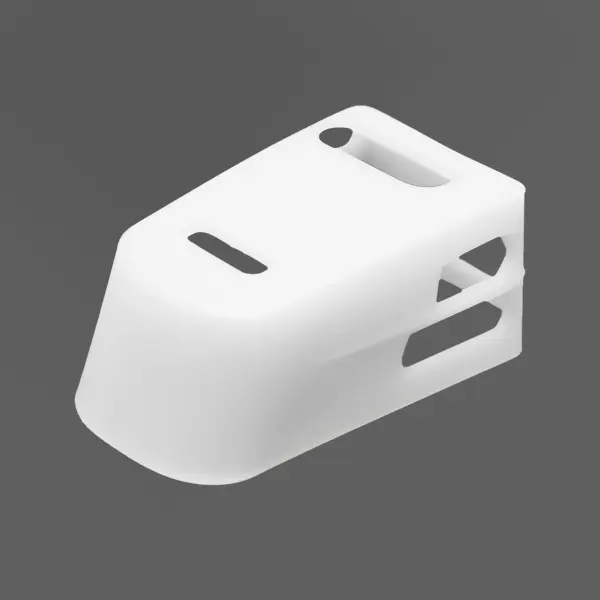


White Vacuum Casting Electronic Protective Enclosure
Its ergonomic rounded shape and strategically placed cutouts demonstrate how vacuum casting can produce smooth, functional plastic parts that closely resemble injection-molded quality, ideal for prototyping and low-volume production.
Quick Info
- Material: ABS
- Application: Electronic / Sensor Housing, Custom Equipment Enclosure
- Finish: Matte as-cast finish (optional painting/coating available)
- Key Features: Ergonomic rounded geometry, integrated cable cutouts, smooth surface finish, lightweight impact-resistant structure
- Tolerance: ±0.1–0.2 mm
- Lead Time: 3–7 days for molds and first samples, 5–10 days for small batches
 Get Free Quote


At KT, we specialize in vacuum casting for functional prototypes and low-volume production. This enclosure is a perfect example of how vacuum casting bridges the gap between 3D printing and injection molding: it delivers parts with ABS-like mechanical properties and surface quality, without the high upfront cost of hard tooling. We focus on producing parts that are not only dimensionally accurate but also visually and functionally representative of your final product.
🛠️ Production Workflow
- Master Pattern Fabrication: First, a high-precision master pattern of the enclosure is created, typically via SLA 3D printing or CNC machining. This master must have a smooth surface finish to ensure the final cast parts are defect-free.
- Silicone Mold Making: The master pattern is placed in a mold box, and liquid silicone is poured around it. After curing, the mold is cut open, and the master is removed, creating a hollow cavity for casting.
- Vacuum Casting Process: Liquid ABS-like PU resin is mixed and poured into the silicone mold under vacuum. The vacuum eliminates air bubbles, ensuring the resin fills every detail of the mold, including the enclosure’s complex cutouts and rounded features.
- Curing & Demolding: The mold is heated to cure the resin. Once fully cured, the part is removed from the mold, and any excess material or sprue is trimmed off.
- Post-Processing & Finishing: The part is cleaned, sanded, and optionally painted or coated to achieve the desired matte finish. Dimensional checks are performed to ensure the enclosure meets tolerance requirements.
📋 Specification Table
| Item | Specification |
|---|---|
| Process | Vacuum Casting (Silicone Mold + ABS-like PU Resin) |
| Material | ABS-like PU Resin |
| Application | Electronic / Sensor Protective Housing |
| Finish | Matte as-cast finish, optional painting/coating |
| Tolerance | ±0.1–0.2 mm |
| Key Features | Ergonomic rounded geometry, integrated cable cutouts, smooth surface finish, impact-resistant |
✅ Core Advantages
- Near-Production ABS-like Quality: Vacuum-cast parts mimic the look, feel, and mechanical properties of injection-molded ABS. They have a smooth, layer-line-free finish, making them ideal for design validation and even low-volume functional use.
- Cost-Effective for Low Volumes: Silicone molds are significantly cheaper and faster to produce than steel injection molds. This makes vacuum casting perfect for small batches (typically 10–50 parts) at a fraction of the tooling cost.
- Complex Geometry & Detail Replication: The vacuum process ensures the resin flows into every corner of the mold, accurately replicating even fine details, undercuts, and thin walls. This is ideal for complex enclosures like this one.
- Fast Iteration & Time-to-Market: From master pattern to finished parts, the entire process can be completed in days, allowing you to quickly validate designs, make changes, and move forward with confidence.
- Functional & Durable Parts: ABS-like resin offers good impact resistance and dimensional stability, so the parts are suitable for fit checks, functional testing, and even short-term end-use applications.
🎯 Applications
- Electronic sensor and module housings
- Consumer product and appliance prototypes
- Medical device and lab equipment components
- Automotive interior and exterior trim prototypes
- Low-volume production of specialty protective covers