Contact Us
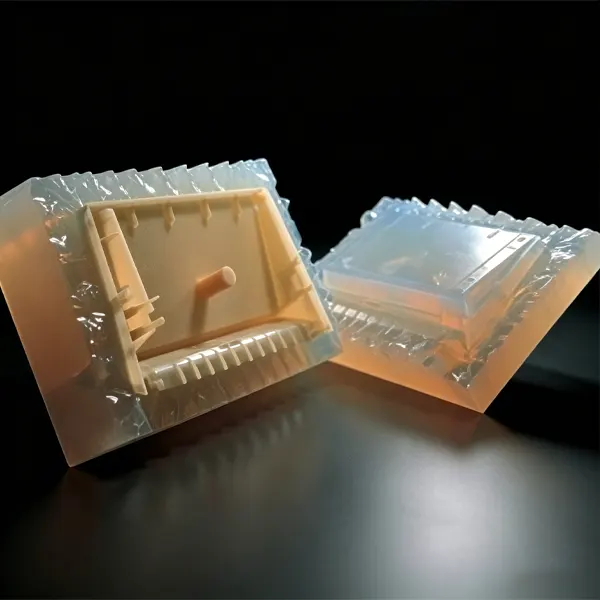


Vacuum Casting Silicone Mold for Enclosure Housing
This case study showcases our vacuum casting solution for a complex enclosure housing, using a precision two-part silicone mold. The process demonstrates how even highly detailed, undercut-rich plastic parts can be replicated accurately for prototyping and small-batch production. Vacuum casting delivers near-production-quality parts without the high cost and lead time of hard tooling.
- Mold Material: Translucent Silicone Rubber
- Prototype Material: Engineering-grade PU Resin (ABS/PP-like)
- Key Features: Undercut replication, fine detail capture, complex internal geometry
- Typical Applications: Product Prototyping, Consumer Electronics, Medical Devices, Industrial Equipment
- Tolerance: ±0.1–0.2 mm
 Get Free Quote


At KT, we specialize in end-to-end vacuum casting services for complex plastic components. From master pattern creation to silicone mold design and final part finishing, we deliver high-fidelity prototypes and small-batch parts. Our expertise in handling intricate geometries, including undercuts, thin walls, and fine features, ensures that your design intent is fully realized in the final part.
📌 Product & Process Overview
- The mold perfectly replicates every detail of the housing, including snap fits, internal ribs, and mounting bosses
- The translucent silicone allows for visual inspection during the casting process
- The two-part mold design enables easy demolding of complex geometries without damage
- The full vacuum casting workflow includes:
- Master pattern fabrication (via CNC or 3D printing)
- Silicone mold making and curing
- Vacuum-assisted resin pouring
- Demolding, trimming, and post-processing
🔍 Mold Design & Key Features
✅ High-Fidelity Detail Capture: The silicone mold reproduces fine features like snap fits, internal ribs, and thin-wall sections with exceptional accuracy.
✅ Undercut Compatibility: Flexible silicone material allows for the release of parts with complex undercuts that would require expensive slides in traditional injection molds.
✅ Translucent Mold Material: Enables visual monitoring of the filling process and helps identify trapped air bubbles.
✅ Durable Mold Construction: Each silicone mold can produce 10–30 parts, making it ideal for small-batch runs.
✨ Surface Finish & Post-Processing
- As-molded smooth surface finish
- Manual trimming of gates and flash
- Deburring of edges and snap fits
- Optional painting, polishing, and assembly
- Functional testing and validation
📋 Specification Table
| Item | Specification |
|---|---|
| Mold Material | Translucent Silicone Rubber |
| Cast Material | PU Resin (ABS/PP/PC-like grades) |
| Process | Vacuum Casting, Silicone Mold |
| Complexity Level | High (internal ribs, snap fits, undercuts) |
| Mold Life | 10–30 parts per mold |
| Typical Lead Time | 3–7 days for mold + first parts |
🎯 Applications
- Consumer Electronics: Enclosures and housings for small appliances, IoT devices, and accessories
- Medical Devices: Non-critical functional components for testing and validation
- Industrial Equipment: Custom enclosures and protective housings for machinery
- Automation: Prototypes of control panels, sensor housings, and interface components
✅ Advantages Summary
- Cost-Effective Tooling: Silicone molds cost a fraction of hard metal molds, eliminating high upfront investment.
- Fast Time-to-Market: Go from design to functional parts in just days, accelerating your product development cycle.
- Geometric Freedom: Produce complex parts with undercuts, thin walls, and fine details that are difficult or impossible to machine.
- Material Versatility: Choose from a wide range of resins with different properties (rigid, flexible, transparent, flame-retardant).
- High-Quality Surface Finish: Parts come out of the mold with a smooth finish, requiring minimal post-processing.
- Ideal for Iterative Design: Quickly produce multiple versions of your part to test different designs without incurring high tooling costs.