Contact Us
  Home /
 What are the advantages of CNC machining over 3D printing?


Table of Contents
- What Is CNC Machining?
- What Is 3D Printing?
- 1. Superior Accuracy and Precision
- 2. Better Surface Finish
- 3. Stronger and More Durable Parts
- 4. Wider Material Selection
- 5. Faster Production for End-Use Parts
- 6. Excellent Repeatability
- 7. Cost-Effective for Medium and Large Production Runs
- 8. Ideal for Industrial Applications
- 9. Better Dimensional Stability
- 10. Easier Certification and Compliance
- CNC Machining vs. 3D Printing: Which Should You Choose?
- Conclusion

Today, CNC machining and 3D printing are important elements in product development and production in modern production. With businesses going for speedier turnaround, better precision, and cost-efficient production solutions, it becomes crucial to select the right production method.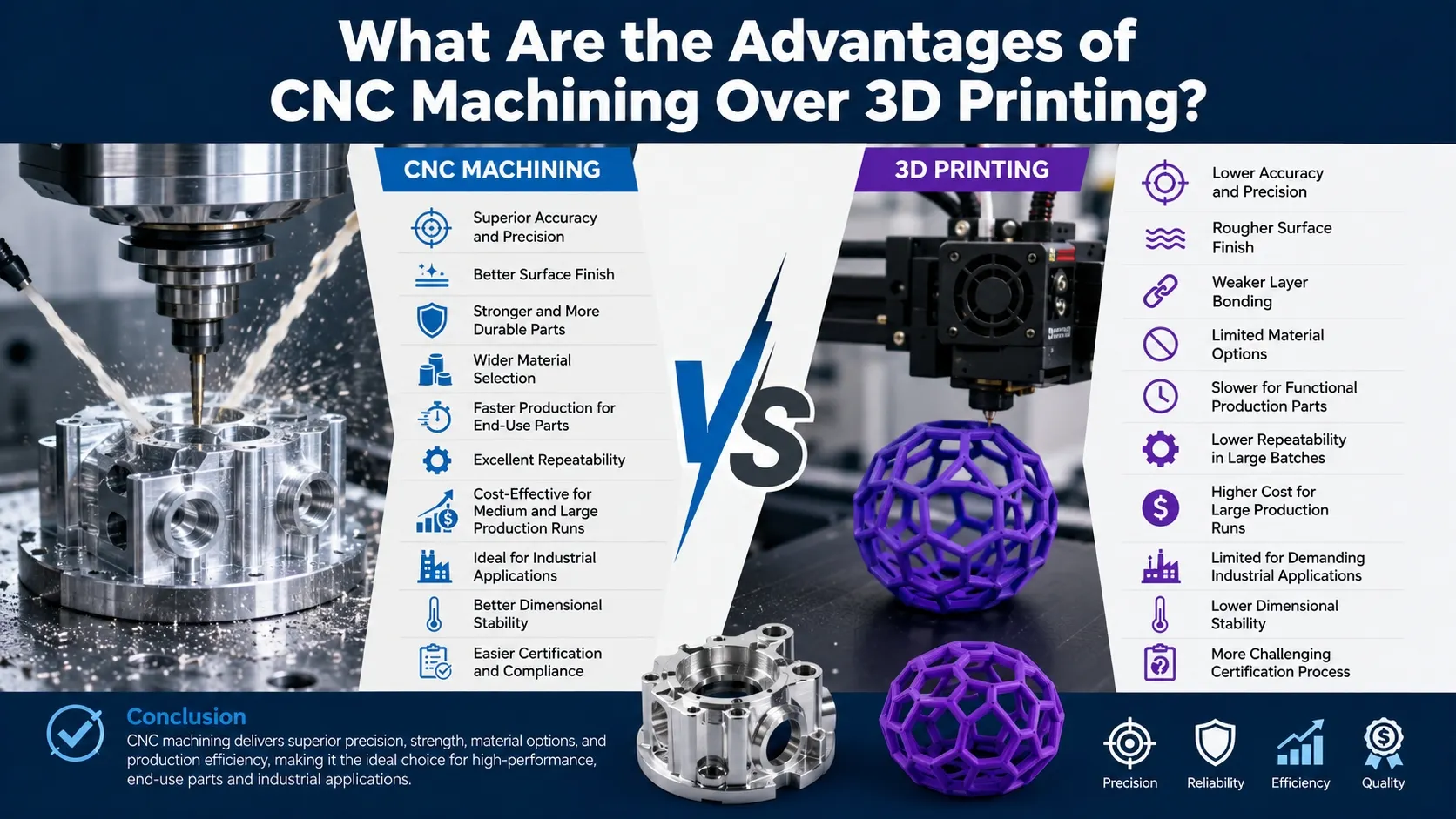
Although 3D printing and CNC machining have grown in popularity, CNC machining is still the preferred choice for industries that demand precision, strength, durability, and scalability. As the CNC process offers many benefits over 3D printing, it is crucial to understand them when designing a product, so that the right decision can be made.
What Is CNC Machining?
CNC (Computer Numerical Control) machining is a subtractive manufacturing process that uses cutting tools to remove material from a solid block of material controlled by a computer. The operations performed are milling, turning, drilling and grinding, which are used to produce highly accurate components.
CNC machining is a widely used technique in various industries including:
- Aerospace
- Automotive
- Medical devices
- Electronics
- Industrial equipment
- Robotics
- Defense
CNC machines are designed to be extremely accurate and repeatable, making them suitable for the creation of high-quality and precision parts.
What Is 3D Printing?
Additive manufacturing, or 3D printing, creates parts by adding layers of materials based on a digital design. Finished parts are produced from materials like plastic, resin, metal powders and composites, which are deposited or fused together.
Common uses of 3D printing are:
- Concept models
- Rapid prototyping
- Design validation
- Low-volume production
- Customized products
While additive manufacturing provides design flexibility, it is also limited by some aspects that can be addressed by CNC machining.
1. Superior Accuracy and Precision
The most significant benefits of CNC machining are its precision.
With the current technology of CNC machines, tolerances of ±0.001 mm are possible depending on the application and the type of equipment. This type of accuracy is critical in industries where slight deviations can mean the product fails.
CNC Machining Benefits:
- Tight dimensional tolerances
- Consistent part quality
- Excellent surface flatness
- Accurate hole placement
- Reliable repeatability
3D Printing Limitations:
There is a variation between layers in 3D printers since they are printed layer by layer. This can lead to inaccuracies and flaws in dimensions and surface.
Generally CNC machining is more appropriate for precision engineering applications.
2. Better Surface Finish
The surface quality is directly related to the product performance, appearance and utility.
Generally, CNC-parts come ready with a smoother finish right after production. Mirror finishes can be obtained with advanced machining techniques, without having to do extensive post-processing.
CNC Surface Finish Advantages:
- Smooth surfaces
- Reduced friction
- Enhanced appearance
- Better sealing performance
- Improved mechanical function
The latter, 3D printed parts, on the other hand, usually have layer lines that need to be sanded, polished or finished in other ways before they are acceptable.
For customer-facing products and industrial components, CNC machining provides a more professional appearance.
3. Stronger and More Durable Parts
In choosing a manufacturing technique, the strength of the material can be an important consideration.
The main principle of CNC machining is that it begins from solid blocks of material, maintaining all the mechanical properties of the material. This leads to more robust and long-lasting parts.
Materials Commonly Used in CNC Machining:
- Aluminum
- Stainless steel
- Titanium
- Brass
- Copper
- Engineering plastics
- Carbon fiber composites
Because the material structure remains intact, CNC-machined parts typically offer:
- Higher tensile strength
- Better impact resistance
- Improved fatigue resistance
- Longer service life
The bond between layers of 3D-printed parts is often weak, thus leading to a potential weak area under load.
CNC machining offers better results for structural, load-bearing or mission critical parts.
4. Wider Material Selection
The flexibility of materials is another aspect in which CNC machining shines.
Manufacturers have access to hundreds of industrial materials to meet other tight performance requirements.
Popular CNC Materials:
Metals
- Aluminum 6061
- Aluminum 7075
- Stainless Steel 304
- Stainless Steel 316
- Titanium Grade 5
- Brass C360
Plastics
- ABS
- POM (Delrin)
- Nylon
- PEEK
- PTFE
- Polycarbonate
Many of these materials are difficult or impossible to process through standard 3D printing technologies.
This broad material selection allows engineers to optimize products for:
- Heat resistance
- Corrosion resistance
- Electrical conductivity
- Chemical resistance
- Wear resistance
5. Faster Production for End-Use Parts
While 3D printing is typically used for quick prototyping, CNC machining can be faster in manufacturing working prototype components.
With the establishment of the machining programs, the CNC machine can quickly and efficiently make the components.
CNC Production Advantages:
- Short production cycles
- High throughput
- Minimal setup changes
- Continuous operation capability
CNC machining often beats 3D printing for medium-sized production volumes, especially when it comes to the speed and efficiency of the process.
6. Excellent Repeatability
Consistency is of prime importance in manufacturing.
One of the major advantages of CNC machining is the level of repeatability, which allows thousands of parts to be manufactured with almost no variation.
Benefits of Repeatability:
- Consistent quality control
- Reduced product defects
- Easier assembly processes
- Improved customer satisfaction
Although the technology of 3D printing continues to develop and progress, there is a lack of replication of quality in large production runs.
Many times, CNC machining is used to produce reliable parts that require consistency.
7. Cost-Effective for Medium and Large Production Runs
Depending on production volume, costs will differ.
3D printing might be more cost-effective in the short term for single prototypes. As the amount of items grows, though, CNC machining can become more cost-effective.
CNC Cost Advantages:
- Lower cost per unit at scale
- Reduced labor requirements
- Faster production cycles
- Higher production efficiency
When businesses are producing hundreds or thousands of parts, it is often the cheaper option to have CNC machining.
8. Ideal for Industrial Applications
Many industries require parts that meet strict regulatory and performance standards.
Industries That Prefer CNC Machining:
Aerospace
Aircraft components demand precision, reliability, and certified materials.
Medical
Surgical instruments and medical devices require tight tolerances and biocompatible materials.
Automotive
Performance and safety components must withstand demanding operating conditions.
Electronics
Precision housings and thermal management components benefit from CNC accuracy.
In these sectors, CNC machining remains the industry standard because of its proven reliability and quality.
9. Better Dimensional Stability
It is possible that manufactured parts can degrade over time due to environmental conditions.
CNC-machined parts are generally very dimensionally stable as they are made of fully dense material.
Benefits include:
- Reduced warping
- Improved heat resistance
- Better long-term performance
- Greater structural integrity
Some 3D printed materials will bend at high temperatures, humidity or under stress, which is unsuitable for some challenging applications.
10. Easier Certification and Compliance
Aerospace, automotive and medical manufacturing are just a few industries that demand a significant amount of documentation and material certification.
CNC machining has the following advantages:
- Certified material traceability
- Industry-standard manufacturing processes
- Quality inspection reports
- Compliance documentation
These abilities aid in the qualification and regulatory approval procedures.
CNC machining has a considerable advantage for companies that are involved in highly regulated industries.
CNC Machining vs. 3D Printing: Which Should You Choose?
CNC machining vs 3D printing will depend on the project requirements.
If you require:
- Concept models
- Design validation
- Highly complex geometries
- One-off prototypes
- Low-cost experimentation
Choose CNC Machining if you need:
- High precision
- Tight tolerances
- Superior strength
- Production-quality parts
- Excellent surface finishes
- Industrial-grade materials
- Medium-to-high production volumes
Many manufacturers combine the two technologies; where a prototype is needed first, they make use of 3D printing, and then they use CNC for production.
Conclusion
Although 3D printing has revolutionized product development and rapid prototyping, CNC machining still provides a number of benefits for precision manufacturing. CNC machining offers superior accuracy, improved materials, enhanced surface treatments, extensive material options, and repeatability—making it the manufacturing method of choice for industries that require performance and reliability.
In the world of businesses which create high-quality end-use products, CNC machining is still one of the most efficient and reliable manufacturing methods today. A manufacturer identifies which technology technology is best suited to their products based on the strengths of each technology, in order to achieve the lowest cost, faster production times and excellent product quality.
Talk to the Manufacturer, Not a Middleman
Resources & Insights
-
 Hide blog post
CNC Machining Robotic Parts: How GD&T Controls Robot Assembly Accuracy
2026-09-24By KT Engineering -
 Hide blog post
Hardware Stamping Springback Control for High-Strength Steel Parts
2026-09-24By KT Engineering -
 Hide blog post
Spring Stamping Fatigue Life: How Geometry, Material and Edge Quality Affect Cycle Life
2026-09-24By KT Engineering -
 Hide blog post
Mechanical Automation Parts for Robot End Effectors and Positioning Accuracy
2026-09-23By KT Engineering