Contact Us
  Home /
 Why is CNC machining more accurate than die casting?


Table of Contents
- Understanding CNC Machining
- Understanding Die Casting
- 1. CNC Machining Eliminates Material Shrinkage Issues
- 2. Tighter Tolerances in CNC Machining
- 3. Superior Surface Accuracy
- 4. Reduced Tool Wear Impact
- 5. Better Control of Complex Geometries
- 6. Minimal Distortion During Production
- 7. Greater Repeatability
- 8. Enhanced Quality Inspection and Process Control
- When Die Casting Is Still the Better Choice
- Choosing the Right Manufacturing Process
- Conclusion

In today's production processes, accuracy can be a key to success or failure. This is particularly true in the aerospace, medical devices, automotive, electronics, and robotics sectors, which use parts that must meet very close tolerances and dimensional accuracy. There are two common manufacturing techniques for metal components: CNC Machining and Die casting. Though both processes have their pros, CNC machining is known for its high level of accuracy.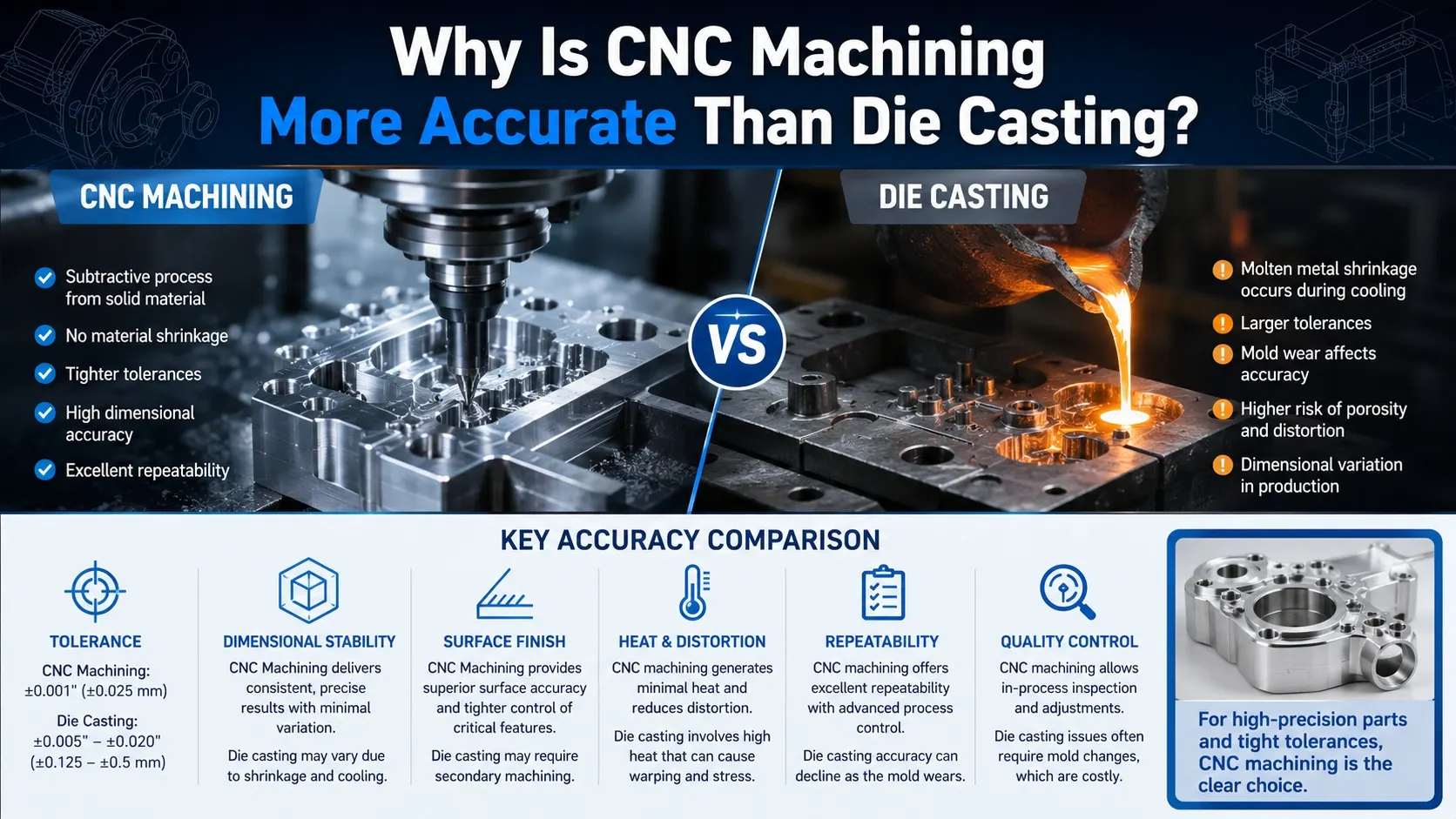
But why is CNC Machining more accurate than Die casting? Engineers, product designers and purchasing managers can use the knowledge of the differences between these manufacturing technologies to select the appropriate manufacturing process for their projects.
Understanding CNC Machining
CNC (Computer Numerical Control) machining is a subtractive manufacturing process, which uses computer-controlled cutting tools to remove material from a solid block of metal, plastic or composite material.
It involves cutting-edge software and cutting-edge equipment to manufacture parts with high precision based on precise designs. The programmed instructions for every movement of the cutting tool enable the manufacturer to attain extremely close tolerances and complex geometries.
Some of the most common CNC machining applications are:
- CNC milling
- CNC turning
- CNC drilling
- CNC grinding
- Multi-axis machining
CNC machining also offers a high precision process, making it ideal for prototypes, custom parts, and high performance components.
Understanding Die Casting
Die casting is a manufacturing process in which the molten metal is injected into a high-pressure steel mold cavity to produce metal parts. The metal is left in the mold, which is then opened and the finished part is removed.
The following are typical applications of die casting:
- High-volume production
- Aluminum components
- Zinc parts
- Magnesium products
- Consumer electronics housings
- Automotive parts
Process is suitable for large production runs, and it provides excellent cost and production speed. But the mold making and the nature of the molten metal can restrict dimensional accuracy.
1. CNC Machining Eliminates Material Shrinkage Issues
The lack of material shrinkage is one of the largest reasons that CNC manufacturing is more precise that die casting.
When the metal is cast in the die, it solidifies and contracts. Although good molds can be designed, it is possible to have dimensional inconsistencies due to some shrinkage variation.
Some factors that contribute towards shrinkage are:
- Metal alloy composition
- Mold temperature
- Cooling rate
- Part geometry
- Wall thickness variations
Unlike CNC machining, on the other hand, starts with a solid material. Since there is no phase change from liquid to solid, shrinkage is virtually eliminated. The machine just cuts away the material until the right size is reached.
This yields much more dimensional control.
2. Tighter Tolerances in CNC Machining
The variation of dimensions of a part, allowable, is called tolerance.
The precision that is commonplace on modern CNC machining centers is typically:
- ±0.001 inch (±0.025 mm)
- ±0.0005 inch (±0.012 mm) for high-precision applications
Typical die casting tolerances are generally larger due to:
- Mold wear
- Metal flow characteristics
- Thermal expansion
- Cooling distortion
For components requiring exceptional precision, CNC machining consistently outperforms die casting.
Industries that demand tight tolerances often rely heavily on CNC machining, including:
- Aerospace
- Defense
- Medical equipment
- Semiconductor manufacturing
- Scientific instruments
3. Superior Surface Accuracy
While surface finishes can be good from the mould, there can be some variation in dimensional accuracy for critical surfaces in the mould.
The liquid metal in the mold may cause problems like:
- Porosity
- Flash
- Warping
- Surface imperfections
CNC machining directly cuts finished surfaces with precision tooling.
Benefits include:
- Better flatness
- Improved roundness
- Precise hole diameters
- Accurate mating surfaces
- Consistent geometric dimensions
CNC machining is a great benefit for assemblies that need to be tightly toleranced.
4. Reduced Tool Wear Impact
Wear of tools occurs in all manufacturing processes, but the effect varies greatly depending on the process, such as CNC machining and die casting.
In die casting, the steel mold is subjected to:
- Extreme temperatures
- Repeated thermal cycling
- High injection pressures
The mould holes get worn over time resulting in dimensional variations of parts produced. To keep it accurate, regular mold maintenance is needed along with eventual replacement.
Modern CNC machines are subject to tool wear as well, but can overcome this by using:
- Tool monitoring systems
- Automatic tool offsets
- Regular calibration
- Advanced cutting strategies
As a result, dimensional consistency remains exceptionally high throughout production.
5. Better Control of Complex Geometries
Modern products often contain intricate features that require precise positioning.
Examples include:
- Medical implants
- Aerospace brackets
- Robotic components
- Electronic enclosures
- Precision gears
Multi-axis CNC machining allows cutting tools to approach parts from multiple angles, enabling highly accurate production of complex geometries.
Die casting molds must account for:
- Draft angles
- Mold release requirements
- Metal flow restrictions
These design constraints can limit precision in certain features.
CNC machining offers greater flexibility while maintaining tight tolerances across intricate designs.
6. Minimal Distortion During Production
Heat plays a significant role in manufacturing accuracy.
Die casting introduces molten metal at temperatures that can exceed:
- 660°C for aluminum alloys
- 400°C for zinc alloys
As parts cool, thermal stresses may develop, leading to:
- Warping
- Internal stress
- Shape distortion
Distortion can also impact dimensional accuracy, even when it is minimal.
Usually, CNC machining is performed on stable solids. Powered cutting systems and cutting techniques reduce thermal effects while cutting is done.
This helps to enhance the overall accuracy and repeatability.
7. Greater Repeatability
The terms accuracy and repeatability are similar but not synonymous.
Accuracy of parts is how close it is to its dimensions.
Repeatability indicates the degree of precision a production line can achieve when making parts.
The following are the reasons for the excellent repeatability of CNC machining:
- Programs are digitally controlled
- Tool paths remain consistent
- Machine calibration is highly precise
- Automated processes reduce human error
Thousands of parts can be manufactured with virtually identical dimensions when proper quality control procedures are followed.
8. Enhanced Quality Inspection and Process Control
Modern CNC manufacturing integrates advanced quality assurance systems.
These may include:
- Coordinate Measuring Machines (CMM)
- Laser scanning
- In-process probing
- Automated inspection systems
Throughout the production, the measurements can be checked and if there is any deviation then it can be corrected immediately.
Inspection methods are also commonly used in the die casting process, but if dimensional problems are encountered, mold changes may be necessary, and these may be costly and time consuming.
Compared to conventional manufacturing methods, CNC machining offers more flexibility in maintaining the exact specifications.
When Die Casting Is Still the Better Choice
While CNC machining provides the best accuracy, in many cases die casting is still a great manufacturing method.
The advantages of the Die Casting are:
- Production volumes are extremely high
- Part complexity is suitable for mold production
- Cost per unit is critical
- Moderate tolerances are acceptable
- Lightweight metal components are needed
Near net shape manufacturing is often done using a combination of both, with many manufacturers making near-net-shape parts by using die-casting and then CNC machining critical tolerances.
This is a combination of both approaches, which balance cost and precision.
Choosing the Right Manufacturing Process
The decision between CNC machining and die casting depends on several factors:
- Required tolerance levels
- Production volume
- Material selection
- Part complexity
- Budget
- Lead time
Generally, CNC machining is the better option for precision, repeatability and dimensional stability, particularly for applications where these requirements are paramount.
Die casting could be more economical for high volume manufacturing, where tolerances are not as critical.
Conclusion
The advantage of CNC machining is that there is no shrinkage of material, which makes it more accurate than die casting, it has tighter tolerance, better surface precision, low distortion and high process control. Precision components are used in demanding applications across a wide range of industries, and computer-controlled cutting operations allow manufacturers to create precision parts that satisfy the high precision requirements of these industries.
Although die casting is still a great manufacturing process for large-scale production, CNC machining is still the better option when it comes to high accuracy, consistency and quality. With the advancement of manufacturing technology, CNC machining is still one of the best ways to obtain precision-machined parts in various fields.
Talk to the Manufacturer, Not a Middleman
Resources & Insights
-
 Hide blog post
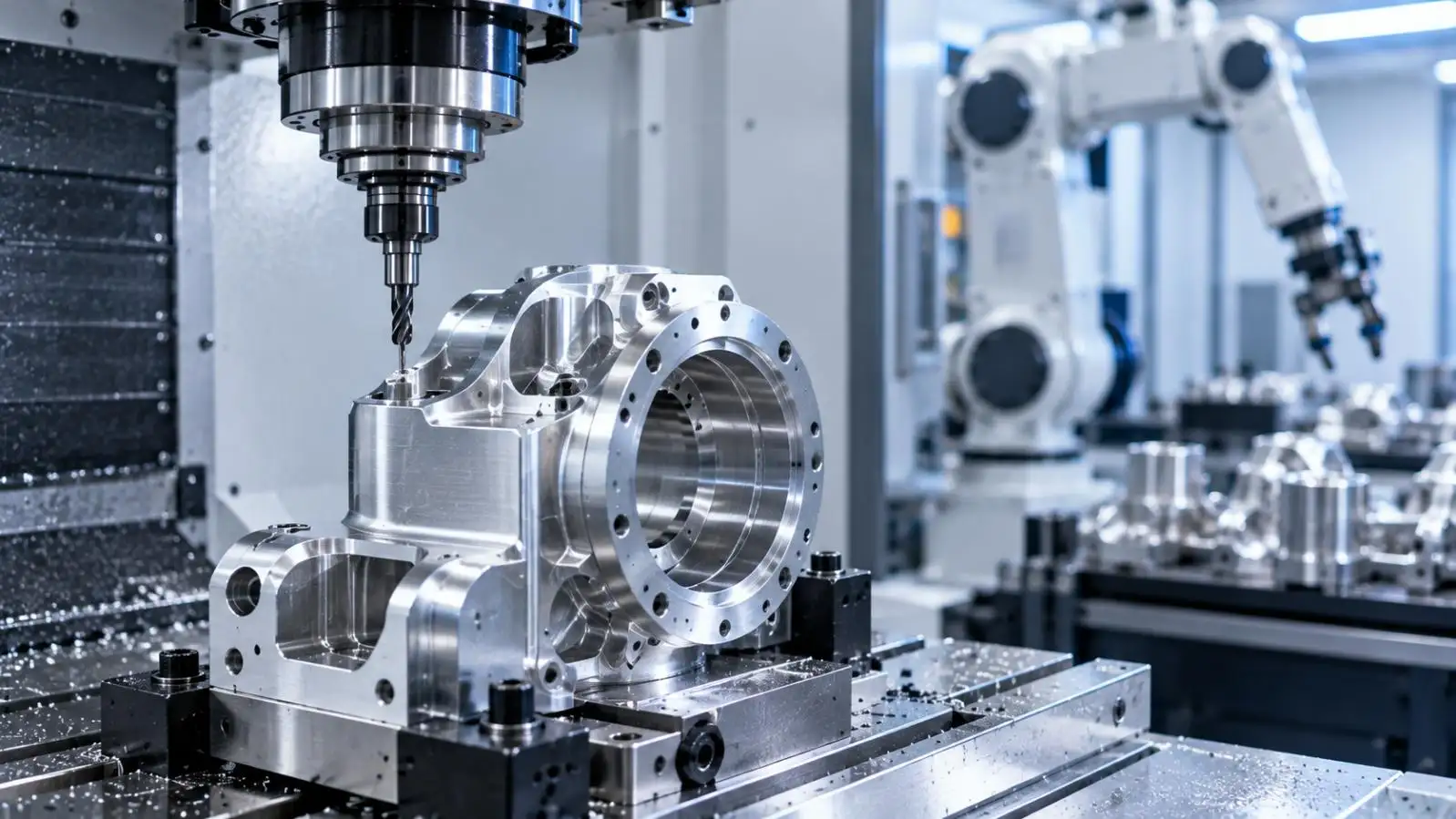
CNC Machining Robotic Parts: How GD&T Controls Robot Assembly Accuracy
2026-09-24By KT Engineering -
 Hide blog post
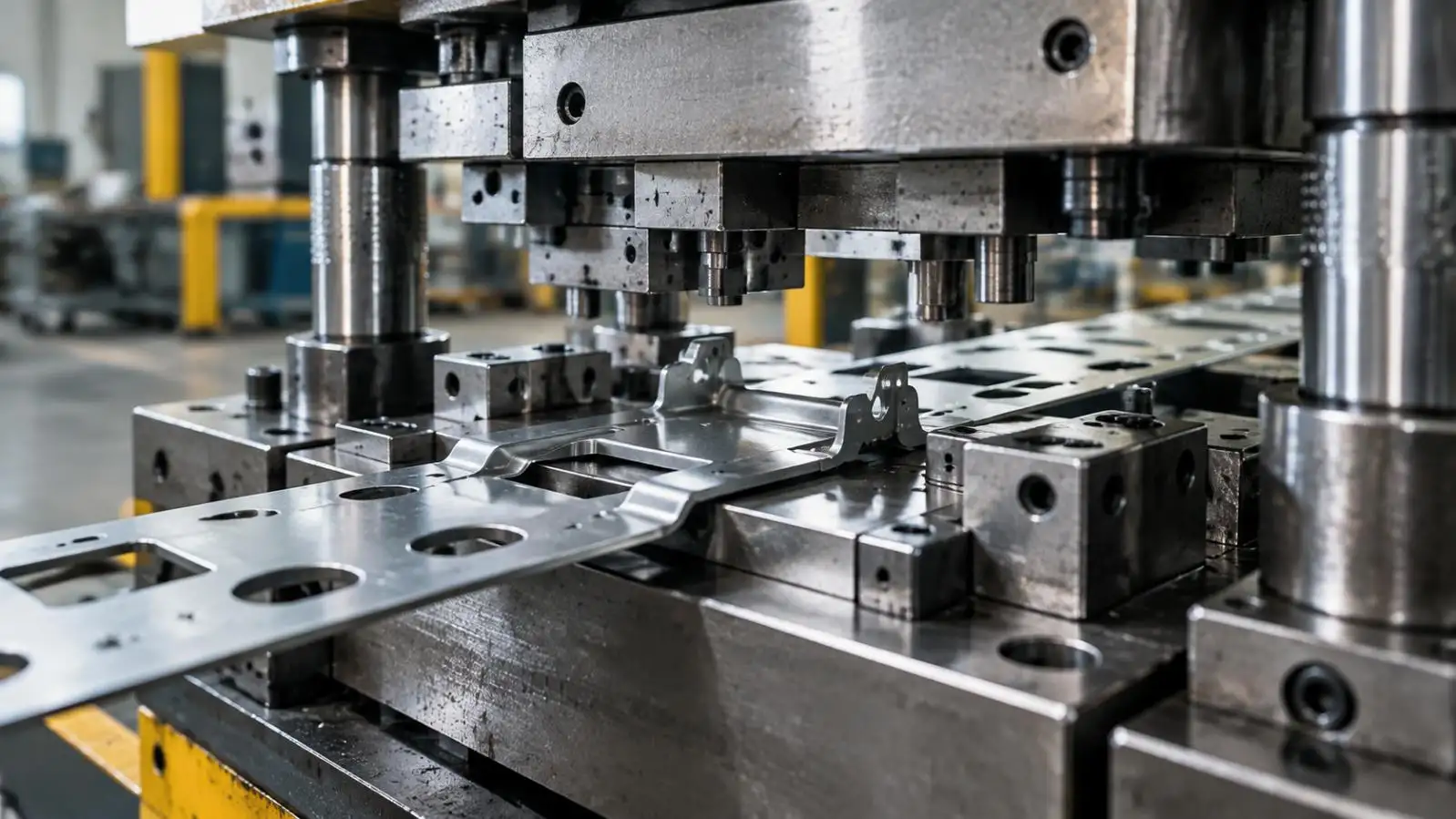
Hardware Stamping Springback Control for High-Strength Steel Parts
2026-09-24By KT Engineering -
 Hide blog post
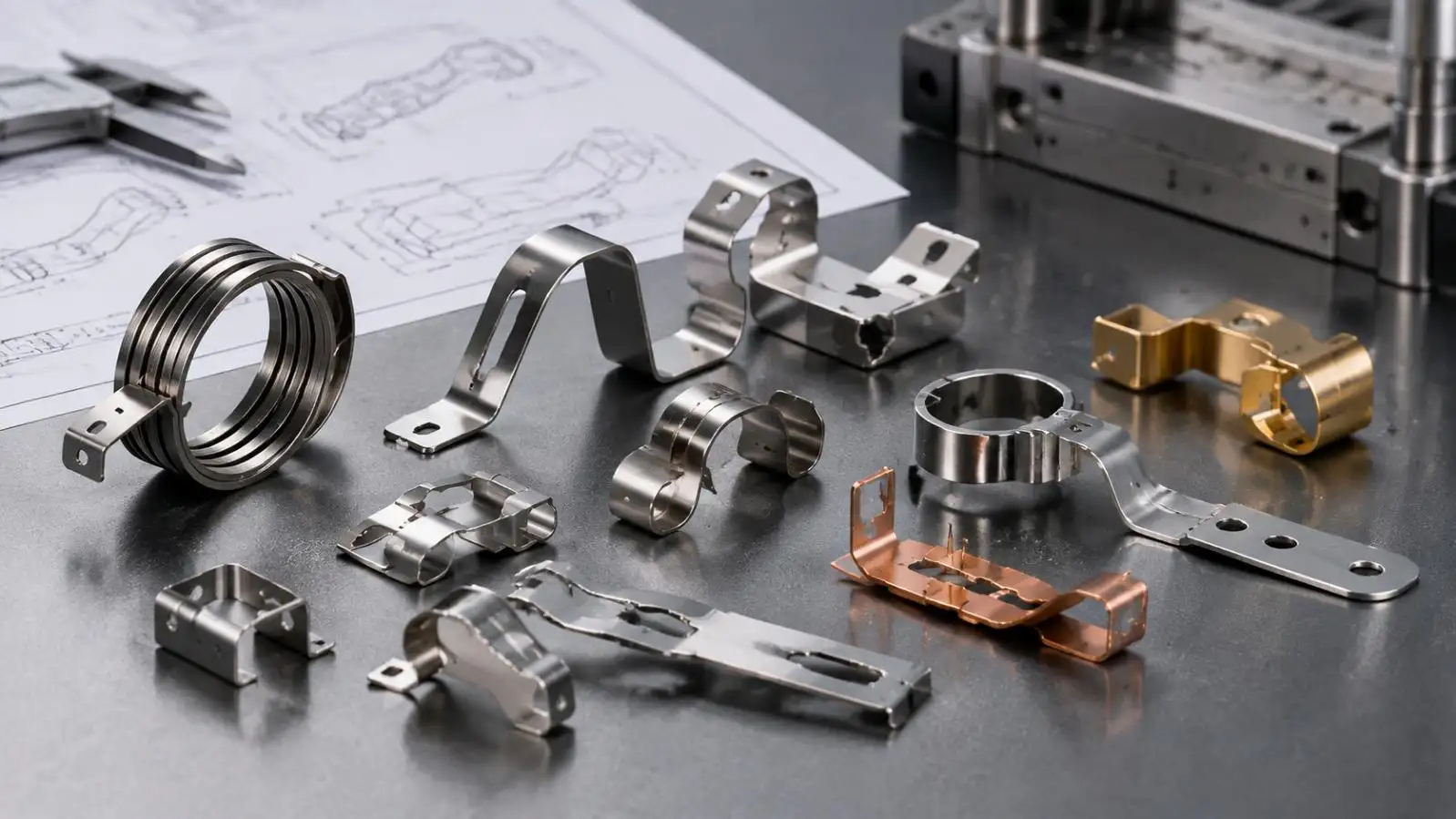
Spring Stamping Fatigue Life: How Geometry, Material and Edge Quality Affect Cycle Life
2026-09-24By KT Engineering -
 Hide blog post
Mechanical Automation Parts for Robot End Effectors and Positioning Accuracy
2026-09-23By KT Engineering