Contact Us
  Home /
 Aircraft Parts Machining: Precision CNC Manufacturing for Aerospace Components


Table of Contents
- Introduction: Why Aircraft Parts Machining Matters Today
- What Is Aircraft Parts Machining?
- Market Trends in Aircraft Parts Machining
- Key Requirements for Aircraft Parts Machining
- Materials Used in Aircraft Parts Machining
- CNC Processes Used in Aircraft Parts Machining
- Quality Control in Aircraft Parts Machining
- Cost Drivers and Optimization in Aircraft Parts Machining
- How KTC Supports Aircraft Parts Machining Projects
- When to Use CNC Machining vs. Other Processes for Aircraft Parts
- Applications and Use Cases for Aircraft Parts Machining
- How to Source Aircraft Parts Machining Services Effectively
- Conclusion: Building Reliable Partnerships in Aircraft Parts Machining

Introduction: Why Aircraft Parts Machining Matters Today
Aircraft parts machining is essential to modern aerospace. From structural brackets and engine components to landing gear and interiors, machined metal and plastic parts directly affect aircraft safety, performance, fuel efficiency, and lifecycle cost.
Aerospace OEMs and Tier-1 suppliers face converging pressures:
- Recovery and growth in commercial aviation post-pandemic
- Strong demand for fuel-efficient and lower-emission aircraft
- Rising material and labor costs
- Stricter quality, traceability, and safety regulations
- Shorter development cycles for new platforms and retrofits
High-precision, reliable, and cost-effective aircraft parts machining has become critical. A qualified CNC machining partner can help aerospace buyers deliver complex parts on schedule, control costs, and meet strict certification and documentation requirements.
What Is Aircraft Parts Machining?
Definition and Scope
Aircraft parts machining uses subtractive manufacturing processes—primarily CNC milling and turning—to produce metal and engineering-plastic components for commercial aircraft, business jets, helicopters, UAVs, and space launch and satellite subsystems.
These machined parts range from simple bushings and spacers to complex 5-axis structural components and engine parts with tight tolerances and demanding surface finishes.
Typical Aerospace Machined Components
Common machined aircraft parts include structural components (brackets, ribs, frames, fitting, seat tracks, and avionics mounting interfaces), powerplant and engine parts (compressor casings, shafts, flanges, and engine mounts), landing gear parts (trunnions, pistons, cylinders, clevises, and axles), cabin components (seat parts, galley hardware, and door frames), and avionics hardware (enclosures, heat sinks, and manifold blocks).
Each category has distinct material, tolerance, and certification requirements, but all require stable, repeatable, high-precision aircraft machining.
Market Trends in Aircraft Parts Machining
Demand Recovery and Backlog Pressure
The global aerospace market is recovering steadily, with major aircraft OEMs reporting strong order books and multi-year backlogs. Airlines prioritize new fuel-efficient single-aisle aircraft, fleet renewal to meet emission targets, and increased narrow-body production rates.
For CNC machining suppliers, this means higher volumes of standard structural and systems components, tight delivery schedules to keep assembly lines supplied, and growing interest in near-shoring and dual sourcing for supply-chain resilience.
Weight Reduction and Fuel Efficiency
Reducing aircraft weight remains a top priority. This drives wider use of high-strength aluminum alloys and titanium, topology-optimized part designs with complex geometries, thinner wall sections, and tight tolerance control. To support these designs, aircraft parts machining increasingly relies on 5-axis CNC machining centers, advanced fixturing, simulation-driven toolpath optimization, and lightweight finishing solutions.
Supply Chain Resilience and Dual Sourcing
Recent global disruptions have pushed aerospace buyers to diversify supplier bases, qualify additional manufacturers for critical part families, and prioritize suppliers with flexible capacity and strong quality systems. For machining partners, this means demonstrating consistent quality and on-time delivery, building clear communication and transparent documentation, and offering competitive lead times and scalable capacity.
Digitalization and Data-Driven Quality
Aerospace manufacturers are adopting digital tools to manage machining operations, including CAD/CAM integration, digital job travelers and traceability records, statistical process control (SPC), and electronic first article inspection (FAI). Buyers seek machining suppliers who can integrate smoothly into digital workflows and provide the data needed for compliance and continuous improvement.
Key Requirements for Aircraft Parts Machining
Tolerances and Dimensional Accuracy
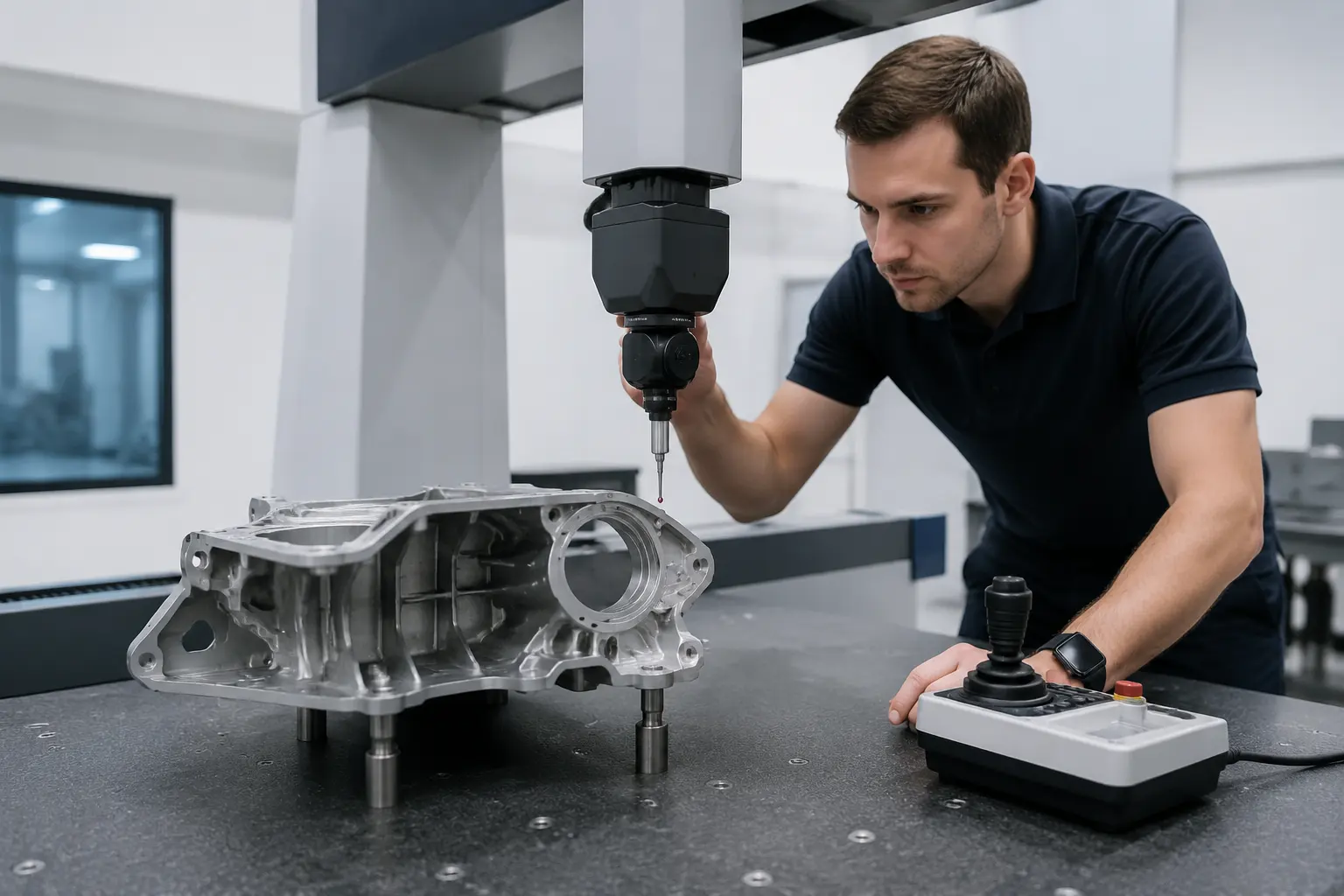
Aircraft parts often require dimensional tolerances down to ±0.005 mm for critical features and strict geometric tolerances for flatness, perpendicularity, cylindricity, and true position. A capable aircraft machining shop must combine high-precision CNC machines with stable thermal control, calibrated measurement equipment and coordinate measuring machines (CMMs), and skilled machinists with rigorous process control.
Surface Finish and Functional Surfaces
Surface finish affects not only aesthetics but also fatigue performance, sealing, and wear behavior in moving interfaces. Typical requirements include Ra 0.8–1.6 μm for many functional surfaces, lower roughness for sealing or sliding surfaces, and controlled chamfers, deburring, and edge breaks.
Material Certification and Traceability
Aircraft parts machining must use fully traceable materials with documented properties, including mill certificates (e.g., EN 10204 3.1) and batch or heat numbers recorded on manufacturing documentation. End users typically require detailed material certificates submitted with each batch, full traceability from raw material to finished part, and long-term record retention.
Process Documentation and FAI
Before serial production, aerospace customers frequently request first article inspection (FAI) reports, ballooned drawings with measurement results, and complete documentation of process steps, tools, and fixtures. During production, stable aircraft machining processes are supported by control plans, inspection plans, and in-process checks at defined intervals.
Materials Used in Aircraft Parts Machining
Aluminum Alloys
Aluminum is the most widely used material for aircraft parts machining, especially for structural components, interior parts, and avionics housings. Common aerospace-grade aluminum alloys include 6061 and 6082 (good machinability, general-purpose structural parts), 7075 (high strength for critical applications), and 2024 (fatigue-resistant airframe components).
Advantages include excellent strength-to-weight ratio, good corrosion resistance (often enhanced by anodizing), and high machinability with shorter cycle times.
Titanium Alloys
Titanium is widely used in high-strength structural parts, landing gear components, and engine and nacelle elements. Key benefits include high strength with low density, excellent corrosion resistance, and good performance at elevated temperatures. Machining challenges include low thermal conductivity concentrating heat at the cutting edge, tendency to work-harden, and higher tool wear and longer cycle times. Effective aircraft parts machining in titanium requires optimized tooling, coolant management, and cutting parameters.
Stainless Steels and High-Strength Steels
These materials are used for landing gear hardware, fluid manifolds, hydraulic components, and fasteners. Typical types include 17-4PH and 15-5PH precipitation-hardened stainless steels and high-strength alloy steels for fatigue-resistant components. Machining considerations include achieving tight tolerances while controlling distortion, managing heat and tool life, and ensuring proper heat treatment and hardness.
High-Performance Plastics and Composites
Certain aircraft parts are machined from PEEK, PTFE, nylon, and acetal, commonly used in interior components, electrical insulators, low-weight brackets, and bushings. Machining plastics for aircraft parts requires attention to dimensional stability and thermal expansion, chip evacuation and burr control, and surface finish and cleanliness for assembly.
CNC Processes Used in Aircraft Parts Machining
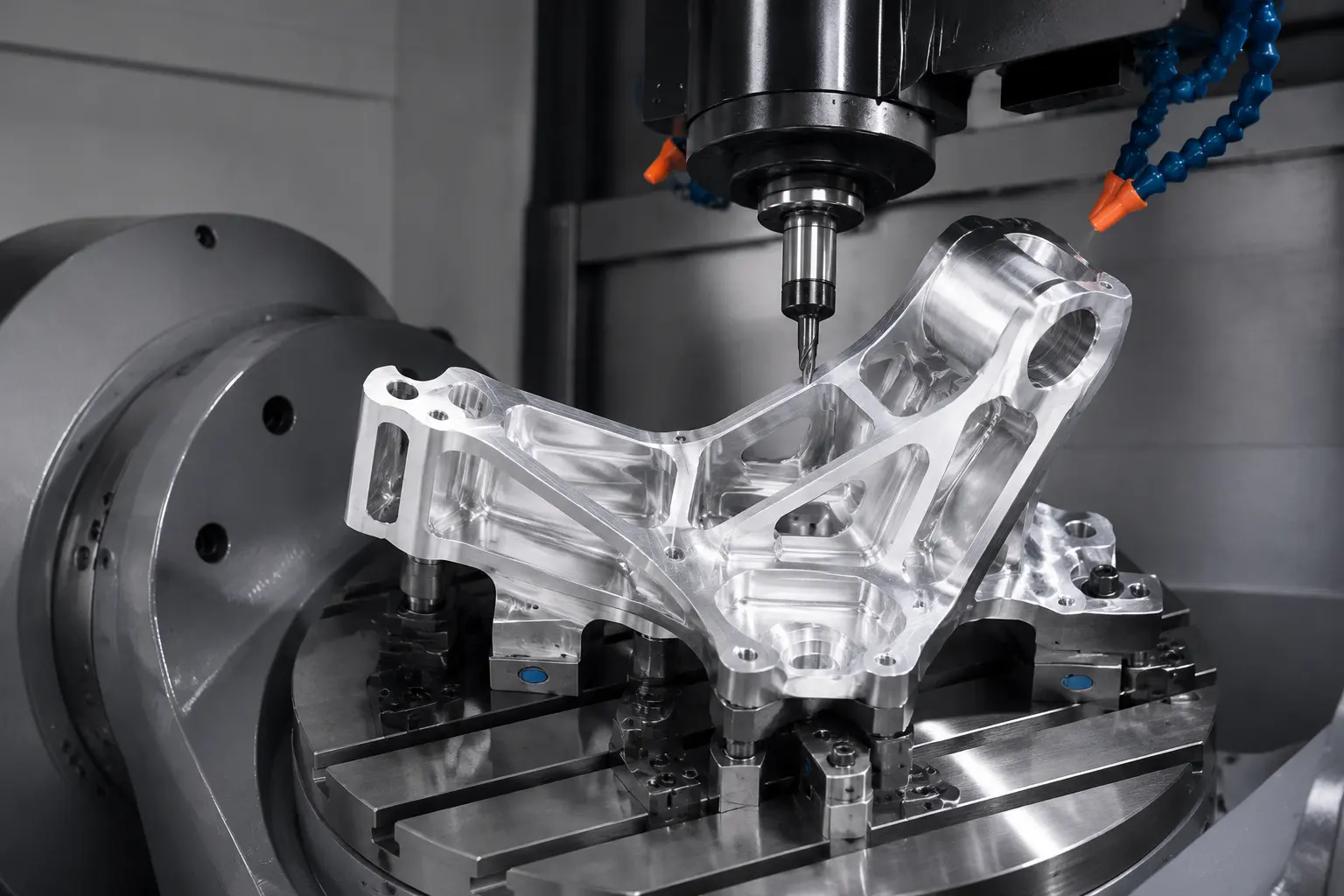
3-Axis and 5-Axis CNC Milling
Milling is central to aircraft parts machining, particularly for complex 3D surfaces, thin walls, and weight-optimized geometries. While 3-axis milling is suitable for simpler geometries and plate-type parts, 5-axis machining enables complex organic shapes, reduced setups, higher accuracy among faces, and access to hard-to-reach features without compromising rigidity.
CNC Turning and Turn-Mill
Turning is used for rotational components such as shafts, spindles, bushings, sleeves, and cylinders. Turn-mill centers combine turning and milling in a single setup, which is advantageous for complex hydraulic components, rotational parts with flats and slots, and reduced handling with improved concentricity.
Secondary Operations and Finishing
Aircraft parts machining often includes secondary processes such as threading, tapping, reaming, honing, deburring, and edge finishing. Surface treatments may include anodizing, hard anodizing, conversion coatings, plating (e.g., zinc-nickel), and passivation. Dimensional control before and after finishing is critical to ensure final compliance.
Quality Control in Aircraft Parts Machining
Inspection and Metrology
Reliable aircraft parts machining depends on robust inspection capabilities, including coordinate measuring machine (CMM) measurements, height gauges, bore gauges, micrometers, and surface roughness testers. Inspection strategies usually cover incoming material verification, first-piece inspection at setup, in-process checks on key features, and 100% inspection for critical characteristics if specified.
Documentation and Traceability
Aerospace customers expect complete, organized documentation including inspection reports with measured values, material certificates and heat numbers, and process records traceable via job numbers or barcodes. This documentation supports compliance with aerospace standards, efficient root-cause analysis, and long-term safety tracking.
Cost Drivers and Optimization in Aircraft Parts Machining
Main Cost Drivers
Key factors affecting machined aircraft part cost include material type and buy-to-fly ratio, part complexity and required tolerances, number of setups and required 5-axis operations, volume and batch size, and inspection and documentation intensity. High-performance materials and features such as thin walls or deep cavities typically increase cost due to longer machining times and higher risk.
Strategies to Optimize Cost Without Compromising Quality
Buyers and design teams can work with machining experts to reduce total cost. Design for manufacturability involves simplifying geometries where possible, adjusting tolerances to functional needs rather than defaulting to ultra-tight values, and reducing unnecessary thin sections that cause distortion. Consider using less costly alloys where performance requirements allow, or high-strength aluminum instead of titanium when feasible. Group orders into larger batches to amortize setup costs, and standardize components across platforms where possible. Engage a machining partner early in the design phase and request design for manufacturability feedback before finalizing drawings.
How KTC Supports Aircraft Parts Machining Projects
As a professional CNC machining manufacturer, KTC offers capabilities that align closely with aerospace demands. For buyers seeking high-precision aircraft parts machining, KTC can provide multi-axis CNC milling (including 3- and 5-axis) for complex aircraft components, CNC turning and turn-mill operations for shafts and bushings, and prototyping and low- to medium-volume production.
Materials and processes include machining of aluminum, stainless steel, and other common aerospace metals, experience with structural parts, brackets, and precision fittings, and coordination of secondary processing such as anodizing and plating through qualified partners. Quality and inspection include dimensional inspection with calibrated tools, documentation and measurement reports for critical features, and process control aligned with demanding industrial customers.
For detailed capability confirmation, drawings review, or a project discussion, you can contact KTC CNC Machining at +86-769-88660896, sales@ktcncmachining.com, or No.1, Shanmei Enterprise Zone, Huangjiang Town, Dongguan City, Guangdong Province, China.
When to Use CNC Machining vs. Other Processes for Aircraft Parts
CNC Machining vs. Additive Manufacturing
Additive manufacturing is increasingly used in aerospace for complex, lightweight parts. However, CNC machining remains the preferred choice when tolerances are very tight and surfaces need excellent finish, materials are standard aerospace alloys that are more economical to machine, production volumes are medium to high, or certification pathways favor well-established processes. In many cases, 3D printed parts are still finish-machined on critical surfaces, so CNC remains essential even in additive workflows.
CNC Machining vs. Casting and Forging
Castings and forgings are suitable for high-volume parts with complex shapes and components where material properties and grain structure are critical. Yet aircraft parts machining is preferred when volumes are low to medium, design changes are frequent (e.g., prototypes, development programs), or the cost and lead time of tooling are not justified. Often, a hybrid approach is used: forgings are rough-formed and then precision-machined to final dimensions.
Applications and Use Cases for Aircraft Parts Machining
Prototyping and Design Validation
During early development phases, CNC machined prototypes allow designers to validate fit, function, and assembly. Design changes can be implemented quickly without tooling delays, and functional testing can be performed on parts made from final-spec materials.
Low-Volume and Spare Parts
Many part families are produced in low annual volumes. CNC machining is flexible enough for on-demand manufacturing, and machined parts can directly replace legacy components if design data is available and requirements are met.
Production and Long-Term Programs
Even in long-term aircraft programs, many structural and system components are produced by CNC machining throughout the program lifespan. Multi-year contracts can be supported by stable machining processes and continuous optimization, and data collected over time allows process refinement and cost improvements.
How to Source Aircraft Parts Machining Services Effectively
Step 1: Clarify Technical Requirements
When preparing an RFQ for aircraft parts machining, provide fully defined drawings with tolerances, materials, and surface treatments, annual volume estimates and batch sizes, any specific standards or documentation requirements, and information about critical features that impact safety or functionality.
Step 2: Evaluate Supplier Capabilities
Check that potential partners can machine the required materials and complexity (e.g., 5-axis capability), meet quality and documentation expectations, and provide reasonable lead times and communication responsiveness.
Step 3: Request DFM Feedback
Before freezing designs, ask suppliers for manufacturability feedback, discuss potential changes to reduce cost or risk, and align on inspection and reporting expectations.
Step 4: Start with Pilot Batches
For new suppliers or parts, begin with a pilot batch and thorough inspection, review performance in assembly and functional tests, and scale up volumes once consistency is proven.
Conclusion: Building Reliable Partnerships in Aircraft Parts Machining
Aircraft parts machining sits at the intersection of precision engineering, strict quality control, and cost-effective production. As the aerospace industry continues to prioritize fuel efficiency, reduced emissions, and robust supply chains, reliable CNC machining partners will play an increasingly important role.
Buyers need machining suppliers who can deliver accurate, repeatable parts from aerospace-grade materials, support design for manufacturability, prototyping, and low- to medium-volume production, provide consistent documentation, traceability, and inspection data, and scale capacity in line with program growth and market demand.
KTC CNC Machining combines multi-axis CNC capabilities, experience with complex metal components, and strong quality practices to support demanding applications, including aircraft and aerospace-related parts where appropriate.
If you are planning a new aircraft parts machining project or looking to strengthen your supply base, contact KTC at +86-769-88660896 or sales@ktcncmachining.com. Providing your drawings, technical requirements, and target quantities will allow a detailed feasibility and cost evaluation, helping you move from design to flight-ready components with confidence.
Talk to the Manufacturer, Not a Middleman
Resources & Insights
-
 Blog
BlogCNC Machining Robotic Parts: How GD&T Controls Robot Assembly Accuracy
2026-09-24By KT Engineering -
 Blog
BlogHardware Stamping Springback Control for High-Strength Steel Parts
2026-09-24By KT Engineering -
 Blog
BlogSpring Stamping Fatigue Life: How Geometry, Material and Edge Quality Affect Cycle Life
2026-09-24By KT Engineering -
 Blog
BlogMechanical Automation Parts for Robot End Effectors and Positioning Accuracy
2026-09-23By KT Engineering