Contact Us
  Home /
 Best Injection Molding Services for Precision Manufacturing


Table of Contents

One of the most productive and most used manufacturing processes in the world is injection molding. Whether it's manufacturing automotive parts, medical devices, consumer electronics, or household goods, injection molding is a process that allows businesses to create high-quality plastic parts with unparalleled accuracy and consistency.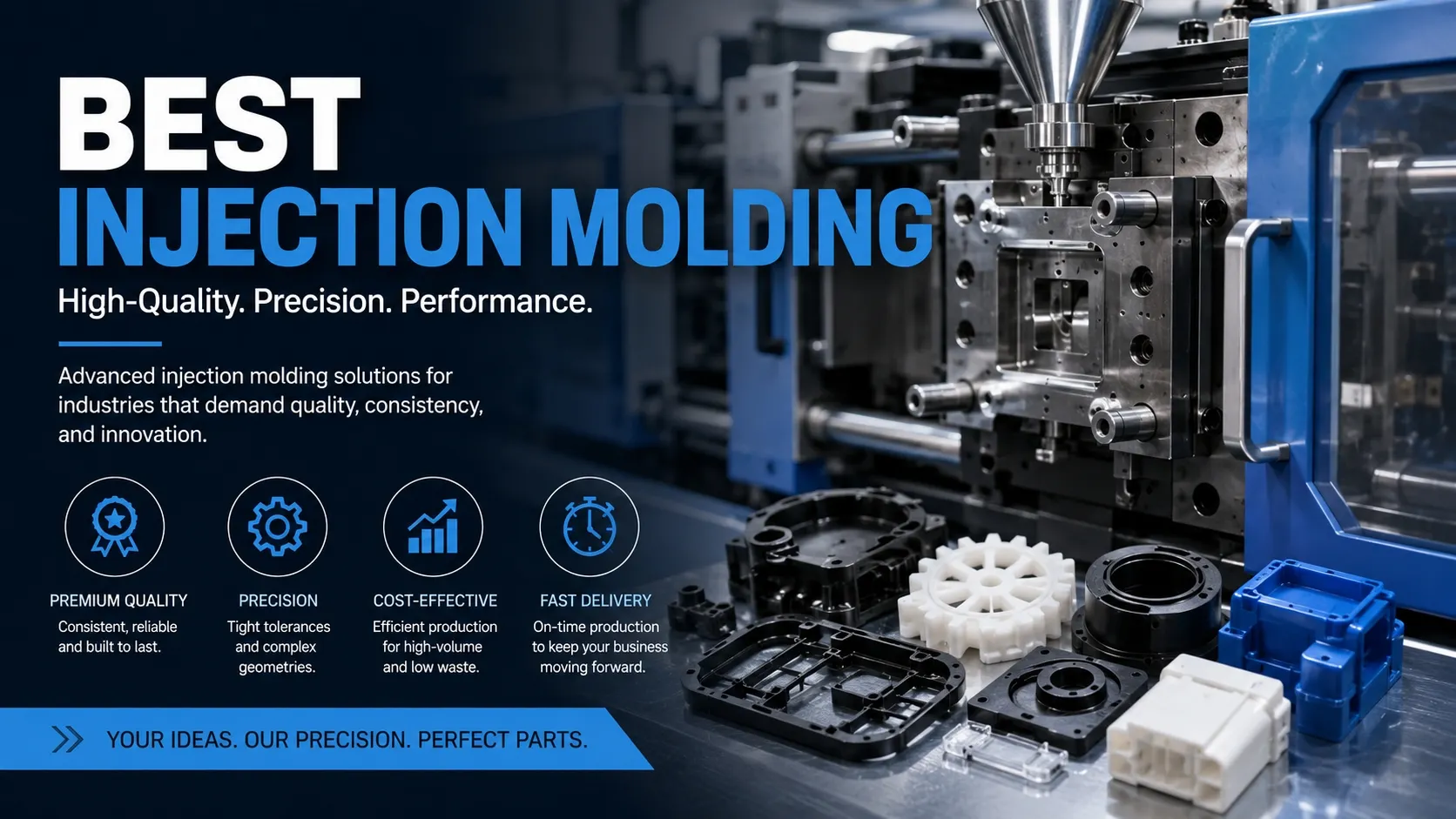
Companies seek the most optimal injection molding solutions when they want a manufacturing process that delivers high-quality, low-cost products, scale-up capability and quick production cycles. Choosing the right injection molding partner can significantly impact product performance, production costs, and market competitiveness.
This guide will take a look at what makes the best injection molding services and the benefits of injection molding, key industry use-cases, and how to choose the right injection molding manufacturing partner for your project.
What Is Injection Molding?
Injection molding is a manufacturing process where molten plastic material is injected into a custom designed mold under high pressure to create plastic components. Once cooled and solidified the part is removed from the mold and can be used or further processed.
It is the perfect method for manufacturing a large number of identical components that have tight tolerances and a high degree of complexity.
The following materials are typical for injection molding:
- ABS (Acrylonitrile Butadiene Styrene)
- Polypropylene (PP)
- Polycarbonate (PC)
- Nylon (PA)
- Polyethylene (PE)
- POM (Acetal)
- TPU (Thermoplastic Polyurethane)
- Medical-grade plastics
Why Injection Molding Is the Best Manufacturing Solution
1. High Production Efficiency
The major benefits of injection molding when compared to other manufacturing processes is the capability to produce thousands or even millions of parts quickly. After the mold is developed, the cycle times are typically in seconds.
This allows injection molding to be the preferred method for mass production in many industries.
2. Exceptional Precision and Accuracy
Today, manufacturers can now create molds with very small tolerances thanks to the use of CNC machining. Complex design, intricate detail and functional features can be consistently produced in mass production.
With high precision, there are fewer problems with assembly, and the overall quality of the product is enhanced.
3. Cost-Effective for Large Volumes
While mold tooling starts with a capital investment, the cost of parts manufactured in medium to large volumes is very low.
Benefits include:
- Reduced labor costs
- Minimal material waste
- Automated production
- Faster cycle times
- Lower unit costs
Injection molding is an excellent choice for companies that want to manufacture efficiently over an extended period.
4. Wide Material Selection
There are hundreds of thermoplastics and engineering-grade materials that can be used for specific performance requirements, all of which can be selected by manufacturers.
The properties of a material can be:
- Heat resistance
- Chemical resistance
- UV resistance
- Electrical insulation
- Impact strength
- Flexibility
- Medical compliance
This versatility allows injection molding to be used in almost every industry.
5. Excellent Surface Finish
These are just a few of the surface finishes parts can have, all created directly in the mold through injection molding:
- Glossy finishes
- Matte finishes
- Textured surfaces
- Custom branding
- Engraved logos
This reduces secondary finishing operations and improves product aesthetics.
Industries That Benefit from Injection Molding
Automotive Industry
Automotive manufacturers rely heavily on injection molding to produce:
- Dashboard components
- Interior trims
- Bumpers
- Air vents
- Electrical housings
- Sensor covers
The process ensures lightweight, durable, and cost-effective components.
Medical Devices
Medical manufacturers require precise and sterile plastic components.
Common applications include:
- Syringes
- Diagnostic equipment housings
- Medical packaging
- Laboratory consumables
- Surgical instrument handles
Medical-grade injection molding complies with strict quality and regulatory standards.
Consumer Electronics
The electronics industry uses injection molding for:
- Device enclosures
- Connectors
- Battery housings
- Switch components
- Protective covers
High dimensional accuracy is critical for electronic products.
Household Products
Everyday products manufactured through injection molding include:
- Storage containers
- Kitchen utensils
- Cleaning tools
- Toys
- Furniture accessories
The process enables affordable mass production while maintaining quality.
Industrial Equipment
Industrial applications often require engineering plastics capable of handling demanding environments.
Examples include:
- Machine components
- Fluid handling systems
- Electrical insulation parts
- Safety equipment
Injection molding delivers reliable performance and repeatability.
Characteristics of the Best Injection Molding Company
Advanced Manufacturing Equipment
Leading injection molding companies invest in:
- Modern injection molding machines
- CNC machining centers
- Automated production systems
- Robotics integration
- Real-time quality monitoring
Advanced equipment improves consistency and production efficiency.
Strong Engineering Support
The best manufacturers offer comprehensive engineering services, including:
- Design for Manufacturing (DFM)
- Mold flow analysis
- Material selection guidance
- Prototype development
- Product optimization
Engineering expertise helps reduce costs and improve product performance.
High-Quality Mold Manufacturing
Mold quality directly affects production outcomes.
A professional injection molding company should provide:
- Precision mold design
- Durable mold materials
- Efficient cooling systems
- Long mold lifespan
- Regular maintenance programs
High-quality molds ensure consistent production and lower operating costs.
Strict Quality Control
Reliable manufacturers implement quality systems such as:
- ISO 9001 certification
- Incoming material inspections
- In-process monitoring
- Dimensional inspections
- Final product verification
Quality control minimizes defects and ensures customer satisfaction.
Flexible Production Capacity
The best injection molding providers can accommodate:
- Prototype production
- Low-volume manufacturing
- Medium-volume production
- High-volume mass production
Flexible production capabilities support businesses at every stage of product development.
How to Choose the Best Injection Molding Partner
Evaluate Industry Experience
Look for a manufacturer with proven experience in your industry. Industry-specific knowledge often leads to better material recommendations, optimized designs, and faster project execution.
Review Manufacturing Capabilities
Consider factors such as:
- Machine tonnage range
- Material expertise
- Mold-making capabilities
- Secondary operations
- Assembly services
A full-service manufacturer can streamline your supply chain.
Assess Quality Certifications
Quality certifications demonstrate commitment to manufacturing excellence.
Important certifications may include:
- ISO 9001
- ISO 13485
- IATF 16949
- RoHS compliance
These standards help ensure reliable production.
Request Samples and Case Studies
Previous projects can give you an idea of the quality, technical knowledge and the ability of a manufacturer.
Good case studies can be a sign of the production experience.
Compare Total Cost, Not Just Unit Price
The lowest quote is not always the best value.
Consider:
- Tooling quality
- Lead times
- Product consistency
- Engineering support
- Long-term reliability
A trusted injection molding partner can save significant costs over the product lifecycle.
Future Trends in Injection Molding
The injection molding industry continues to evolve through innovation and automation.
Key trends include:
- Smart manufacturing technologies
- Industry 4.0 integration
- Sustainable materials
- Recycled plastics
- Energy-efficient machinery
- AI-driven process optimization
- Rapid tooling solutions
These innovations contribute to boosting manufacturing productivity, minimize waste, and address the demand for more products in the market.
Conclusion
Choosing a manufacturer with the lowest price is not enough when looking for the best injection molding solution. A great injection molding partner packs cutting-edge tech, engineering know-how, quality control, and production flexibility.
From making automotive components to medical devices, consumer goods, and industrial parts, injection molding is one of the most dependable, efficient, and cost-effective manufacturing processes today.
Working with a seasoned injection molding firm can lead to enhanced product quality, quicker time to market, and continued business success. Injection molding will continue to be a pivotal part of today's manufacturing industry and will likely play an important role in the future.
Talk to the Manufacturer, Not a Middleman
Resources & Insights
-
 Hide blog post
CNC Machining Robotic Parts: How GD&T Controls Robot Assembly Accuracy
2026-09-24By KT Engineering -
 Hide blog post
Hardware Stamping Springback Control for High-Strength Steel Parts
2026-09-24By KT Engineering -
 Hide blog post
Spring Stamping Fatigue Life: How Geometry, Material and Edge Quality Affect Cycle Life
2026-09-24By KT Engineering -
 Hide blog post
Mechanical Automation Parts for Robot End Effectors and Positioning Accuracy
2026-09-23By KT Engineering