Contact Us
  Home /
 Best CNC Machines for Metal


Table of Contents

Precision, consistency and efficiency are all required in the metalworking trade. From manufacturing aerospace components and automotive parts to medical devices and industrial equipment, and even creating custom prototypes, the type of CNC machine chosen has a direct effect on product quality, manufacturing speed, and manufacturing costs.
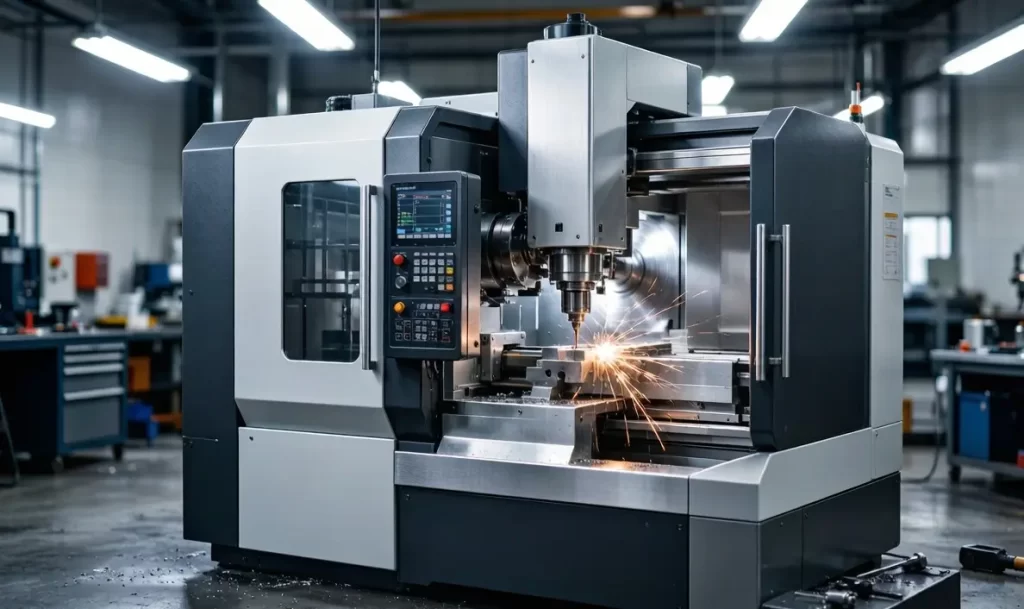
If metal cutting is not performed on machinery that is very rigid, powerful spindles, motion control precise and effective, and chip removal is not carried out, then it is impossible to do metal cutting. Manufacturers can benefit from a higher tolerance, longer tool life and higher productivity through investing in the right equipment.
This guide examines the advantages of the various CNC machines used for metal work, and outlines the pros and cons of each, while outlining how to choose the most suitable option for your metal work needs.
What Is a CNC Machine for Metal?
An automated manufacturing system that can cut, drill, mill, bore, engrave or shape metal workpieces with outstanding precision, following programmed instructions, is called a CNC (Computer Numerical Control) machine.
The modern CNC can work all of the following materials:
- Aluminum
- Stainless steel
- Carbon steel
- Tool steel
- Brass
- Copper
- Titanium
- Magnesium alloys
- Nickel alloys
Compared with manual machining, CNC technology provides:
- Superior dimensional accuracy
- Excellent repeatability
- Faster production cycles
- Lower labor costs
- Reduced material waste
- Consistent quality across large production runs
Types of CNC Machines for Metal
1. CNC Milling Machines
CNC milling machines are one of the most versatile metalworking systems that are available today.
In the rotating cutting tool, material is removed as the cutting tool rotates, while the workpiece is stationary, or moves from multiple axes.
Best Applications
- Precision mechanical components
- Mold manufacturing
- Aerospace parts
- Medical instruments
- Automotive components
- Aluminum housings
Advantages
- High precision
- Complex geometry machining
- Excellent surface finish
- Wide material compatibility
- Suitable for prototypes and mass production
Three-axis mills are more suitable for standard parts, 4-axis and 5-axis machines can greatly enhance the efficiency of manufacturing complicated components.
2. CNC Turning Machines (Lathes)
CNC lathes spin workpieces with stationary cutters removing material.
These machines are best suited for creating cylindrical parts rapidly and precisely.
Ideal Products
- Shafts
- Bushings
- Connectors
- Pins
- Hydraulic fittings
- Fasteners
Benefits
- Outstanding roundness accuracy
- Fast cycle times
- Excellent repeatability
- Low production cost for rotational parts
Many modern turning centers are also equipped to perform milling and drilling tasks in a single setup with the use of live tooling.
3. CNC Machining Centers
Machining centers integrate several manufacturing processes within a single machine and are very automated.
Features commonly include:
- Automatic tool changers
- Tool measurement systems
- Coolant delivery
- High-speed spindle control
- Automatic pallet changers
These machines save a lot of time for set up and improve productivity to a great extent.
Machining centers are essential to continuous manufacturing operations in industries like aerospace and medical manufacturing.
4. 5-Axis CNC Machines
5-axis machining provides the greatest flexibility for manufacturers making very complicated parts.
In contrast to 3 axis systems, a 5 axis machine enables the cutting tool to move towards the work piece from practically any direction.
Advantages
- Fewer setups
- Better surface quality
- Higher machining accuracy
- Reduced fixture complexity
- Shorter manufacturing time
Typical applications include:
- Turbine blades
- Medical implants
- Aerospace components
- High-performance automotive parts
- Precision molds
Advanced manufacturing may benefit from the investment because of productivity gains.
5. CNC EDM Machines
Electrical Discharge Machining (EDM) is a metal removal process that utilizes electrical sparks to cut metal instead of a cutting tool.
A main advantage of EDM is the ability to process extremely hard materials which are difficult to process using the conventional machining tools.
Common applications include:
- Injection molds
- Die manufacturing
- Precision tooling
- Small internal features
- Sharp internal corners
Because no cutting forces are generated, delicate parts can be machined without distortion.
6. CNC Laser Cutting Machines
Laser cutting machines employ the laser beam to pierce through the sheet metal with great speed and accuracy.
Suitable materials include:
- Stainless steel
- Carbon steel
- Aluminum
- Brass
- Copper
Advantages include:
- Minimal material waste
- High cutting speed
- Smooth edges
- Excellent repeatability
- Little post-processing required
Laser cutting is widely used in sheet metal fabrication industries.
Important Features to Consider
Machine Rigidity
One of the most important factors in metal machining is rigidity.
A stiff machine frame reduces vibration, enhances surface finishes and increases the life of cutting tools.
Heavy duty metal cutting is normally performed with cast iron machine structures.
Spindle Power
The spindle is responsible for the efficiency of material removal.
Increase spindle power, which leads to:
- Larger cutting tools
- Higher feed rates
- Better performance on steel
- Reduced machining time
High-speed spindles are very effective for aluminum.
In the case of hardened steels, the torque becomes more and more important.
Precision and Accuracy
Typical manufacturing tolerances are a few microns.
It is done by high quality CNC machines by:
- Precision ball screws
- Linear guideways
- Thermal compensation
- High-resolution encoders
- Advanced CNC controllers
In the aerospace, medical and electronics industries, consistent accuracy is critical.
Automatic Tool Changer
Automatic tool changers eliminate manual intervention between machining operations.
Benefits include:
- Faster production
- Lower labor costs
- Improved automation
- Reduced downtime
Machines with larger tool magazines are especially valuable for complex parts requiring multiple tools.
Cooling System
Metal cutting generates significant heat.
A reliable coolant system:
- Prevents overheating
- Improves surface finish
- Increases tool life
- Flushes away chips
- Maintains dimensional accuracy
Proper coolant management is essential during extended machining operations.
Choosing the Right CNC Machine for Your Business
Before investing, evaluate the following factors.
Production Volume
For prototype production, flexibility may be more important than speed.
High-volume manufacturing benefits from:
- Automatic loading systems
- Tool changers
- Pallet changers
- Multi-axis machining
Material Type
Different metals require different machining characteristics.
For example:
| Material | Recommended Machine |
|---|---|
| Aluminum | High-speed CNC mill |
| Stainless Steel | Heavy-duty machining center |
| Titanium | 5-axis CNC machine |
| Brass | CNC lathe or mill |
| Tool Steel | CNC machining center or EDM |
Selecting equipment suited to your primary material improves both efficiency and tool life.
Part Complexity
Simple components generally require only 3-axis machining.
More intricate parts featuring compound angles, deep cavities, or complex contours often benefit from 5-axis technology, reducing multiple setups while improving accuracy.
Budget
Machine costs vary considerably.
General investment ranges include:
- Entry-level CNC mills
- Professional vertical machining centers
- Industrial 5-axis machining centers
- Automated production cells
Rather than focusing solely on purchase price, evaluate the total cost of ownership, including maintenance, tooling, software, and operator training.
Industries That Depend on CNC Metal Machining
Modern CNC equipment supports nearly every precision manufacturing industry.
Common sectors include:
- Aerospace
- Automotive
- Medical devices
- Defense
- Electronics
- Robotics
- Energy
- Industrial automation
- Semiconductor manufacturing
- Consumer products
Each industry relies on CNC machining for repeatable quality and high production efficiency.
Maintenance Tips for Long-Term Performance
Routine maintenance maximizes machine reliability and minimizes downtime.
Best practices include:
- Inspect spindle performance regularly
- Lubricate guideways and ball screws
- Replace worn cutting tools promptly
- Monitor coolant concentration
- Clean chips from the machine daily
- Calibrate machine accuracy periodically
- Check tool holders for wear
Preventive maintenance significantly extends equipment lifespan while maintaining machining precision.
Future Trends in Metal CNC Machining
Manufacturing continues to evolve with smarter automation and digital technologies.
Emerging trends include:
- AI-assisted machining optimization
- Predictive maintenance
- Digital twins
- Real-time process monitoring
- Robotic material handling
- Cloud-based production management
- Intelligent tool wear detection
- Lights-out manufacturing
These innovations help manufacturers improve productivity while reducing operating costs.
Conclusion
In consideration of metal CNC machine, there are many factors to consider, such as materials, production quantity, accuracy, as well as long-term business objectives. CNC milling machines are unsurpassed in their versatility, rotational parts are made better with turning centers, production is faster with machining centers, and 5-axis systems are unmatched in their ability to work with complex geometries.
Manufacturers should consider the rigidity of the machine, the performance of the spindle, the level of precision, degree of automation and after-sales service, rather than just the price. The right CNC solution enhances the quality of the parts manufactured, decreases manufacturing costs, cuts lead times and boosts competitiveness.
With the continuous development of metal manufacturing industry, the current situation of smart factory and automation is gradually becoming the new trend in metal processing, and the investment of the right CNC equipment is a very valuable choice for any metal precision manufacturing business.
Talk to the Manufacturer, Not a Middleman
Resources & Insights
-
 Hide blog post
CNC Machining Robotic Parts: How GD&T Controls Robot Assembly Accuracy
2026-09-24By KT Engineering -
 Hide blog post
Hardware Stamping Springback Control for High-Strength Steel Parts
2026-09-24By KT Engineering -
 Hide blog post
Spring Stamping Fatigue Life: How Geometry, Material and Edge Quality Affect Cycle Life
2026-09-24By KT Engineering -
 Hide blog post
Mechanical Automation Parts for Robot End Effectors and Positioning Accuracy
2026-09-23By KT Engineering