Contact Us
 Home /
CNC Machining Cost for Automation Parts: Pricing Factors and Ways to Save


Table of Contents
- 1. How Much Do CNC Machined Automation Parts Cost in the USA?
- 2. What Factors Affect CNC Machining Costs for Automation Components?
- 3. CNC Machining Cost Breakdown: An Automation Bracket Example
- 4. CNC Machining Costs for Common Industrial Automation Parts
- 5. How to Reduce CNC Machining Costs for Automation Parts
- 6. CNC Machining in the USA vs. Overseas: What Should Automation OEMs Consider?
- 7. How to Get an Accurate CNC Machining Quote for Automation Parts
- 8. Why Choose KT TOOL for Custom CNC Automation Parts?
-
9. Frequently Asked Questions
- How much does CNC machining cost per part in the USA?
- What is the cheapest material for CNC automation parts?
- Why are tight-tolerance automation parts more expensive?
- How does order quantity affect CNC machining prices?
- Is 5-axis CNC machining more expensive than 3-axis machining?
- How can I get a quote for custom CNC automation components?
- Conclusion

How much does CNC machining cost for automation parts? For a custom automation bracket, robotic gripper component, or precision fixture, the answer depends on more than material and size. Machine setup, programming, tolerances, machining time, inspection, and order quantity all affect the final price.
For U.S. automation equipment manufacturers, sourcing CNC machined parts also involves balancing unit cost with dimensional consistency, delivery schedules, and total landed cost.
A practical estimate begins with the following formula:
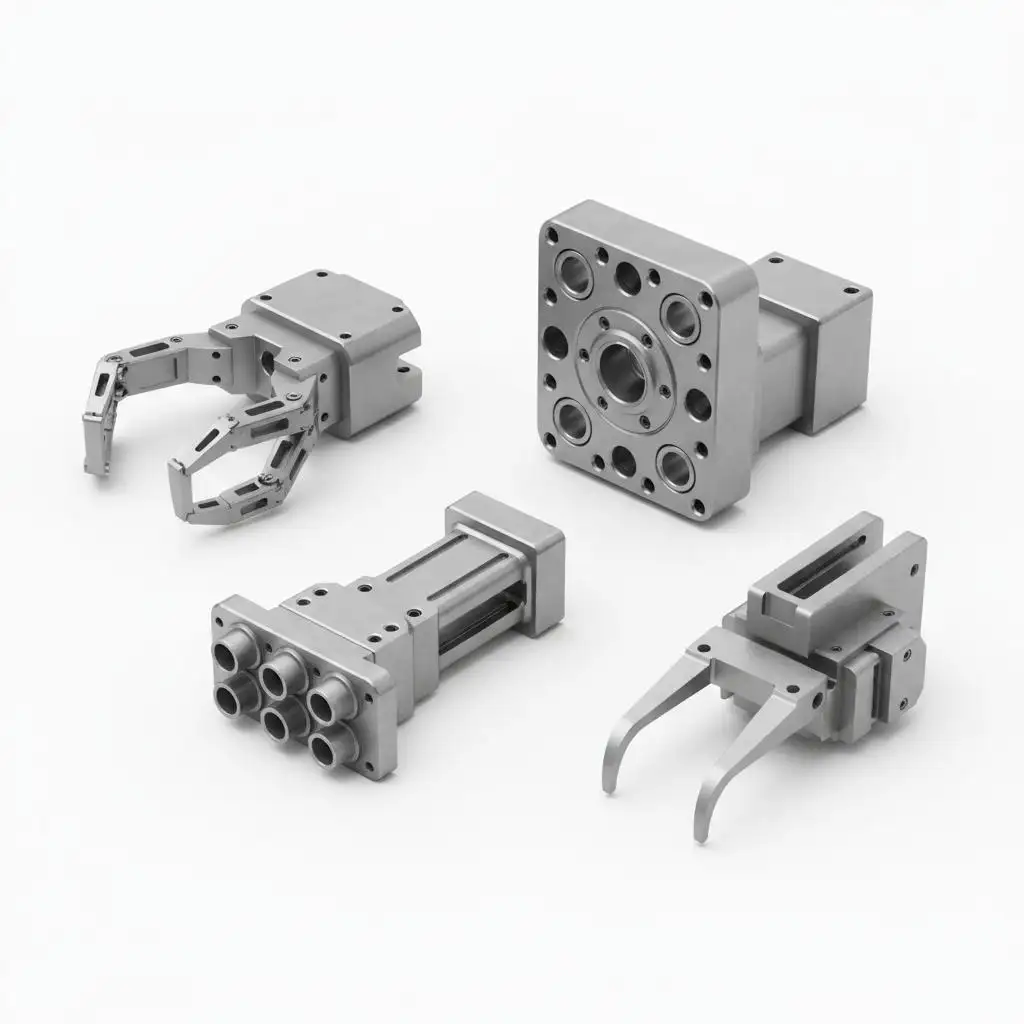
Estimated Cost Per Part = Material + Machining + Tooling + Inspection + Finishing + Allocated Setup Costs
Commercial quotations also account for overhead, manufacturing risk, margin, packaging, and applicable logistics costs.
This guide explains the main factors behind CNC machining cost for automation parts, provides a detailed aluminum bracket pricing example, and outlines how engineering and purchasing teams can control manufacturing expenses without compromising equipment performance.
1. How Much Do CNC Machined Automation Parts Cost in the USA?
There is no standard price for custom CNC machined automation components. Even parts with similar overall dimensions can require very different manufacturing processes.
A simple aluminum sensor bracket with four mounting holes may be produced efficiently using 3-axis milling. A robotic gripper housing with complex internal geometry and precision mating surfaces may require multiple operations, specialized fixtures, or multi-axis machining.
For American buyers, it is useful to distinguish three cost categories:
- Prototype cost: Typically includes one-time programming, setup, and first-part verification distributed across a small number of components.
- Low-volume production cost: Spreads preparation expenses across a larger batch but may still involve frequent machine changeovers.
- Repeat production cost: May benefit from established programs, dedicated fixtures, and more efficient production scheduling.
Estimated CNC Machining Costs by Automation Part Type
The following table summarizes typical manufacturing challenges rather than claiming universal market prices.
| Automation Component | Common Material | Main Cost Drivers | Relative Machining Complexity |
|---|---|---|---|
| Sensor mounting bracket | Aluminum 6061 | Hole patterns, slots, setup time | Low to moderate |
| Robotic gripper jaw | Aluminum 6061 or 7075 | Profile geometry, locating features | Moderate |
| Precision fixture plate | Aluminum or steel | Flatness, hole positioning, inspection | Moderate to high |
| Motor mounting bracket | Aluminum or steel | Bore alignment, mounting interfaces | Moderate |
| Bearing housing | Aluminum, steel, or stainless steel | Bore tolerances, alignment, surface finish | Moderate to high |
| Multi-sided automation housing | Aluminum alloy | Multiple setups, pockets, internal features | High |
These complexity categories are indicative. A large, simple plate can cost more in material than a small complex component, while a tight-tolerance miniature part can require extensive machining and inspection.
Prototype vs. Production Pricing
A one-piece prototype often has a higher unit price because the entire engineering preparation cost is assigned to that single part.
For recurring automation assemblies, the manufacturing process can become more efficient as order quantities grow.
However, the lowest possible unit price is not always the most economical purchasing decision. A U.S. equipment manufacturer should also consider inventory carrying costs, design revisions, and expected consumption.
For instance, ordering 500 brackets at once may reduce the setup cost per unit, but purchasing 100 parts per release may be more appropriate if the design is still evolving.
2. What Factors Affect CNC Machining Costs for Automation Components?
Understanding the primary cost drivers helps engineers identify which specifications truly influence manufacturing expenses.
Material Selection and Machinability
Raw material price is only one element of material-related cost.
Machinability influences cutting speeds, tool wear, achievable surface finish, and cycle time. Material condition, available stock dimensions, and waste generated during machining also affect pricing.
Common automation component materials include:
| Material | Common Applications | Manufacturing Considerations |
|---|---|---|
| Aluminum 6061-T6 | Brackets, machine mounts, fixtures | Generally easy to machine; good overall cost efficiency |
| Aluminum 7075-T6 | Lightweight, higher-strength structural parts | Higher material cost; useful where strength requirements justify it |
| Stainless Steel 304 | Washdown equipment, corrosion-resistant components | Often requires more careful tooling and cutting parameters |
| Carbon Steel | Mounting plates, structural supports, shafts | Can be economical but may need additional corrosion protection |
| POM (Acetal) | Guides, spacers, low-friction components | Good machinability; dimensional behavior requires attention |
| PEEK | Specialized engineering components | Expensive stock material and application-specific requirements |
Aluminum 6061-T6 is often a practical choice for robot brackets and sensor mounts because it combines relatively low weight with good machinability.
However, replacing steel with aluminum simply to lower machining expenses can be a poor decision when stiffness, wear resistance, or loading requirements favor steel.
Material selection should therefore follow the mechanical function and operating environment.
Part Geometry and Machining Complexity
The geometry of a component affects tool accessibility, cutting time, number of operations, and workholding requirements.
Expensive design features may include deep pockets, narrow slots, thin walls, long-reach holes, and features positioned on several different faces.
Consider an aluminum robotic end-effector body.
A design with accessible mounting holes and shallow machined features may require relatively straightforward milling.
Adding intersecting internal passages, deep cavities, and precision mounting features on different orientations could increase programming and fixture requirements.
The cost impact is not determined by how complicated the part looks. It depends on how the geometry must be manufactured.
Tolerances and Precision Requirements
Automation systems rely on accurate mechanical relationships, particularly in robotic positioning, motion control, bearing alignment, and inspection equipment.
However, tight tolerances should be assigned according to function.
For example, a noncritical outer profile may allow a tolerance of ±0.005 in. (approximately ±0.127 mm), while a critical locating feature may require ±0.001 in. (approximately ±0.0254 mm) or tighter.
These are illustrative drawing requirements, not universal recommendations for all components.
More restrictive tolerances can increase costs through additional machining passes, improved workholding, environmental control, and dimensional inspection.
Engineers can reduce unnecessary expenses by using an appropriate datum strategy and applying GD&T only where functional requirements justify the added control.
Machine Setup and Programming
CNC machining requires preparation before the first part is produced.
Manufacturers typically need to review CAD drawings, select tooling, create CAM programs, establish fixturing, and verify the machining process.
These activities create costs that are partly independent of production quantity.
A component requiring several machining orientations may have higher preparation expenses than a part that can be completed in one straightforward setup.
For complex multi-sided automation parts, 4-axis or 5-axis machining may reduce repositioning and datum transfer requirements, even when the equipment has a higher hourly operating rate.
Surface Finishing and Inspection
Surface finishing is another potential cost contributor.
Automation equipment components may require anodizing, plating, black oxide, passivation, bead blasting, or other treatments.
Additional inspection may also be necessary for critical mounting interfaces, bearing features, or geometrically controlled surfaces.
A basic mounting spacer may need only dimensional verification, while a locating fixture could require CMM inspection and a documented dimensional report.
Specifying only the finishing and inspection necessary for the application's function can help reduce unnecessary expenses.
Production Volume and Lead Time
Production quantity affects how setup and engineering expenses are distributed.
Small batches typically have a higher preparation cost per piece. Larger recurring orders may benefit from process optimization and more efficient material purchasing.
Urgent delivery requirements can also increase expense if they require overtime, schedule changes, expedited material purchasing, or faster freight.
Whenever possible, share anticipated quantities and realistic production schedules with the machining supplier.
3. CNC Machining Cost Breakdown: An Automation Bracket Example
A detailed cost model helps explain how manufacturers calculate the price of a custom automation component.
Consider a hypothetical CNC machined sensor mounting bracket used in an automated inspection system.
Example Part Specifications
| Parameter | Specification |
|---|---|
| Component | Sensor mounting bracket |
| Material | Aluminum 6061-T6 |
| Overall size | 4.0 × 2.5 × 1.0 in. |
| Metric equivalent | Approx. 102 × 64 × 25 mm |
| Machining process | 3-axis CNC milling |
| Features | Mounting holes, locating slot, shallow pocket |
| Finish | As-machined |
| Production batch | 100 pieces |
The following calculation is an illustrative manufacturing-cost model, not a verified U.S. market quotation or KT TOOL selling price.
Estimated Manufacturing Cost
| Cost Element | Assumed Cost |
|---|---|
| Material and stock allowance | $4.00 per part |
| Machining: 15 minutes at $60/hour | $15.00 per part |
| Tooling and consumables | $1.50 per part |
| Basic dimensional inspection | $2.00 per part |
| Programming and setup | $200 per batch |
The machining cost is:
15 minutes ÷ 60 × $60 = $15.00 per part
The allocated preparation cost for 100 pieces is:
$200 ÷ 100 = $2.00 per part
Therefore:
Estimated Direct Cost Per Part = $4.00 + $15.00 + $1.50 + $2.00 + $2.00 = $24.50
The estimated direct manufacturing cost for the complete batch is:
100 × $24.50 = $2,450
This model does not include all factory overhead, margin, packaging, freight, import duties, or taxes.
Actual CNC machining quotations depend on validated machining time, stock requirements, quality specifications, and supplier pricing policies.
How Order Quantity Changes Unit Cost
Assuming the same $200 fixed preparation cost and $22.50 variable cost per part, the effect of batch quantity becomes clear.
| Order Quantity | Preparation Cost Per Part | Direct Cost Per Part |
|---|---|---|
| 5 | $40.00 | $62.50 |
| 20 | $10.00 | $32.50 |
| 50 | $4.00 | $26.50 |
| 100 | $2.00 | $24.50 |
| 500 | $0.40 | $22.90 |
The figures demonstrate fixed-cost allocation, not guaranteed quantity discounts. Actual production costs may change with equipment capacity, tooling life, workholding strategy, and inspection requirements.
For automation equipment builders, this illustrates why discussing expected annual demand can be useful even when the first purchase order is relatively small.
4. CNC Machining Costs for Common Industrial Automation Parts
Automation components have different cost drivers depending on how they function within the equipment.
Robotic Grippers and End-Effector Parts
Robotic grippers often require lightweight construction, repeatable mounting locations, and accurately controlled contact surfaces.
Typical components include gripper fingers, mounting adapters, wrist interface blocks, and custom tool plates.
Machining costs may increase when designs require complex contours, thin walls, multiple machining orientations, or accurately positioned locating features.
Engineers should focus precision requirements on the gripping interfaces and mounting relationships rather than applying the same tolerances to every external surface.
Precision Jigs and Fixtures
Assembly fixtures and inspection jigs depend on repeatable workpiece positioning.
Locating pins, datum surfaces, and hole patterns may require careful positional control.
For a precision fixture plate, the major cost driver may be inspection and geometric accuracy rather than the complexity of the outer profile.
The drawing should clearly distinguish functional datum features from mounting or clearance features with less restrictive requirements.
Linear Motion and Motor Mounting Components
Linear guide supports, bearing blocks, motor mounts, and coupling adapters connect components that must remain aligned during equipment operation.
Misalignment can contribute to premature wear, vibration, and assembly difficulties.
For these parts, bore relationships, perpendicularity, and mounting surface geometry can be more important than cosmetic appearance.
Manufacturing cost should be evaluated against the accuracy required for the motion system, not simply the cheapest available process.
Sensor Brackets and Equipment Housings
Sensor mounts and protective housings are common in automated inspection and assembly equipment.
They may include threaded holes, cable slots, mounting pockets, and access features.
Many designs can be produced efficiently using aluminum or suitable engineering plastics.
However, requirements such as environmental sealing, thin walls, or multi-sided internal geometry may increase manufacturing complexity.
For these applications, simplifying cable access features and standardizing mounting patterns can often improve manufacturability.
5. How to Reduce CNC Machining Costs for Automation Parts
Cost reduction should start during engineering design rather than after a supplier submits a quotation.
The goal is to remove unnecessary manufacturing work while maintaining the mechanical performance required by the automation system.
Simplify Part Designs with DFM
Design for Manufacturability (DFM) helps identify expensive features before production.
For example, replacing an unnecessarily deep pocket with a shallower design may reduce cutting time and improve tool accessibility.
Similarly, selecting practical internal corner radii can avoid the need for very small cutting tools.
A DFM review should consider stock selection, fixture access, machining sequence, and component function.
Avoid Unnecessary Tight Tolerances
Critical bearing locations and precision datum surfaces deserve appropriate dimensional control.
However, nonfunctional external dimensions and protective features generally do not require the same precision.
Applying unnecessarily tight tolerances across an entire drawing can increase machining and inspection costs.
A better approach is to define the functional interfaces clearly and use appropriate general tolerances for the remaining features.
Choose Cost-Effective Materials
The most economical material is the one that satisfies performance requirements at the lowest practical total manufacturing cost.
Aluminum 6061 may be appropriate for lightweight equipment brackets, while carbon steel may be better for certain high-stiffness mounting applications.
POM can be useful for selected low-friction guides, but dimensional stability and wear requirements must be evaluated.
Always consider material availability, machining time, surface treatment, and service conditions before making a substitution.
Standardize Holes, Threads, and Features
Standardized features simplify production planning and can reduce tool changes.
For U.S.-designed automation equipment, purchasing teams should confirm whether drawings use inch-based or metric fasteners.
Avoiding unnecessary mixtures of thread systems can simplify tooling, purchasing, and maintenance.
Standardized mounting patterns may also allow related components to share fixtures or machining strategies.
Optimize Batch Sizes for Production
Ordering larger quantities can lower allocated setup costs, but inventory and engineering revision risks must also be considered.
For an established automation platform, forecast-based purchasing may support more efficient manufacturing.
For a new machine design, smaller prototype and pilot batches can limit the cost of design changes.
The ideal quantity balances manufacturing efficiency with engineering flexibility.
6. CNC Machining in the USA vs. Overseas: What Should Automation OEMs Consider?
American automation manufacturers frequently compare domestic machining suppliers with overseas manufacturers.
The most useful comparison is not simply the quoted unit price. It is the total cost of obtaining acceptable components at the required delivery date.
Unit Price vs. Total Landed Cost
An overseas quote may offer a lower manufacturing price, but importing components can create additional expenses.
A practical comparison should include:
Total Landed Cost = Supplier Price + Freight + Insurance + Applicable Duties + Customs and Handling Costs + Other Import-Related Expenses
Purchasing teams should also assess the expected financial impact of quality failures, late deliveries, and inventory requirements.
Import duties depend on the country of origin, product classification, and regulations applicable when the goods enter the United States. They should be confirmed for each shipment rather than estimated using a universal tariff percentage.
Lead Times, Shipping, and Import Duties
Domestic production may offer logistical advantages for urgent design revisions, site visits, or replacement parts.
Overseas manufacturing may be attractive for planned production batches where transportation time can be managed.
When comparing quotations, U.S. buyers should confirm the applicable Incoterms, production lead time, shipping method, and responsibility for customs clearance.
These commercial details can affect the true cost of the purchase.
Quality Consistency and Engineering Communication
Regardless of supplier location, precision automation parts must meet the same functional requirements.
Buyers should evaluate drawing review practices, inspection capability, material documentation, revision control, and corrective-action procedures.
For repeat orders, consistent manufacturing processes and reliable communication can matter more than a small difference in initial unit price.
7. How to Get an Accurate CNC Machining Quote for Automation Parts
A detailed request for quotation helps manufacturers identify the correct process and reduces uncertainty in cost estimation.
Before requesting a quote, prepare the following information:
- 3D CAD files: STEP models or another suitable neutral format.
- 2D engineering drawings: Critical dimensions, tolerances, GD&T, threads, and drawing revisions.
- Material specifications: Required alloy or plastic grade, material condition, and restrictions on substitution.
- Surface finish requirements: Coatings, treatments, roughness, and cosmetic expectations.
- Order quantity: Prototype volume, initial batch, and expected annual demand.
- Inspection requirements: Critical dimensions, dimensional reports, certificates, or traceability.
- Delivery requirements: Target dates, shipping destination, and commercial preferences.
For complex automation assemblies, providing information about mating parts can also be helpful.
If a component contains a bearing seat, locating interface, or precision guide feature, identify that function clearly on the drawing.
This helps the supplier determine which surfaces require special attention and where manufacturing costs can be optimized.
8. Why Choose KT TOOL for Custom CNC Automation Parts?
KT TOOL provides custom CNC machining services for industrial applications, supporting prototype development and production requirements.
Its manufacturing capabilities include 3-axis, 4-axis, and 5-axis CNC machining, allowing different component geometries to be evaluated for suitable production methods.
For automation equipment manufacturers, KT TOOL can support the evaluation of custom brackets, robotic components, fixtures, mounting blocks, and other precision mechanical parts.
The company's broader manufacturing capabilities also include processes such as sheet metal fabrication and surface finishing, which can be useful for projects involving multiple component types.
By supplying complete CAD models, engineering drawings, material requirements, and expected quantities, U.S. equipment manufacturers can request a project-specific assessment rather than relying on generic machining price assumptions.
Request a CNC Machining Quote for Your Automation Parts
Are you developing robotic tooling, precision fixtures, equipment mounts, or custom automation components?
Contact KT TOOL with your technical drawings and purchasing requirements to discuss machining feasibility, material options, production quantities, and quotation details.
9. Frequently Asked Questions
How much does CNC machining cost per part in the USA?
CNC machining cost varies with material, part dimensions, geometry, tolerances, machining time, and quantity. Simple components may require relatively little machining, while complex precision assemblies involve more operations and inspection. The most reliable way to determine actual pricing is to request quotations using consistent drawings and production specifications.
What is the cheapest material for CNC automation parts?
There is no universally cheapest material because total cost depends on component geometry, material availability, and functional requirements. Aluminum 6061 is often cost-effective for lightweight brackets and housings. Carbon steel may be suitable for certain structural parts, while engineering plastics can be economical for applications requiring their specific mechanical properties.
Why are tight-tolerance automation parts more expensive?
Tight tolerances may require additional cutting passes, more stable workholding, temperature control, and detailed inspection. The cost increase depends on the feature, material, and machining method. Engineers can often improve cost efficiency by applying strict dimensional control only to critical bearing interfaces, locating features, and precision mounting relationships.
How does order quantity affect CNC machining prices?
Small orders carry a larger share of fixed programming and machine setup costs. Increasing quantity can reduce these costs per component and improve production efficiency. However, the savings depend on actual manufacturing conditions, tooling requirements, and inspection needs. Larger batches are not automatically the most economical purchasing option.
Is 5-axis CNC machining more expensive than 3-axis machining?
A 5-axis machine may have a higher operating rate, but it can reduce repositioning and setup requirements for complex components. For simple brackets, 3-axis milling may remain more economical. For multi-sided automation components with tightly related features, 5-axis machining can sometimes lower total manufacturing cost.
How can I get a quote for custom CNC automation components?
Provide a 3D CAD model, 2D drawing, material specification, quantity, critical tolerances, finishing requirements, and delivery destination. Include expected annual demand when available. These details help the machining supplier evaluate programming, setup, production time, inspection needs, and commercial requirements before preparing a quotation.
Conclusion
CNC machining cost for automation parts depends on how the component is designed, manufactured, inspected, and purchased.
Material selection, geometric complexity, tolerance requirements, and production volume influence the final price. For U.S. automation OEMs, freight, import costs, quality consistency, and delivery reliability are also important factors.
By applying DFM principles and providing complete engineering documentation, manufacturers can control unnecessary machining costs while maintaining the accuracy required for reliable industrial automation equipment.
For custom automation components, contact KT TOOL to request a project-specific CNC machining quotation based on your drawings and production requirements.
Talk to the Manufacturer, Not a Middleman
Resources & Insights
-
 Blog
CNC Machining Robotic Parts: How GD&T Controls Robot Assembly Accuracy
2026-09-24By KT Engineering -
 Blog
Hardware Stamping Springback Control for High-Strength Steel Parts
2026-09-24By KT Engineering -
 Blog
Spring Stamping Fatigue Life: How Geometry, Material and Edge Quality Affect Cycle Life
2026-09-24By KT Engineering -
 Blog
Mechanical Automation Parts for Robot End Effectors and Positioning Accuracy
2026-09-23By KT Engineering