Contact Us
  Home /
 How to Evaluate a Provider of OEM 3D Printing Services: A Buyer's Technical Checklist


Table of Contents
- 1. Confirm Technology Variety: SLA, SLS, DMLS
- 2. Validate Precision Guarantees: ±0.05 mm to ±0.2 mm
- 3. Evaluate Capabilities of Materials: Engineering Plastics and Metal Powders
- 4. Assess Hybrid Manufacturing Capabilities: CNC + 3D Printing
- 5. Assess Time to Market and Volume
- 6. Check Quality management Systems: ISO 9001 and Related Standards
- 7. Look at Post Processing and Surface Finishing
- 8. Ask for Design Support (DFAM)
- 9. Compare Pricing Models: No Tooling, But Not Zero Cost
- 10. Run a Practical Test: The "Critical Feature" Sample

Selecting the right OEM 3D Printing Services partner is more than comparing price per part. It is a strategic decision that affects your product's mechanical performance, surface quality, and time-to-market. With the rise of industrial additive manufacturing, not all providers are equal. This guide provides a framework for assessing suppliers across a range of criteria, from machine calibration to quality management systems, using technical, non-biased parameters applicable to engineers and procurement specialists.
1. Confirm Technology Variety: SLA, SLS, DMLS
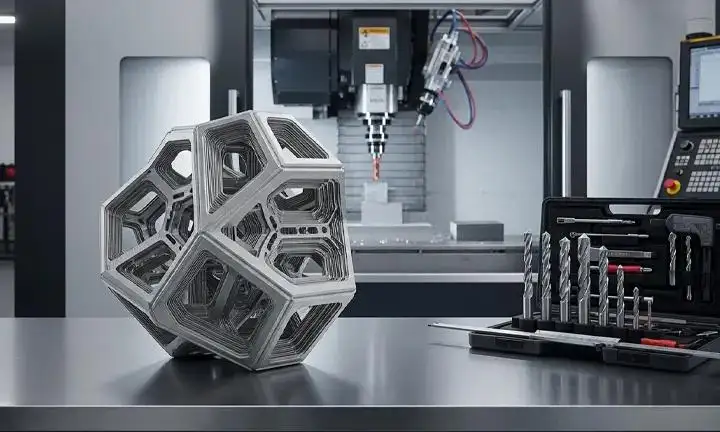
Not all OEM 3D Printing Services providers use the same 3D Printing technologies. In fact, each of the different processes caters to a specific requirement of the design.
• Stereolithography (SLA): Builds parts with superior surface finish having fit with tolerances with ± .1mm. SLA is used primarily for visual prototypes and master patterns for castings.
• SLS (Selective Laser Sintering): Produces fully functional nylon parts, which do not require support structures and are therefore ideal for parts like snap fits and living hinges.
• DMLS (Direct Metal Laser Sintering): is the technology of choice for end use metal parts. DMLS is particularly important for the aerospace and medical fields.
✅ KT TOOL's offering: All three technologies are used, and cover the gamut of Polymers and Powders from SLA, SLS, and DMLS.
2. Validate Precision Guarantees: ±0.05 mm to ±0.2 mm
A lot of suppliers claim to offer high precision, however the tolerances offered are often highly dependent on part orientation, geometry, and even post processing.
• Typical precision guarantee for FDM technology is ± 0.2 mm. Suitable for form-fit prototypes but not for press-fit bearings.
• Industrial SLA tolerance: Can achieve ±0.05–0.1 mm. Reliable for assemblies which interact with one another and require more precision in fit.
• Metal DMLS tolerance: typically at around ±0.1–0.2 mm on as-printed parts. CNC finishing helps to yield a better tolerance.
For a test part involving features like holes, thin walls, and overhangs, you should ask for a tolerance report. A provider that helps achieve first article inspections using an industrial 3D measurement system can be certified reliable.
3. Evaluate Capabilities of Materials: Engineering Plastics and Metal Powders
Available materials shape designs. A strong OEM 3D Printing Services will include:
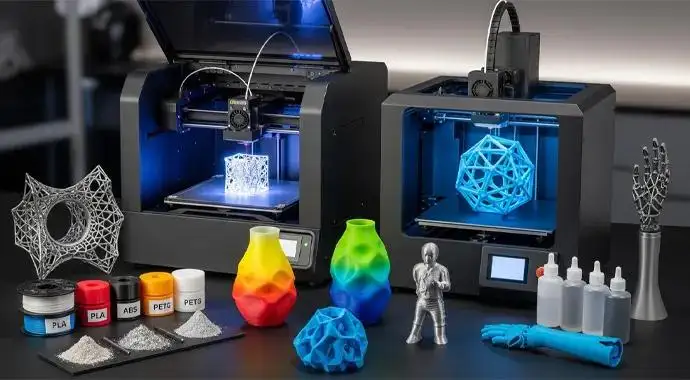
• SLA photopolymer resins: standard, tough, hi-temp
• SLS Nylons (PA12, PA11): having good impact strength and chemical resistance
• FDM engineering plastics: ABS, PETG, flexible TPU along with high-performance PEEK, that can withstand extreme thermals.
• Metal powders: AlSi10Mg (great thermal conductivity) and 316L (bio-compatible and used in medical tools).
From rapid prototyping to end-use parts, KT TOOL's offerings include resins, nylons, FDM engineering plastics, and more, including metals.
4. Assess Hybrid Manufacturing Capabilities: CNC + 3D Printing
Pure 3D printing has challenges with surface finish and with certain critical tolerances. The best OEM suppliers offer a combination of additive and subtractive methods.
• The advantage of hybrid is that 3D printing gets you close to net shape and CNC finishing gets you precise holes and flat sealing surfaces along with threaded features.
• The hybrid provider gives parts the design freedom of 3D printing along with the quality surface finish of a machined part (Ra 1.6 µm or better).
A provider that combines CNC with 3D printing can produce parts that are end-use worthy.
5. Assess Time to Market and Volume
Speed is a huge benefit of OEM 3D Printing Services, but only when the vendor has enough machines.
• Fast turnaround for resin parts: As fast as 24 hours for small SLA prototypes.
• Batch production: Reliable for quantities from 10 to 1000+ units without tooling costs.
• Scalability indicator: Ask how many industrial printers (FDM, SLS, metal) are running daily. A large machine farm of 20 or more shows leads that are reliable.
KT TOOL shows: rapid turnaround from 24 hours for resin parts, completed for both prototyping and production.
6. Check Quality management Systems: ISO 9001 and Related Standards
One of the differentiators between a hobbyist shop and an industrial OEM 3D Printing Services is quality documentation.
• QMS ISO 9001:2015 certified: Quoting, production, inspection, and shipping are all done with an assurance of quality.
• Compliance to ISO/ASTM 52901:2017: Additive Manufacturing standards and defines requirements for parts to be purchased.
• Lot traceability: especially with metal powders, the batch should have a material test certificate.
First article check: done with industrial 3D measurement systems like CMM or structured light scanners.
7. Look at Post Processing and Surface Finishing
Rarely do parts as printed meet the requirements of a final product. Full service providers offer many finishing options.
• Polishing: used for high gloss parts that are visual prototypes.
• Anodizing: applied to metal parts that increases wear and corrosion resistance.
• Electroplating: increases metal hardness and adds EMI shielding.
• Powder coating: adds an outdoor or high wear component coating that is durable and protective.
• Sanding shot peening: produces a painted surface or reduces a metal part's fatigue.
• Why this is important: A nylon part (SLS) might need bead blasting or vapor smoothing to be ready for production.
8. Ask for Design Support (DFAM)
The best OEM 3D Printing Services doesn't simply print your file. They print your file and design for additive manufacturing support.
• DFAM Analysis: look for unsupported walls, overhangs, and stress concentrations.
• Print Orientation: a good print orientation reduces the amount of supports, increases the quality of the print and surface, and increases the part strength.
• Material Recommendation Based on Load Case: TPU is preferred for flexible seals whereas nylon is preferable for rigid clips.
A provider who combines 3D design analysis with material consultation eliminates the risk of failed prints and redundant cycles of design.
9. Compare Pricing Models: No Tooling, But Not Zero Cost
The cost benefit of OEM 3D printing services is the absence of fixed tooling. But, costs become variable with:
• Part Volume: For some quantities, the price-per-part drops significantly and improves overall economics of the build due to packing.
• Material Consumption and the Need for Support Structures: Support structures for a given part volume can vary significantly between processes, e.g. Metal DMLS vs. SLS nylon.
• Post-processing complexity: A polished, anodized metal part costs more than a raw printed one.
Ask for a cost breakdown showing material, machine time, and finishing. Transparent providers will share this.
10. Run a Practical Test: The "Critical Feature" Sample
Before committing to large volumes, order a small test part that includes:
• Holes with 3 mm diameter (tests tolerance)
• Vertical and horizontal thin walls (0.8 mm) (tests process stability)
• Overhang without support (45° angle) (tests cooling and material sag)
• Engraved and embossed text (1 mm height) (tests resolution)
A competent OEM 3D Printing Services partner will deliver this sample with a full inspection report.
Conclusion: A Multi-Dimensional Decision
Evaluating an OEM 3D Printing Services provider requires checking technology diversity (SLA/SLS/DMLS), material breadth (nylon, resin, AlSi10Mg, 316L), precision (0.05–0.2 mm), hybrid CNC finishing, ISO 9001 certification, turnaround time (from 24 hours), and post-processing options (polishing, anodizing, electroplating). Incorporating these criteria with a practical test section allows you to systematically identify a partner who offers industrial-grade quality functional prototypes and production parts.
Here is KT TOOL's profile:
• SLA/SLS/DMLS with resins, nylons, and metals
• Precision: 0.05–0.1 mm
• CNC + 3D printing for surface quality
• Turnaround: from 24 hours for resins
• Certified QMS: ISO 9001:2015
• Finishing: polishing, anodizing, electroplating, and others
Use this checklist on your next RFQ to minimize expense and ensure quality.
FAQs
Q1. What are the usual tolerances for 3D printing in industrial OEM?
Typically, ±0.05–0.2 mm (SLA being the tightest, FDM the loosest).
Q2. What are the typical materials used for producing parts?
Strong and high performance parts are made from Nylon PA12 (SLS), AlSi10Mg (DMLS) and PEEK (FDM). These materials are preferred.
Q3. What's the OEM minimum lead-time for a prototype?
OEMs can produce resin parts in rapid prototyping systems in less than a day. However, metal parts can take a week.
Q4. What's Hybrid CNC + 3D Printing?
Hybrid CNC + 3D Printing describes a combination of both additive manufacturing and its subtraction counterpart. This method enables the manufacture of components of very tight tolerances and high quality surface finishes.
Q5. Are there any restrictions to 3D printing metal parts?No, with the right metal alloys (like 316L stainless, Ti6Al4V, or AlSi10Mg) DMLS can do that.
Talk to the Manufacturer, Not a Middleman
Resources & Insights
-
 Blog
BlogCNC Machining Robotic Parts: How GD&T Controls Robot Assembly Accuracy
2026-09-24By KT Engineering -
 Blog
BlogHardware Stamping Springback Control for High-Strength Steel Parts
2026-09-24By KT Engineering -
 Blog
BlogSpring Stamping Fatigue Life: How Geometry, Material and Edge Quality Affect Cycle Life
2026-09-24By KT Engineering -
 Blog
BlogMechanical Automation Parts for Robot End Effectors and Positioning Accuracy
2026-09-23By KT Engineering