Contact Us
  Home /
 best injection molding factory


Table of Contents
- What Is an Injection Molding Factory?
- Why Choosing the Best Injection Molding Factory Matters
- Characteristics of the Best Injection Molding Factory
- Industries Served by Injection Molding Factories
- How to Evaluate an Injection Molding Factory
- Future Trends in Injection Molding Manufacturing
- Conclusion

Injection molding is among the most significant manufacturing processes today. Injection molded parts come in a variety of shapes and sizes, ranging from a variety of items used in automotive technology, medical technology, consumer electronics and household goods, just to list a few. In today's fast-paced world of precision plastic manufacturing, selecting the right injection molding factory is crucial for ensuring quality, efficiency, and sustained success.
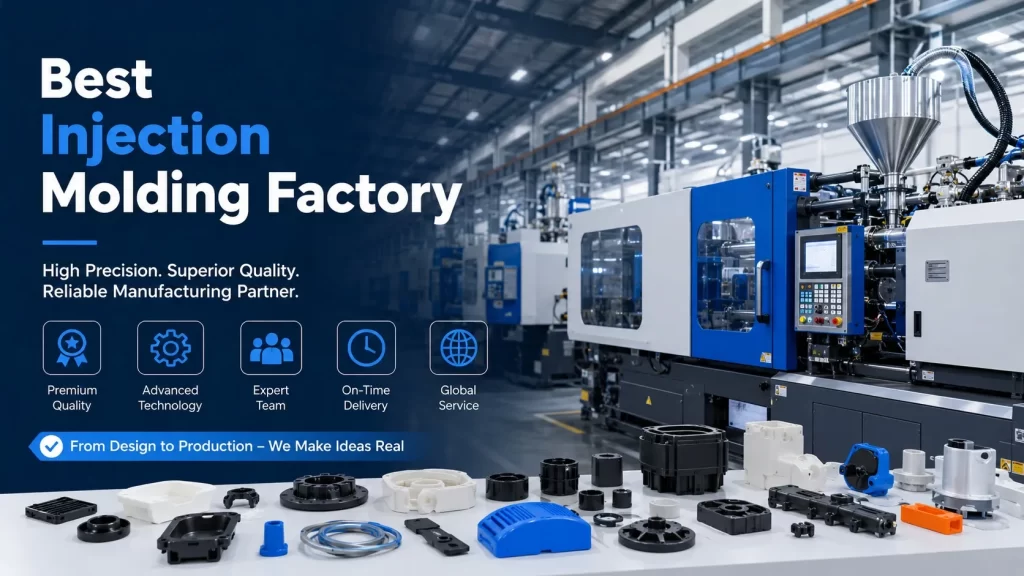
From new products to expanding existing production runs, choosing the right injection molding manufacturer can affect product quality, production costs and delivery schedules.
What Is an Injection Molding Factory?
Injection molding factory is a place where plastic parts are manufactured in the custom designed mold via injecting hot melted plastic material. After being molded and set, the molded parts are ejected and ready for assembly, package or shipment.
A good factory of injection molding components provides the following services:
- Product design assistance
- Mold design and manufacturing
- Prototype development
- Mass production
- Surface finishing
- Quality inspection
- Assembly services
- Global logistics support
By combining advanced machinery with experienced engineering teams, top factories can manufacture complex plastic components with exceptional precision and consistency.
Why Choosing the Best Injection Molding Factory Matters
Manufacturers do not always offer the same quality products and services. At the best injection molding factory, it isn't just about producing molded parts, it's about optimizing product development and manufacturing processes.
Key benefits include:
Superior Product Quality
Well-established factories employ cutting-edge molding machines, precision tools and quality control systems. They guarantee dimensional accuracy, uniform appearance and performance which is reliable.
Cost Efficiency
Their own manufacturing experience helps reduce manufacturing waste, maximizes material use and minimises manufacturing cycle times which leads to overall lower manufacturing costs.
Faster Time to Market
Skilled injection molding factories optimize the mould development, prototypes and production, so that products can be sent to the customers in timely.
Technical Expertise
If these are identified by an informed engineering team, they can stop production getting underway, thereby avoiding unnecessary delays and production problems.
Scalability
As your company grows, a good factory can easily increase production capacity to meet the growing demand as soon as.
Characteristics of the Best Injection Molding Factory
When evaluating potential manufacturing partners, consider the following factors.
Advanced Manufacturing Equipment
High-tech injection molding machines with automation systems, robotics, and real-time monitoring technologies are sought after by top factories.
Advanced equipment provides:
- Higher production efficiency
- Greater precision
- Reduced defect rates
- Consistent product quality
Even small and large size plastic components fit to many sizes of machines in the factories.
Comprehensive Engineering Support
Leading manufacturers provide invaluable engineering skills as advancements to aid in the creation of advanced technology.
A quality engineering team can help with:
- Product design optimization
- Material selection
- Mold flow analysis
- Design for manufacturability (DFM)
- Prototype development
Early engineering support often leads to significant savings in production costs and tooling expenses.
High-Quality Mold Manufacturing
The mould forms the basis of any product manufactured by the injection molding process. High quality mold design and making requirements are set by the most exquisite injection molding factories.
Premium molds provide:
- Longer service life
- Better dimensional accuracy
- Faster production cycles
- Improved product consistency
Johns can provide superior quality and maintenance of the molds if a factory has its own tooling workshop.
Strict Quality Control
Quality assurance should be integrated into every stage of production.
Leading factories implement:
- Incoming material inspections
- In-process quality checks
- Dimensional testing
- Functional testing
- Final product inspections
Many top manufacturers also hold internationally recognized certifications such as ISO 9001 and ISO 13485.
Material Expertise
Plastic materials vary widely in performance characteristics.
The best factories have extensive experience working with:
- ABS
- Polycarbonate (PC)
- Polypropylene (PP)
- Nylon (PA)
- POM
- TPU
- PET
- Medical-grade plastics
Their expertise helps ensure optimal material selection based on product requirements and operating conditions.
Industries Served by Injection Molding Factories
Injection molding is used across numerous industries due to its flexibility and cost-effectiveness.
Automotive Industry
Manufacturers produce components such as:
- Dashboard parts
- Interior trim
- Connectors
- Lighting housings
- Engine-related components
Automotive applications require strict tolerances and durability standards.
Medical Industry
Medical injection molding demands exceptional precision and cleanliness.
Common products include:
- Syringes
- Diagnostic device housings
- Surgical instrument components
- Laboratory consumables
Certified factories often operate cleanroom manufacturing environments.
Consumer Electronics
Electronic products rely heavily on injection molded components.
Examples include:
- Device enclosures
- Connectors
- Charging accessories
- Smart home device housings
Industrial Equipment
Industrial applications require robust plastic parts capable of withstanding demanding operating conditions.
Common products include:
- Control panels
- Protective covers
- Mechanical housings
- Precision components
How to Evaluate an Injection Molding Factory
Before selecting a manufacturing partner, businesses should conduct a thorough evaluation.
Review Production Capabilities
Ask about:
- Machine tonnage range
- Production capacity
- Automation systems
- Secondary processing services
A capable factory should be able to support both current and future production requirements.
Examine Quality Certifications
Certifications demonstrate a commitment to quality and compliance.
Look for:
- ISO 9001
- ISO 13485
- IATF 16949
- RoHS compliance
These standards indicate robust quality management systems.
Request Sample Products
Reviewing actual production samples provides valuable insight into manufacturing quality, surface finish, and dimensional accuracy.
Evaluate Communication
Effective communication is critical for successful project management.
The best factories provide:
- Fast response times
- Clear technical feedback
- Transparent project updates
- Dedicated account managers
Assess Delivery Performance
Reliable delivery schedules are essential for maintaining supply chain stability.
Ask manufacturers about:
- Average lead times
- On-time delivery rates
- Logistics capabilities
- Inventory management services
Future Trends in Injection Molding Manufacturing
The injection molding industry continues to evolve through technological innovation.
Emerging trends include:
Smart Manufacturing
Factories increasingly utilize Industry 4.0 technologies, including:
- IoT-enabled machines
- Predictive maintenance
- Real-time production monitoring
- Automated quality inspection
Sustainable Production
Environmental responsibility is becoming a key priority.
Many factories now focus on:
- Recycled materials
- Energy-efficient equipment
- Waste reduction programs
- Sustainable packaging solutions
Advanced Automation
Labor costs, production speed, and efficiency are enhanced with robotic systems, which convey a degree of consistency and stability.
Conclusion
The selection of the best injection molding company is a very important step that will have a considerable impact on the product quality, production speed and development of the business. A world class partner provides state of the art manufacturing facilities, engineering skills, quality control and production capacity.
With careful consideration of technical skills, certifications, communication protocols, and production capabilities, companies can form enduring partnerships that foster innovation and drive success in the market. With the continuous improvement of manufacturing technology, manufacturing companies will become of great significance to providing high-quality plastic products in various industries around the world.
Talk to the Manufacturer, Not a Middleman
Resources & Insights
-
 Hide blog post
CNC Machining Robotic Parts: How GD&T Controls Robot Assembly Accuracy
2026-09-24By KT Engineering -
 Hide blog post
Hardware Stamping Springback Control for High-Strength Steel Parts
2026-09-24By KT Engineering -
 Hide blog post
Spring Stamping Fatigue Life: How Geometry, Material and Edge Quality Affect Cycle Life
2026-09-24By KT Engineering -
 Hide blog post
Mechanical Automation Parts for Robot End Effectors and Positioning Accuracy
2026-09-23By KT Engineering