Contact Us
  Home /
 best sheet metal factory


Table of Contents
- What Is a Sheet Metal Factory?
- Why Choosing the Best Sheet Metal Factory Matters
- Key Capabilities of a Top Sheet Metal Factory
- Global Sourcing: Where to Find the Best Sheet Metal Factory
- How to Evaluate the Best Sheet Metal Factory
- Common Applications of Sheet Metal Manufacturing
- Trends in Modern Sheet Metal Fabrication
- Cost Factors in Sheet Metal Manufacturing
- Red Flags to Avoid
- Final Thoughts

This is because in today's global manufacturing environment, the key success factor isn't simply the price, it's precision, reliability, scale, and engineering ability. Whether you're developing industrial machinery, automotive parts, electronics casings or prototypes of your own, a suitable sheet metal fabrication partner can play a significant role in the quality of your product and how fast it makes it to market.
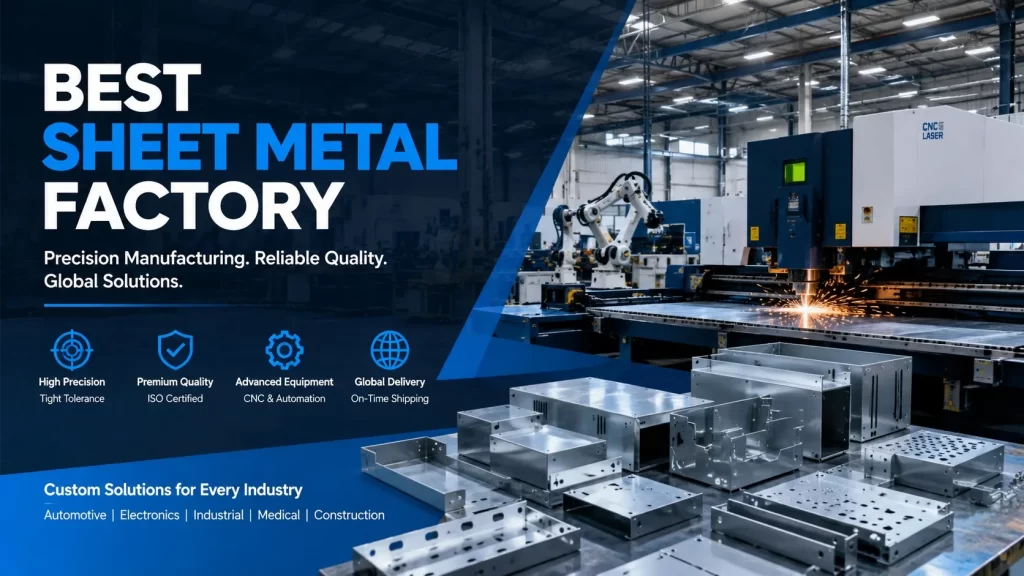
The purpose of this guide is to show you what sets a great sheet metal manufacturer apart, the services you can expect, and how to choose suppliers to ensure you will experience success, particularly when sourcing in the global marketplace.
What Is a Sheet Metal Factory?
Sheet metal factory is a manufacturing company where the raw material used is a flat metal sheet, which is then cut, bent, punched, welded and surface treated to make other useful parts and structures.
Common materials include:
- Stainless steel
- Aluminum
- Carbon steel
- Galvanized steel
- Copper and brass (for specialized applications)
Particularly parts for industries such as aerospace, automotive, telecommunication, medical devices, construction, and consumer electronics.
Why Choosing the Best Sheet Metal Factory Matters
Selecting the right factory is critical because sheet metal parts often require:
- Tight tolerances (±0.1 mm or better)
- Consistent batch quality
- Structural strength and durability
- Surface finish precision (powder coating, anodizing, polishing)
- Fast turnaround for prototyping and mass production
A low-quality supplier can result in:
- Product failure in assembly
- Higher scrap rates
- Delayed launches
- Increased long-term costs
Key Capabilities of a Top Sheet Metal Factory
When searching for the best sheet metal factory, look for these core capabilities:
1. Advanced Cutting Technology
High-end factories use:
- CNC laser cutting
- Fiber laser systems
- Plasma cutting (for thicker materials)
These ensure high accuracy, smooth edges, and minimal material waste.
2. Precision Bending and Forming
Modern sheet metal shops rely on CNC press brakes for:
- Complex geometries
- Repeatable accuracy
- High-volume production consistency
Multi-axis bending systems are a strong indicator of advanced capability.
3. Welding Expertise
A reliable factory should offer:
- TIG welding (high precision)
- MIG welding (speed and efficiency)
- Spot welding (thin sheet applications)
- Robotic welding (mass production consistency)
Welding quality directly affects product strength and durability.
4. Surface Finishing Services
Top-tier factories provide finishing options such as:
- Powder coating
- Anodizing
- Brushing and polishing
- Electroplating
These processes improve corrosion resistance, aesthetics, and product lifespan.
5. Engineering and Design Support
The best sheet metal factories are not just production units—they are engineering partners. They offer:
- DFM (Design for Manufacturing) analysis
- CAD/CAM support
- Rapid prototyping
- Material selection guidance
This reduces production errors and improves efficiency.
Global Sourcing: Where to Find the Best Sheet Metal Factory
The global supply chain offers multiple sourcing options:
Asia Manufacturing Hubs
Countries like China, Vietnam, and India dominate sheet metal production due to:
- Lower labor costs
- Advanced CNC infrastructure
- Large-scale production capacity
These regions are ideal for both prototyping and mass production.
United States and Europe
Factories in the US and EU often specialize in:
- High-precision aerospace components
- Medical-grade manufacturing
- Small-to-medium batch production
They are typically more expensive but offer strict compliance and faster domestic logistics.
Eastern Europe and Mexico
These regions are growing as nearshore manufacturing hubs, offering:
- Competitive pricing
- Faster delivery to US/EU markets
- Skilled technical workforce
How to Evaluate the Best Sheet Metal Factory
Before selecting a supplier, evaluate them using these criteria:
1. Equipment Modernity
Ask whether they use CNC laser cutting, automated bending, and robotic welding systems.
2. Quality Certifications
Look for certifications such as:
- ISO 9001 (Quality Management)
- ISO 14001 (Environmental Management)
- IATF 16949 (Automotive industry)
3. Sample Capability
A reliable factory should provide:
- Prototype samples
- Material test reports
- Dimensional inspection reports
4. Production Capacity
Check whether they can scale from:
- Single prototypes
- Small batch runs
- Mass production
5. Communication and Engineering Support
Strong English communication and responsive engineering teams are essential for international buyers.
Common Applications of Sheet Metal Manufacturing
The best sheet metal factories serve a wide range of industries:
Automotive Industry
- Car body panels
- Brackets and structural frames
- Battery enclosures for EVs
Electronics Industry
- Server racks
- Control cabinets
- EMI shielding enclosures
Industrial Equipment
- Machine frames
- Protective housings
- Conveyor system parts
Construction
- HVAC ducting systems
- Metal roofing components
- Structural supports
Trends in Modern Sheet Metal Fabrication
The industry is rapidly evolving. Leading factories now adopt:
Automation and Smart Manufacturing
- Robotic arms for welding
- AI-based quality inspection
- Automated material handling systems
Digital Manufacturing Integration
- Cloud-based production tracking
- Real-time order monitoring
- Digital twins for prototyping
Sustainability Practices
- Recyclable metal usage
- Energy-efficient laser systems
- Waste reduction processes
These trends separate average suppliers from the best sheet metal factory candidates.
Cost Factors in Sheet Metal Manufacturing
Pricing depends on several variables:
- Material type and thickness
- Part complexity
- Surface finishing requirements
- Order volume
- Tooling and setup costs
While cost is important, the cheapest option is rarely the most reliable for long-term production.
Red Flags to Avoid
When evaluating suppliers, watch out for:
- Lack of CNC equipment
- No quality documentation
- Poor communication responsiveness
- Inconsistent sample quality
- No clear production process
These signs often indicate unstable manufacturing capability.
Final Thoughts
A sheet metal manufacturer must be optimized and cost-efficient, have engineering prowess, and be scalable. It's not only about creating parts, it's about helping optimize your design, being able to make it cheaper to produce, and ensuring consistent quality at scale.
No matter whether you are looking locally or internationally, make sure the factories have good engineering staff, advanced CNC machines and experience in the production of your preferred items. In a competitive market, your manufacturing partner is crucial to your success in launching your product.
Talk to the Manufacturer, Not a Middleman
Resources & Insights
-
 Hide blog post
CNC Machining Robotic Parts: How GD&T Controls Robot Assembly Accuracy
2026-09-24By KT Engineering -
 Hide blog post
Hardware Stamping Springback Control for High-Strength Steel Parts
2026-09-24By KT Engineering -
 Hide blog post
Spring Stamping Fatigue Life: How Geometry, Material and Edge Quality Affect Cycle Life
2026-09-24By KT Engineering -
 Hide blog post
Mechanical Automation Parts for Robot End Effectors and Positioning Accuracy
2026-09-23By KT Engineering