Contact Us
  Home /
 custom sheet metal fabrication


Table of Contents
- What Is Custom Sheet Metal Fabrication?
- Common Materials Used in Sheet Metal Fabrication
- Modern Sheet Metal Fabrication Processes
- Industries That Depend on Custom Sheet Metal Fabrication
- Benefits of Custom Sheet Metal Fabrication
- How to Choose the Right Sheet Metal Fabrication Company
- Future Trends in Sheet Metal Fabrication
- Conclusion

Custom fabricated sheet metal is used by many industries, including aerospace, medical devices, construction, electronics, and automotive manufacturing, and is one of the most versatile manufacturing processes available. Manufacturers can use it to create a wide range of parts and assemblies, from simple brackets to intricate machine enclosures, all while maintaining a high degree of precision and accuracy.
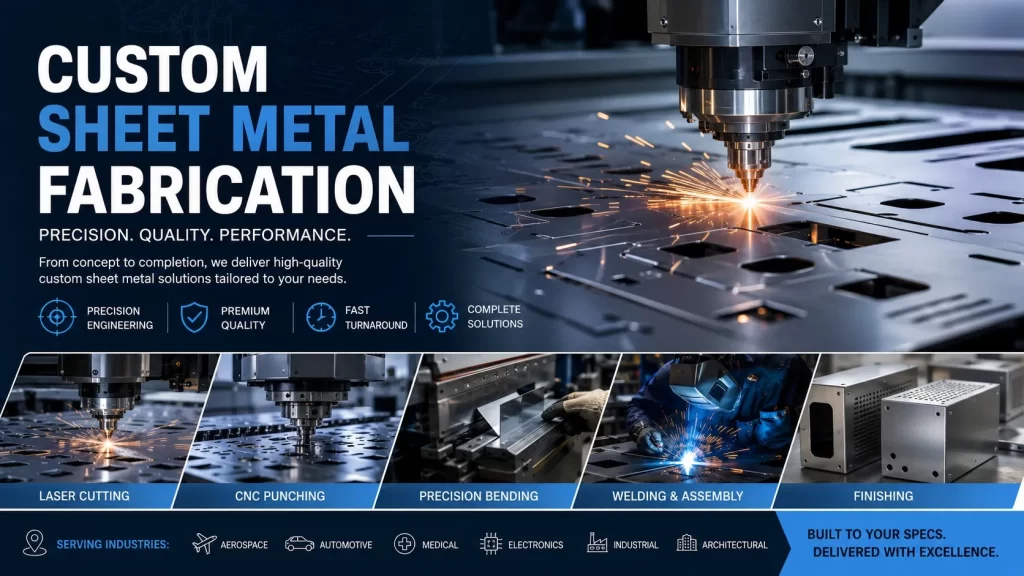
With the continued development of manufacturing technology, CNC controlled manufacturing processes are becoming increasingly essential to businesses to help ensure quality, reduce waste and decrease production lead times. Whether you're looking for a single prototype or high-volume production, it's important to understand the process to help you select the manufacturing partner and get the best possible results. Today's fabrication businesses utilize cutting-edge technology and skilled engineering to produce repeatable and predictable quality results on complex projects.
What Is Custom Sheet Metal Fabrication?
Custom sheet metal fabrication involves a series of precise metal manufacturing processes that are used to produce a finished product from a flat sheet of metal. Custom fabrication differs from mass-produced components in that it is built to the customer's specifications, dimensions, tolerances and desired performance.
The manufacturing process usually consists of:
- CAD design and engineering
- Material selection
- CNC laser cutting
- Turret punching
- Precision bending
- Welding and assembly
- Surface finishing
- Quality inspection
- Packaging and shipping
Every stage helps in creating long-lasting and efficient metal parts that align with specific customer requirements.
Common Materials Used in Sheet Metal Fabrication
One of the most critical choices is the materials selection in any fabrication process. Various metals have distinctive mechanical characteristics, corrosion resistance, and cost benefits.
Stainless Steel
Stainless steel is widely used because of its:
- Excellent corrosion resistance
- High strength
- Attractive appearance
- Long service life
- Easy maintenance
Typical applications include:
- Food processing equipment
- Medical devices
- Pharmaceutical equipment
- Industrial machinery
- Commercial kitchens
Aluminum
Aluminum offers an outstanding balance of strength and lightweight performance.
Advantages include:
- Lightweight construction
- Excellent corrosion resistance
- High thermal conductivity
- Easy machining
- Recyclability
Common applications:
- Aerospace components
- Electronic enclosures
- Transportation equipment
- Architectural panels
Carbon Steel
Carbon steel remains one of the most economical fabrication materials.
Benefits include:
- High strength
- Excellent weldability
- Cost-effectiveness
- Versatility
It is frequently used in:
- Structural frames
- Machine bases
- Equipment supports
- Industrial cabinets
Copper and Brass
Copper and brass provide excellent electrical conductivity and aesthetic appeal.
Ideal applications include:
- Electrical components
- Decorative fixtures
- HVAC systems
- Architectural projects
Modern Sheet Metal Fabrication Processes
Today's fabrication facilities rely heavily on automated CNC equipment that delivers exceptional precision and repeatability.
CNC Laser Cutting
Laser cutting uses high-powered fiber lasers to create extremely accurate cuts with minimal material waste.
Benefits include:
- Tight tolerances
- Clean edges
- Fast production
- Complex geometry capability
- Minimal finishing requirements
Laser cutting works well for:
- Precision panels
- Machine housings
- Electrical enclosures
- Prototype parts
CNC Punching
Turret punching creates holes, slots, louvers, and custom shapes efficiently without secondary machining.
Ideal for:
- Ventilation panels
- Electrical cabinets
- Control boxes
- Industrial enclosures
Precision Bending
Press brake forming transforms flat sheet metal into three-dimensional parts.
Advanced CNC press brakes provide:
- Consistent bend angles
- Tight tolerances
- Repeatable production
- Complex multi-bend components
Welding and Assembly
After forming, components are joined using professional welding techniques such as:
- TIG welding
- MIG welding
- Spot welding
- Stud welding
These methods ensure structural integrity while maintaining appearance and dimensional accuracy.
Surface Finishing
Finishing improves both appearance and performance.
Popular options include:
- Powder coating
- Brushed finish
- Bead blasting
- Anodizing
- Zinc plating
- Painting
Proper finishing increases corrosion resistance while extending product life.
Industries That Depend on Custom Sheet Metal Fabrication
Precision sheet metal fabrication supports virtually every manufacturing sector.
Aerospace
Aircraft manufacturers require:
- Lightweight materials
- Tight tolerances
- High structural integrity
- Consistent quality
Medical Equipment
Hospitals and medical device manufacturers rely on fabricated components for:
- Diagnostic equipment
- Laboratory instruments
- Sterile enclosures
- Medical carts
Electronics
Electronics manufacturers need precision metal fabrication for:
- Server racks
- Control cabinets
- Equipment enclosures
- Heat sinks
- Mounting brackets
Industrial Manufacturing
Factories use fabricated metal products for:
- Machine guards
- Conveyor systems
- Production equipment
- Control panels
Construction and Architecture
Architectural fabrication includes:
- Decorative panels
- Railings
- Stair systems
- Facades
- Structural supports
Benefits of Custom Sheet Metal Fabrication
Superior Precision
Modern CNC equipment consistently produces highly accurate components with tight tolerances that improve assembly efficiency and product performance.
Design Flexibility
Custom fabrication allows engineers to create unique parts optimized for specific applications rather than relying on standard components.
Cost Efficiency
Although tooling costs exist, custom fabrication often reduces overall expenses through:
- Lower material waste
- Faster production
- Reduced assembly time
- Improved product lifespan
Rapid Prototyping
Manufacturers can quickly produce prototypes for design validation before moving into full-scale production.
This shortens development cycles and reduces costly design revisions.
Scalability
A reliable fabrication partner can support:
- Prototype production
- Low-volume manufacturing
- Medium production runs
- Large-scale manufacturing
without compromising quality.
How to Choose the Right Sheet Metal Fabrication Company
Selecting the right fabrication partner directly impacts project quality, delivery time, and overall cost.
Consider the following factors:
Manufacturing Experience
Choose companies with extensive experience across multiple industries and fabrication techniques.
Advanced Equipment
Modern CNC machinery improves:
- Accuracy
- Production speed
- Repeatability
- Efficiency
Material Expertise
Experienced fabricators help customers choose the most suitable material based on:
- Strength requirements
- Corrosion exposure
- Budget
- Appearance
- Manufacturing complexity
Quality Control
Quality and conforming to customer specifications are guaranteed by reliable manufacturers who have rigorous inspection processes in place throughout their manufacturing process. Many are also ISO 9001 certified.
Engineering Support
The best fabrication companies assist customers with:
- Design optimization
- Cost reduction
- Manufacturability improvements
- Material recommendations
Early engineering involvement often results in better-performing products at lower overall costs.
Future Trends in Sheet Metal Fabrication
The future of sheet metal fabrication can be imagined.The future of sheet metal fabrications can be envisioned.
Emerging trends include:
- AI-assisted production planning
- Smart factory automation
- Industry 4.0 integration
- Robotic welding
- Automated inspection systems
- Digital quality tracking
- Sustainable manufacturing practices
These innovations are designed to boost productivity, minimize waste and ensure product consistency.
Conclusion
Custom sheet metal fabrication is still one of the most efficient and versatile types of manufacturing solutions that are available today. Manufacturers can ensure precision components for a variety of industries by using advanced CNC technology, professional engineering, and excellent materials.
From prototyping to product launching or scaling up production, collaborating with a seasoned fabrication company guarantees that your components satisfy demanding performance, quality, and delivery standards. Every aspect of the process, from material choice to precision laser cutting and welding, finishing and inspection, ensures that the products are long-lasting and reliable, contributing to the success of businesses in the long term. With the rapid development of automation and digital manufacturing, custom sheet metal fabrication will continue to be a crucial part of modern industrial manufacturing.
Talk to the Manufacturer, Not a Middleman
Resources & Insights
-
 Hide blog post
CNC Machining Robotic Parts: How GD&T Controls Robot Assembly Accuracy
2026-09-24By KT Engineering -
 Hide blog post
Hardware Stamping Springback Control for High-Strength Steel Parts
2026-09-24By KT Engineering -
 Hide blog post
Spring Stamping Fatigue Life: How Geometry, Material and Edge Quality Affect Cycle Life
2026-09-24By KT Engineering -
 Hide blog post
Mechanical Automation Parts for Robot End Effectors and Positioning Accuracy
2026-09-23By KT Engineering