Contact Us
  Home /
 precision sheet metal fabrication companies


Table of Contents
- What Is Precision Sheet Metal Fabrication?
- Core Manufacturing Processes
- Materials Used in Precision Sheet Metal Fabrication
- Industries That Depend on Precision Sheet Metal
- What to Look for in a Precision Sheet Metal Fabrication Company
- Why Precision Matters
- Questions to Ask Before Selecting a Supplier
- Future Trends in Precision Sheet Metal Fabrication
- Conclusion

The precision sheet metal fabrication sector is the foundation of numerous industries such as aerospace, auto, medical devices, electronics, renewable, and industrial equipment. The choice of the right sheet metal fabrication company can influence the product's quality, production time and manufacturing costs, no matter whether it is a prototype or full production.
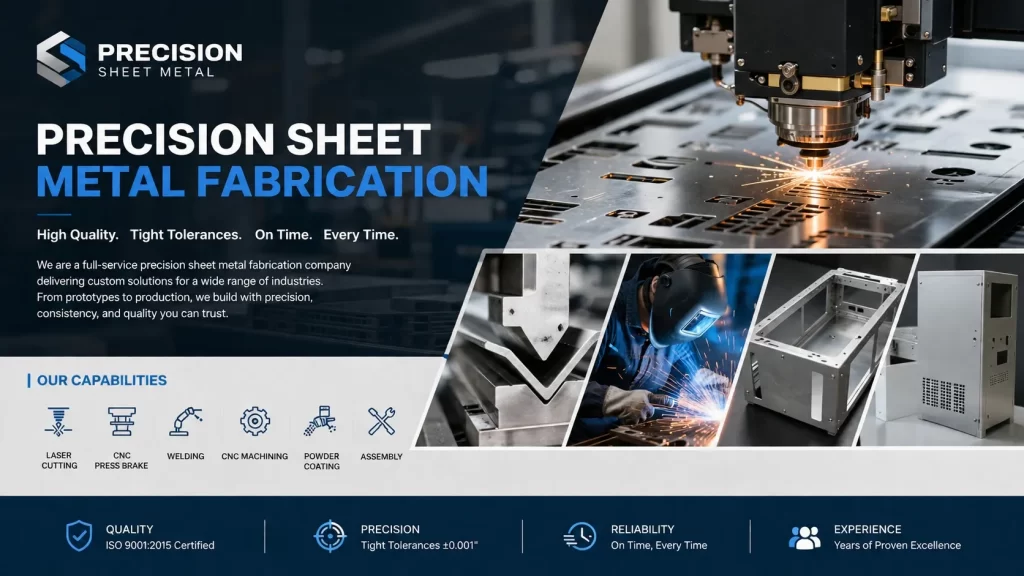
This guide will provide you with a definition of precision sheet metal fabrication, the services you can expect from a quality manufacturer, and some of the factors you should consider when selecting a long-term producing partner.
What Is Precision Sheet Metal Fabrication?
Precision sheet metal fabrication involves the use of sophisticated manufacturing methods to create complex components and assemblies from flat metal with extremely close tolerances. Precision fabrication is fundamentally different from traditional metalworking in that it emphasizes the close tolerances, high repeatability, and good surface quality.
Current manufacturers have computer controlled machines to assure that all components are made to exact engineering specifications. These fabricated components are commonly found in:
- Electronic enclosures
- Medical equipment
- Telecommunications cabinets
- Automotive components
- Aerospace structures
- Industrial machinery
- Energy storage systems
- Robotics and automation equipment
Precision fabrication not only saves material but also produces high-strength, lightweight, and economic metal products.
Core Manufacturing Processes
A precision sheet metal fabrication company normally has several manufacturing processes, all housed in a single building.
Laser Cutting
Fiber laser cutting features superior cutting precision, smooth cutting edges and high productivity. It can be used for complex geometries, and it minimizes secondary finishing operations.
Advantages include:
- High cutting speed
- Minimal heat distortion
- Excellent edge quality
- Tight dimensional accuracy
- Lower production costs
CNC Punching
CNC punching is excellent for high volume production of holes, slots, louvers, etc. and repetitive parts. It provides good consistency, and faster cycle times for appropriate designs.
CNC Bending
Using computer-controlled press brakes for bending sheet metal into 3D pieces guarantees the precise bend angle and repeatable dimensions.
Advanced CNC bending can be used for:
- Complex geometries
- Consistent part quality
- Reduced setup time
- Improved production efficiency
Welding and Assembly
If a fabricated part is to be welded to form a complete assembly, many projects will call for this service.
There are several welding processes that are used, some of which are:
- TIG welding
- MIG welding
- Spot welding
- Laser welding
Experienced technicians ensure strong weld integrity while minimizing distortion.
Surface Finishing
Surface treatments improve both appearance and durability.
Popular finishing options include:
- Powder coating
- Painting
- Anodizing
- Electroplating
- Sandblasting
- Brushing
- Polishing
- Silk screening
These finishes enhance corrosion resistance, wear performance, and product aesthetics.
Materials Used in Precision Sheet Metal Fabrication
The most popular metal fabrication firms work with a variety of engineering metals and process them according to application needs.
Stainless Steel
Stainless steel is highly resistant to corrosion and possesses excellent strength and durability, making it suitable for medical devices, food processing equipment, and industrial machinery.
Aluminum
Aluminum features a combination of light weight design, high corrosion resistance and excellent machinability. It has many applications in the aerospace, electronics, transportation and renewable energy markets.
Carbon Steel
Carbon steel offers a high level of strength at an affordable cost, making it a good choice for structural elements, machinery, and industrial equipment.
Copper
Copper has excellent electrical and heat conductivity properties and is used for electrical parts and heat transfer.
Brass
Brass is used in decorative and precision industrial applications due to its attractive appearance, corrosion resistance and excellent machinability.
Industries That Depend on Precision Sheet Metal
Precision-fabricated metal components are integral pieces in modern manufacturing.
Medical Equipment
The medical device industry demands a high level of dimensional accuracy, clean finishes and quality control to meet standards.
Aerospace
The properties of aircraft parts require light weight materials, high structural integrity and extremely close manufacturing tolerances.
Automotive
Precision sheet metal parts are needed by automotive manufacturers for brackets, chassis parts, battery enclosures and structural assemblies.
Electronics
Electronic products use precision sheet metal for:
- Control cabinets
- Server racks
- Electrical enclosures
- Cooling systems
- Communication equipment
Renewable Energy
Solar energy systems, battery storage equipment, and EV charging infrastructure all require durable custom-fabricated metal components.
What to Look for in a Precision Sheet Metal Fabrication Company
Choosing the right supplier involves much more than comparing prices.
Advanced Manufacturing Equipment
Look for manufacturers equipped with:
- Fiber laser cutting machines
- CNC punch presses
- CNC press brakes
- Robotic welding systems
- Automated production lines
- Precision inspection equipment
Modern machinery improves productivity while maintaining consistent quality.
Engineering Support
An experienced engineering team should provide:
- Design for Manufacturability (DFM)
- Material recommendations
- Cost optimization
- Prototype validation
- Assembly improvements
Early engineering collaboration helps eliminate production issues before manufacturing begins.
Comprehensive Quality Control
Reliable manufacturers implement quality systems throughout production.
Typical inspections include:
- Incoming material inspection
- First Article Inspection (FAI)
- In-process inspection
- Final dimensional inspection
- Functional testing
Many leading companies operate under internationally recognized quality management systems such as ISO 9001.
One-Stop Manufacturing
Working with a supplier that handles fabrication, welding, finishing, assembly, and packaging in-house simplifies project management and shortens lead times.
Benefits include:
- Better communication
- Faster production
- Lower logistics costs
- Consistent quality
- Reduced supplier management
Prototype to Mass Production
An ideal manufacturing partner supports every stage of product development, including:
- Rapid prototyping
- Pilot production
- Low-volume manufacturing
- High-volume production
- Continuous engineering improvements
This allows products to transition smoothly from development to full-scale manufacturing.
Why Precision Matters
Even small dimensional deviations can create assembly problems, increase production costs, or reduce product performance.
Precision fabrication offers several advantages:
- Improved product reliability
- Better component interchangeability
- Reduced assembly time
- Lower scrap rates
- Enhanced customer satisfaction
- Longer product lifespan
For industries with demanding performance requirements, manufacturing accuracy is not optional—it is essential.
Questions to Ask Before Selecting a Supplier
Before requesting a quotation, consider asking the following questions:
- What materials do you specialize in?
- What tolerances can you consistently achieve?
- Do you provide DFM engineering support?
- Can you handle both prototypes and mass production?
- What inspection reports are available?
- Are surface finishing services completed in-house?
- What certifications does your facility maintain?
- What is your average production lead time?
- Can you assist with product assembly and packaging?
The answers will help determine whether the supplier can support your project over the long term.
Future Trends in Precision Sheet Metal Fabrication
Manufacturing continues to evolve with digital technologies and automation.
Emerging trends include:
- AI-assisted production scheduling
- Smart factory automation
- Robotic welding systems
- Automated quality inspection
- Digital manufacturing workflows
- Sustainable production practices
- Energy-efficient fabrication equipment
These investments can provide higher productivity, faster lead times and more consistent product quality for companies.
Conclusion
The world of precision sheet metal fabrication is essential to modern manufacturing, providing accurate, long-lasting and cost-effective metal parts for a wide range of industries. The top fabrication partners bring a combination of state-of-the-art equipment, professional engineers, quality control measures and in-house expertise to make sure that every production is created to high performance requirements.
From quick prototypes, custom assemblies to large volume production, choosing a precision sheet metal fabrication company that has experience significantly lowers manufacturing risk, enhances quality and speeds up time to market. Companies can assess technical skills, engineering knowledge, quality processes, and manufacturing capabilities to foster sustainable partnerships and ensure product development success.
Talk to the Manufacturer, Not a Middleman
Resources & Insights
-
 Hide blog post
CNC Machining Robotic Parts: How GD&T Controls Robot Assembly Accuracy
2026-09-24By KT Engineering -
 Hide blog post
Hardware Stamping Springback Control for High-Strength Steel Parts
2026-09-24By KT Engineering -
 Hide blog post
Spring Stamping Fatigue Life: How Geometry, Material and Edge Quality Affect Cycle Life
2026-09-24By KT Engineering -
 Hide blog post
Mechanical Automation Parts for Robot End Effectors and Positioning Accuracy
2026-09-23By KT Engineering