Contact Us
  Home /
 What Is the Die Casting Process?


Table of Contents
- What Is Die Casting?
- How Does the Die Casting Process Work?
- Types of Die Casting Processes
- Common Materials Used in Die Casting
- Advantages of the Die Casting Process
- Limitations of Die Casting
- Industries That Use Die Casting
- Die Casting vs. Other Manufacturing Processes
- How to Choose the Right Die Casting Partner
- Frequently Asked Questions
- Final Thoughts

The high efficiency of die casting process enables the production of complex precision metal components with good precision, strength and repeatability. The die-casting process is used for high-volume production, offering a fast, consistent, and cost-effective process for producing millions of parts for automotive engine housings, consumer electronics, and industrial machinery.
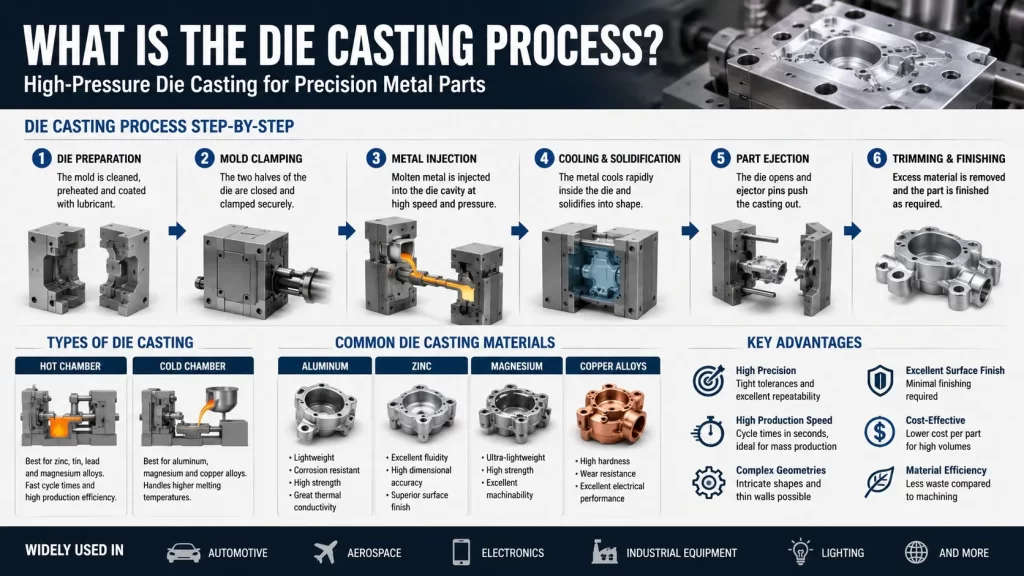
This guide will explain the die casting process, the various types of die casting, die casting materials, benefits of die casting, die casting limitations and when to consider it as the correct manufacturing solution for your next product. Typically, the procedure consists of high pressure injection of non-ferrous molten metal into reusable steel tooling to achieve quick manufacture of near-net-shape and accurate parts.
What Is Die Casting?
Die casting is a manufacturing process that injects molten metal into a precision-machined steel mold (called a die) under extremely high pressure. The mould is opened after the metal has hardened, the formed piece is ejected and the cycle is repeated.
Unlike sand casting, which features one-time use castable molds, die casting is a process that employs a hardened steel die that can be used many, many times and make thousands—or even hundreds of thousands—of identical parts with excellent dimensional accuracy.
It is used extensively in the production of aluminum, zinc, magnesium and copper alloy parts that need:
- Tight dimensional tolerances
- Smooth surface finishes
- Thin wall sections
- Complex geometries
- High production volumes
How Does the Die Casting Process Work?
There are a number of key stages in a typical manufacturing process, although they differ depending on the specific machine and alloy.
1. Die Preparation
Before production begins, the steel mold is:
- Cleaned thoroughly
- Heated to the proper operating temperature
- Coated with a release lubricant
Good lubrication involves better metal flow, extending the mold life, and part ejection.
2. Mold Clamping
The two halves of the die are tightly pressed and locked with powerful hydraulic clamping pressure that is strong enough to withstand the high pressure of injection.
Misalignment can lead to flash, leakage or dimensional issues.
3. Molten Metal Injection
The alloy is first melted in a furnace and then fed at extremely high speeds, and under high pressure into the die-cavity.
The injection pressure varies from a few thousand psi to more than 20,000 psi depending on the machine, all of the cavity being filled so that no corners are missed. The key characteristic of die casting is the high pressure injection into a reusable steel die.
4. Cooling and Solidification
The molten metal cools very quickly after being placed in the die.
The steel molds possess excellent dimensional stability and the solidification is very rapid (heat conductivity is good) which permits short production cycle.
5. Part Ejection
After cooling:
- The die opens
- Ejector pins push the casting out
- The machine prepares for the next cycle
For smaller parts, the entire sequence can be accomplished in a matter of seconds using a modern die casting machine!
6. Trimming and Finishing
After casting, there are runners, gates and flash that need to be removed.
Other finishing operations may be:
- CNC machining
- Deburring
- Sand blasting
- Shot blasting
- Powder coating
- Painting
- Anodizing
- Surface polishing
Die casting can give near net-shape parts for some precision parts, which only need little secondary processing.
Types of Die Casting Processes
Choosing the right process depends largely on the alloy and product requirements.
Hot Chamber Die Casting
Hot chamber die casting keeps the injection system submerged in molten metal.
Best for:
- Zinc alloys
- Tin alloys
- Lead alloys
- Some magnesium alloys
Advantages
- Extremely fast cycle times
- High production efficiency
- Lower operating costs
- Excellent for small precision components
Limitations
Not suitable for aluminum or copper alloys because their higher melting temperatures would damage the injection system.
Cold Chamber Die Casting
Cold chamber machines melt metal in a separate furnace before transferring it into the injection chamber.
Common materials
- Aluminum
- Magnesium
- Copper alloys
Advantages
- Handles higher melting temperatures
- Produces stronger structural components
- Ideal for automotive and industrial applications
Although slightly slower than hot chamber systems, cold chamber die casting remains the preferred method for aluminum manufacturing.
Common Materials Used in Die Casting
Aluminum
Aluminum is the most popular die casting material because it offers:
- Excellent strength-to-weight ratio
- Corrosion resistance
- Good thermal conductivity
- Electrical conductivity
- High dimensional stability
Typical applications include:
- Automotive housings
- LED lighting
- Motor enclosures
- Robotics
- Aerospace components
Zinc
Zinc provides:
- Outstanding casting fluidity
- Excellent surface finish
- High accuracy
- Superior impact resistance
Common applications include:
- Hardware
- Locks
- Consumer electronics
- Decorative parts
Magnesium
Magnesium is valued for:
- Ultra-light weight
- High strength
- Excellent machinability
Industries include:
- Automotive
- Aerospace
- Medical devices
Copper Alloys
Copper alloys deliver:
- High hardness
- Superior wear resistance
- Excellent electrical performance
These are commonly used in specialized industrial equipment.
Advantages of the Die Casting Process
Manufacturers choose die casting because it delivers exceptional production efficiency.
High Precision
Modern die casting produces tight tolerances with outstanding repeatability.
Excellent Surface Finish
Parts often require minimal finishing before assembly or coating.
High Production Speed
Production cycles are measured in seconds, making die casting ideal for mass manufacturing.
Complex Geometries
Thin walls, internal ribs, bosses, and intricate shapes can be produced in a single operation.
Material Efficiency
Compared with machining from solid stock, die casting significantly reduces material waste.
Lower Cost for High Volumes
Although tooling costs are relatively high, the cost per part decreases dramatically as production volume increases.
Limitations of Die Casting
Despite its many benefits, die casting is not suitable for every project.
Potential limitations include:
- High initial tooling investment
- Best suited for medium-to-high production volumes
- Limited to non-ferrous metals
- Tool modifications can be expensive
- Very large parts may require alternative manufacturing methods
For low-volume prototypes, CNC machining or 3D printing may be more economical.
Industries That Use Die Casting
Die casting serves nearly every manufacturing sector.
Automotive
Examples include:
- Engine blocks
- Transmission housings
- Steering components
- Electric vehicle battery housings
Aerospace
Manufacturers use die casting for:
- Lightweight structural parts
- Electronic housings
- Aircraft accessories
Consumer Electronics
Examples include:
- Laptop frames
- Smartphone housings
- Camera bodies
- Heat sinks
Industrial Equipment
Applications include:
- Pump housings
- Motor casings
- Hydraulic components
- Pneumatic systems
Lighting Industry
Die casting is widely used for:
- LED fixtures
- Street lighting
- Heat dissipation components
Die Casting vs. Other Manufacturing Processes
| Process | Best For | Advantages | Limitations |
|---|---|---|---|
| Die Casting | High-volume metal production | Fast, accurate, excellent finish | High tooling cost |
| CNC Machining | Precision prototypes | Tight tolerances, flexible | Higher material waste |
| Sand Casting | Large metal parts | Low tooling cost | Rougher finish |
| Investment Casting | Complex shapes | Excellent detail | Slower production |
| Injection Molding | Plastic parts | Very high productivity | Plastic materials only |
How to Choose the Right Die Casting Partner
The choice of supplier can have significant effect on the product quality and production efficiency.
Check for manufacturers who supply:
- Advanced die casting equipment
- In-house mold design
- CNC machining capabilities
- Strict quality inspection
- ISO-certified manufacturing systems
- Engineering support
- Rapid prototyping
- Global logistics
They can also support the optimization of part geometry for manufacturability and overall production cost by an experienced supplier.
Frequently Asked Questions
Is die casting suitable for low-volume production?
Generally, no. Due to the relatively high cost of tooling, die casting is most cost effective for medium to large production volumes.
What metals cannot be die cast?
Usually the melting points of the ferrous metals like steel and cast iron are high and therefore are not used.
Does die casting require machining afterward?
Trimming and minor finishing is required for many parts. Precision holes, threads or critical surface may need to be produced using CNC, however.
How accurate is die casting?
Today, the modern die casting process in general provides excellent dimensional consistency and can produce some complex parts with tight tolerances as required by some critical industries.
Final Thoughts
The die casting method continues to be one of the most productive ways for mass producing metal parts with tolerances. The use of durable, lightweight, and highly accurate re-usable parts can greatly benefit industries from automotive and aerospace to electronics and industrial equipment, with the integration of reusable steel molds and high-pressure metal injection, combined with rapid production cycles, giving manufacturers the advantage needed to produce durable, lightweight, and accurate parts.
While it is good for simple designs, parts with complicated features and geometry may need to be made by die casting when you need exceptional surface quality and cost-effective high volume manufacturing. By using an experienced partner for Die Casting, tooling can be optimized, quality can be guaranteed, and beginning with the prototype and up to large output production, a reliable flow can be ensured.
Talk to the Manufacturer, Not a Middleman
Resources & Insights
-
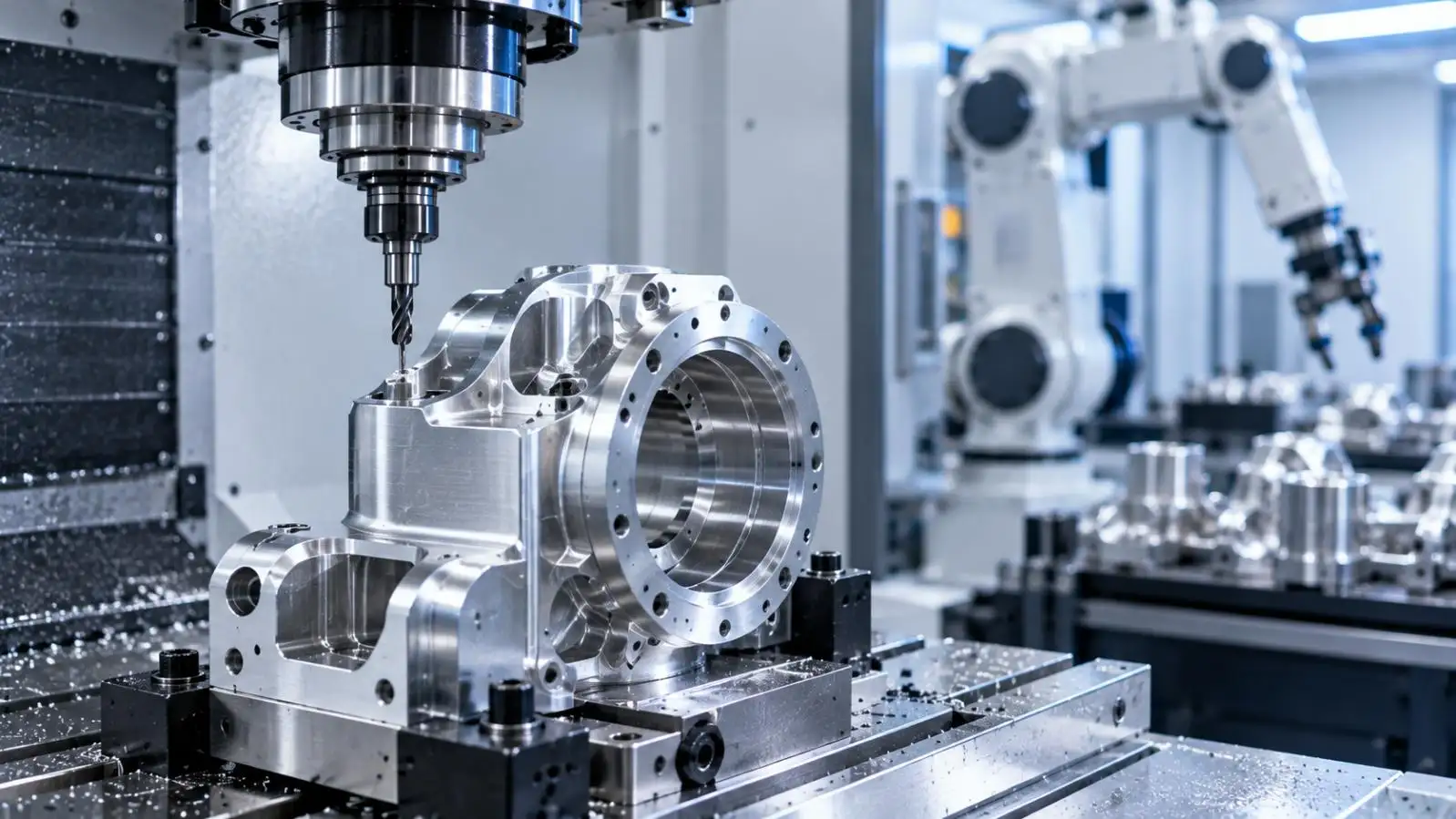 Hide blog post
CNC Machining Robotic Parts: How GD&T Controls Robot Assembly Accuracy
2026-09-24By KT Engineering -
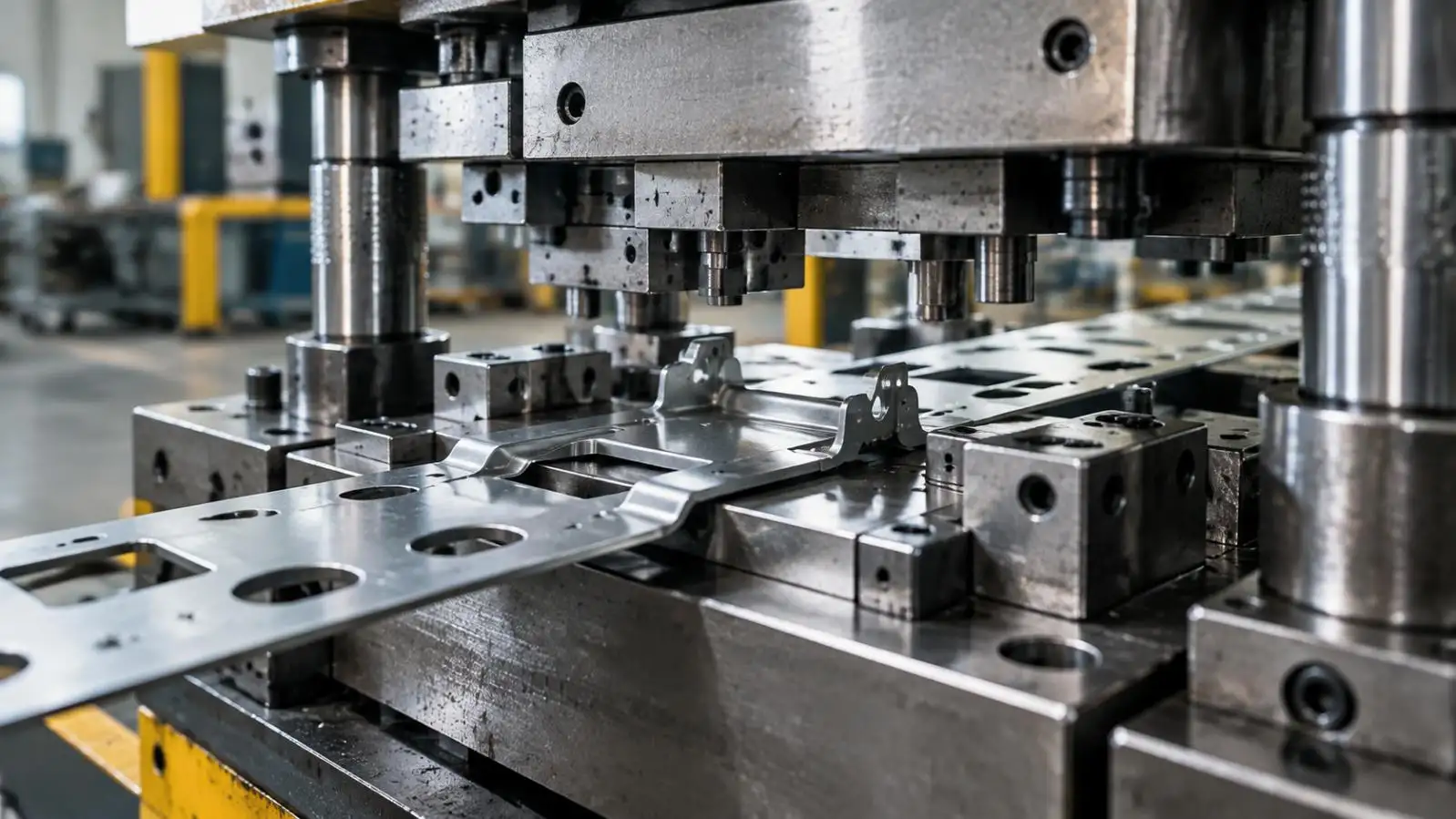 Hide blog post
Hardware Stamping Springback Control for High-Strength Steel Parts
2026-09-24By KT Engineering -
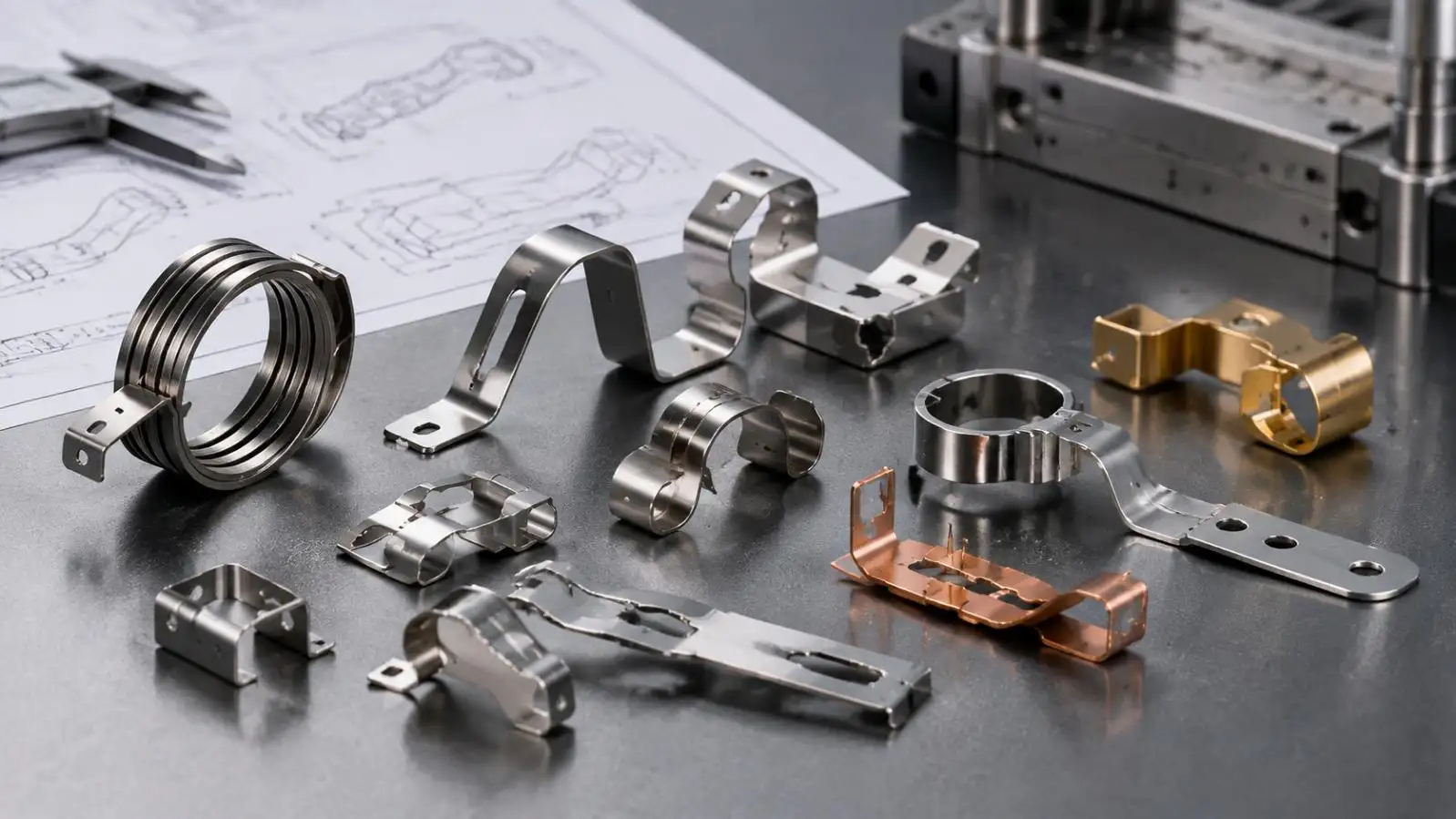 Hide blog post
Spring Stamping Fatigue Life: How Geometry, Material and Edge Quality Affect Cycle Life
2026-09-24By KT Engineering -
 Hide blog post
Mechanical Automation Parts for Robot End Effectors and Positioning Accuracy
2026-09-23By KT Engineering