Contact Us
  Home /
 what is die casting


Table of Contents
- What Is Die Casting?
- How the Die Casting Process Works
- Types of Die Casting
- Common Die Casting Materials
- Advantages of Die Casting
- Limitations of Die Casting
- Industries That Use Die Casting
- Die Casting vs Other Manufacturing Processes
- Design Considerations for Successful Die Casting
- Is Die Casting Right for Your Project?
- Conclusion

Die casting is among the most productive mass production processes for the high precision metal part production. This process can achieve excellent dimensional accuracy, smooth surface finish and excellent repeatability, such as the casing of car engine components and the housing of consumer electronic products. Die casting is still a favored manufacturing solution in a variety of applications that industries seek to deliver—lighter, more durable and cost-effective metal parts for manufacturers worldwide.
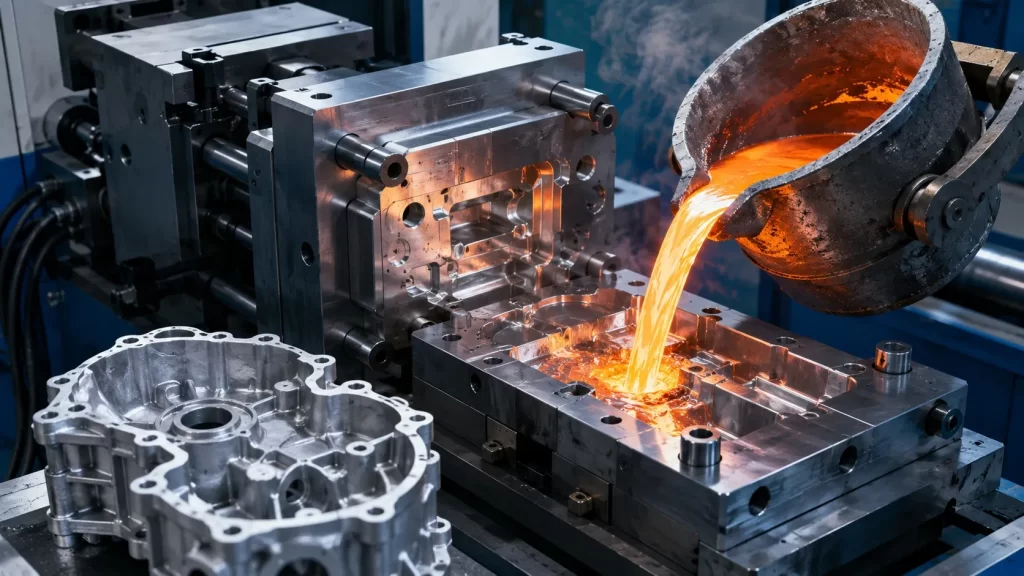
This detailed guide covers the die casting process, types of die casting processes, materials used in die casting, pros and cons of die casting, applications of die casting and when you should consider using die casting in your project.
What Is Die Casting?
Die casting is a method used for making metal parts that involves forcing molten non-ferrous metals into a hardened steel mold (die) at very high pressures. When the metal has cooled and cooled down to solid form, the mold is opened and a near net-shape component is ejected requiring little or no finishing operations.
Unlike conventional casting, that requires the use of permanent steel moulds, manufacturers can produce thousands (or even millions) of identical, high quality parts to exacting tolerances with die casting. The rapid, precise and repeatable production of this kind is perfect for mass production.
How the Die Casting Process Works
The die casting process typically has six steps, although the specific steps depend on the types of alloys and machines used.
1. Mold Preparation
Prior to manufacturing, the two sections of the steel die are cleaned and then coated with a release agent. The lubricant can reduce the mould temperature and facilitates easy removal of the moulded product after solidification.
2. Mold Clamping
The two halves of the die are tightly closed with a high-tonnage clamping system. This ensures no molten metal is lost when it is being injected.
3. Metal Injection
The molten metal is poured into the shot chamber at very high speed and pressure and flows into the mold cavity. High injection pressure ensures that all parts of the mold are being completely filled, even the extremely thin walls and complex parts.
4. Cooling and Solidification
The thermal conductivity of the steel die causes rapid cooling of the metal inside the mold. The temperature of the mould is controlled by the cooling channels, which are built in the mould to reduce cycle times and to provide dimensional stability.
5. Part Ejection
After the mold solidifies, the mold opens and the casting is ejected from the mold without causing any damage to the product.
6. Trimming and Finishing
Runners, gates and flash are removed and taken off. Further processing such as machining, polishing, powder coating, anodizing or plating may be done, depending on the product needs.
Types of Die Casting
There are two primary die casting methods.
Hot Chamber Die Casting
Hot chamber die casting keeps the injection mechanism submerged inside the molten metal.
Suitable materials
- Zinc alloys
- Magnesium alloys
- Lead alloys
- Tin alloys
Advantages
- Faster production cycles
- Lower operating costs
- Excellent for small precision parts
Limitations
Not appropriate for aluminum and copper alloys due to its high melting point which would affect the injection system.
Cold Chamber Die Casting
Cold chamber die casting is a type of die casting with a separate furnace. Before every shot the molten metal is ladled into the injecting chamber.
Suitable materials
- Aluminum alloys
- Copper alloys
- Brass
- Magnesium (certain applications)
Advantages
- Handles higher melting point alloys
- Better suited for structural components
- Common in automotive manufacturing
Cold chamber die casting is currently the dominant process for aluminum die casting production.
Common Die Casting Materials
Selecting the right alloy directly affects product performance, cost, and manufacturability.
Aluminum
Aluminum is the most widely used die casting material because it offers:
- Excellent strength-to-weight ratio
- Corrosion resistance
- High thermal conductivity
- Good electrical conductivity
- Outstanding machinability
Typical applications include:
- Automotive components
- LED lighting housings
- Motor housings
- Electronic enclosures
Zinc
Zinc alloys provide:
- Exceptional dimensional accuracy
- Excellent surface finish
- High ductility
- Lower casting temperatures
- Longer mold life
Common products include:
- Hardware
- Locks
- Consumer electronics
- Decorative components
Magnesium
Magnesium is among the lightest structural metals available.
Benefits include:
- Ultra-lightweight
- High strength
- Excellent vibration damping
- Easy machining
It is widely used in:
- Aerospace
- Medical devices
- Portable electronics
Copper Alloys
Copper-based die castings offer:
- High strength
- Excellent wear resistance
- Superior thermal conductivity
They are commonly used for industrial mechanical parts and electrical applications.
Advantages of Die Casting
Die casting offers numerous manufacturing benefits.
High Production Efficiency
Production cycles can often be completed within seconds, making die casting one of the fastest metal manufacturing processes available.
Excellent Dimensional Accuracy
Parts typically require little or no secondary machining because the process consistently achieves tight tolerances.
Superior Surface Finish
Die cast components leave the mold with smooth surfaces suitable for painting, powder coating, anodizing, or plating.
Complex Geometries
Thin walls, intricate ribs, bosses, and detailed features can all be produced in a single operation.
Material Utilization
Minimal waste is generated because runners and flash can often be recycled.
Cost-Effective for High Volumes
Although tooling costs are relatively high, the per-part cost decreases significantly in large production runs.
Limitations of Die Casting
Despite its many advantages, die casting is not suitable for every project.
High Initial Tooling Cost
Steel dies require precision machining, making tooling expensive for low-volume production.
Limited Material Selection
Die casting primarily uses non-ferrous metals. Steel and iron are generally unsuitable due to their high melting temperatures.
Porosity
High-speed filling may trap gases inside the casting, potentially affecting pressure-tightness or heat treatment performance.
Design Changes Can Be Expensive
Once tooling is manufactured, modifying the die can significantly increase project costs and lead times.
Industries That Use Die Casting
Die casting has become essential across many industries.
Automotive
Manufacturers produce:
- Engine covers
- Transmission housings
- Gearboxes
- Steering components
- Electric vehicle battery housings
Consumer Electronics
Examples include:
- Laptop frames
- Smartphone housings
- Camera bodies
- Heat sinks
Aerospace
Applications include lightweight structural components requiring excellent strength and dimensional precision.
Medical Equipment
Medical manufacturers use die casting for:
- Diagnostic equipment
- Instrument housings
- Surgical device components
Industrial Equipment
Industrial applications include:
- Pumps
- Valves
- Compressors
- Hydraulic systems
Die Casting vs Other Manufacturing Processes
| Process | Best For | Tooling Cost | Production Volume |
|---|---|---|---|
| Die Casting | High-volume precision metal parts | High | High |
| Sand Casting | Large or low-volume parts | Low | Low |
| Investment Casting | Complex precision components | Medium | Medium |
| CNC Machining | Custom prototypes and precision machining | Low | Low to Medium |
| Injection Molding | Plastic components | High | High |
If your project requires thousands of identical metal parts with excellent accuracy and surface finish, die casting is often the most economical choice.
Design Considerations for Successful Die Casting
Optimizing part design can significantly improve manufacturing quality and reduce costs.
Key recommendations include:
- Maintain uniform wall thickness.
- Include proper draft angles for easy ejection.
- Avoid unnecessary sharp corners.
- Add ribs instead of increasing wall thickness.
- Minimize undercuts whenever possible.
- Design for adequate metal flow and venting.
Early communication between product designers and die casting engineers can ensure that no problems arise with the tooling and that production costs are kept down.
Is Die Casting Right for Your Project?
Die casting is an excellent manufacturing solution if your project requires:
- Large production volumes
- Consistent part quality
- Tight dimensional tolerances
- Lightweight metal components
- Excellent cosmetic appearance
- Reduced secondary machining
If the prototype is low volume, or in high turnover, CNC machining or investment casting might offer more flexibility.
Conclusion
Today, die casting is one of the most significant manufacturing technologies used to manufacture high quality metal parts in volume. This offers exceptional dimensional accuracy, repeatability, and surface quality at high speed, so that manufacturers can strive to satisfy stringent performance specifications with low production costs over the long term.
When creating automotive components, industrial equipment, consumer electronics or aerospace parts, it is important to understand the die casting process so that the best manufacturing technique is chosen. By carefully selecting the right parts and working with a manufacturer that isn't just knowledgeable but has a proven track record, you can rest assured of quality, speed and reduced total cost of ownership for your next project.
Talk to the Manufacturer, Not a Middleman
Resources & Insights
-
 Hide blog post
CNC Machining Robotic Parts: How GD&T Controls Robot Assembly Accuracy
2026-09-24By KT Engineering -
 Hide blog post
Hardware Stamping Springback Control for High-Strength Steel Parts
2026-09-24By KT Engineering -
 Hide blog post
Spring Stamping Fatigue Life: How Geometry, Material and Edge Quality Affect Cycle Life
2026-09-24By KT Engineering -
 Hide blog post
Mechanical Automation Parts for Robot End Effectors and Positioning Accuracy
2026-09-23By KT Engineering