Contact Us
  Home /
 What Is a five Axis CNC Machine?


Table of Contents
- What Is a 5-Axis CNC Machine?
- Understanding the Five Axes
- How Does a 5-Axis CNC Machine Work?
- Types of 5-Axis CNC Machines
- Key Advantages of 5-Axis CNC Machining
- Industries That Use 5-Axis CNC Machines
- 3-Axis vs. 5-Axis CNC Machining
- How Much Does a 5-Axis CNC Machine Cost?
- Is a 5-Axis CNC Machine Worth It?
- Best Practices for Successful 5-Axis Machining
- Conclusion

Today's manufacturing requires more precision, speed and flexibility in the design than ever before. Although the traditional 3-axis CNC machine is still the staple of many machine shops, the increased complexity of components used in the aerospace, medical, automotive and electronics industries are calling for more advanced machining. That's where 5-axis CNC Machining comes in.
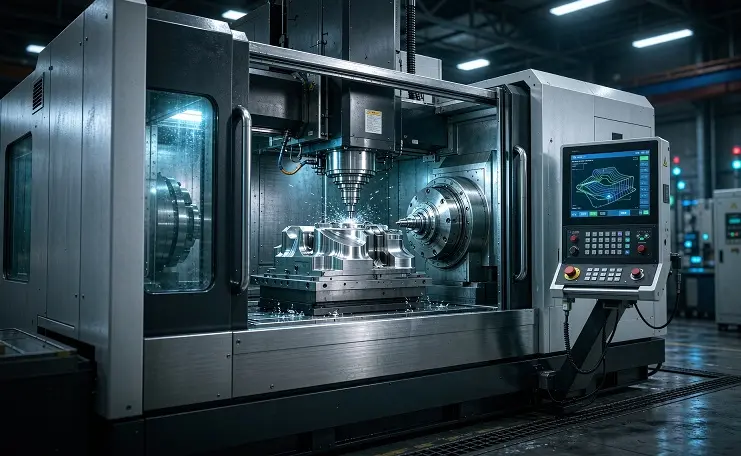
The 5-axis CNC machine is an important tool for manufacturing complex parts with high precision, which can help to save time, enhance surface quality and increase production efficiency. Here, you'll discover the ins and outs of 5-axis CNC machines, including the benefits, uses, expenses, and whether or not they are a worthwhile investment for your manufacturing company. The article relies on industry practices and technical references that are current.
What Is a 5-Axis CNC Machine?
The 5-axis CNC machine is an advanced type of computer-controlled milling machine that can move the cutting tool or a workpiece along five different axes at the same time. A 5-axis machine process can be performed in any direction, including two axis of rotation in addition to the X, Y and Z movements found in standard 3-axis machining.
The increased flexibility of this motion allows manufacturers to produce very complex shapes and geometries in a single machine setup, saving on time and reducing mistakes.
Reduced cumulative positioning errors and shortened production cycles can be achieved, since fewer repositioning operations are needed.
Understanding the Five Axes
A 5-axis CNC machine combines three linear axes with two rotary axes.
X-Axis
Moves the cutting tool left and right across the workpiece.
Y-Axis
Moves the tool forward and backward.
Z-Axis
Controls vertical movement, determining cutting depth.
Rotary Axis (A or B)
Rotates the workpiece or spindle around either the X-axis or Y-axis, depending on machine design.
Rotary Axis (C)
Provides rotation around the Z-axis, allowing the cutting tool to reach multiple faces without manual repositioning.
Different machine configurations use different combinations of rotary axes, such as A+C or B+C, depending on whether the machine features a trunnion table or swivel head.
How Does a 5-Axis CNC Machine Work?
The first step in the machining process is to create a CAD model by engineers or product designers. This digital model is fed into CAM software to produce optimized toolpaths for the machine.
These instructions are passed on to the CNC controller which interprets and synchronizes all 5 axes at once. A servo motor keeps the cutting tool in the desired position and orientation with micron-level accuracy.
5-axis machining can be more effective than traditional machine techniques, which typically involve multiple fixtures and setups, since a large number of parts can often be produced by a single operation.
In general, the workflow is as follows:
- CAD design
- CAM programming
- Toolpath simulation
- Machine setup
- Simultaneous five-axis machining
- Quality inspection
This integrated workflow helps manufacturers reduce production time while maintaining consistent dimensional accuracy.
Types of 5-Axis CNC Machines
There are several common machine configurations available.
Trunnion Style
The worktable rotates and tilts while the spindle remains fixed.
Advantages
- Excellent rigidity
- High positioning accuracy
- Ideal for aerospace components
Swivel Head
The spindle tilts while the worktable remains stationary.
Advantages
- Suitable for large workpieces
- Greater machining envelope
- Improved accessibility
Hybrid Configuration
Some high-end machines combine rotary tables with rotating spindle heads to maximize flexibility for complex manufacturing.
Key Advantages of 5-Axis CNC Machining
1. Reduced Setup Time
Traditional machining often requires several fixtures and multiple operations to machine different sides of a component.
A 5-axis machine can access nearly every surface in one setup, dramatically reducing production time.
2. Higher Precision
Each time a workpiece is repositioned, there is potential for alignment errors.
Single-setup machining minimizes cumulative inaccuracies and improves dimensional consistency.
3. Superior Surface Finish
The cutting tool can maintain an optimal angle throughout machining, reducing vibration and tool deflection.
The result is:
- Smoother surfaces
- Better edge quality
- Less polishing
- Reduced secondary finishing
4. Complex Geometry Capability
5-axis machining excels at producing:
- Deep cavities
- Organic curves
- Turbine blades
- Medical implants
- Aerospace brackets
- Impellers
- Mold components
Many of these features would be impossible—or extremely expensive—to manufacture using standard 3-axis equipment.
5. Longer Tool Life
Because shorter cutting tools can be used at optimal angles, vibration decreases and tool wear is minimized.
Benefits include:
- Longer tool life
- Lower tooling costs
- Better cutting stability
6. Increased Productivity
Completing more machining operations in one setup reduces:
- Labor costs
- Machine downtime
- Fixture changes
- Inspection time
Manufacturers can produce more parts with fewer resources.
Industries That Use 5-Axis CNC Machines
Aerospace
Aircraft manufacturers require lightweight components with extremely tight tolerances.
Typical applications include:
- Turbine blades
- Engine housings
- Structural brackets
- Airframe components
Medical
Medical devices often feature highly intricate shapes requiring exceptional precision.
Examples include:
- Orthopedic implants
- Dental components
- Surgical instruments
- Prosthetics
Automotive
Automotive manufacturers use 5-axis machining for:
- Prototype parts
- Cylinder heads
- Performance components
- Transmission housings
Electronics
Precision aluminum housings, heat sinks, and custom enclosures benefit from five-axis machining.
Mold & Die Manufacturing
Complex molds with deep cavities and freeform surfaces can be machined much faster using simultaneous 5-axis technology.
3-Axis vs. 5-Axis CNC Machining
| Feature | 3-Axis CNC | 5-Axis CNC |
|---|---|---|
| Linear Movement | X, Y, Z | X, Y, Z |
| Rotary Movement | None | Two rotary axes |
| Complex Geometry | Limited | Excellent |
| Number of Setups | Multiple | Usually one |
| Surface Finish | Good | Excellent |
| Machining Speed | Moderate | Faster overall |
| Programming Difficulty | Lower | Higher |
| Equipment Cost | Lower | Higher |
Although 3-axis machines remain ideal for many simple components, 5-axis machining becomes significantly more efficient when manufacturing intricate or multi-sided parts.
How Much Does a 5-Axis CNC Machine Cost?
Investment varies depending on:
- Machine size
- Working envelope
- Spindle speed
- Automation level
- Controller features
- Brand reputation
Typical price ranges include:
- Entry-level systems: $100,000–$250,000
- Mid-range industrial machines: $250,000–$600,000
- High-end production centers: $600,000–$1 million+
Beyond the purchase price, buyers should also consider:
- Installation
- Tooling
- CAM software
- Operator training
- Maintenance
- Automation systems
Despite the higher initial investment, many manufacturers achieve long-term savings through improved productivity and reduced labor costs.
Is a 5-Axis CNC Machine Worth It?
A 5-axis CNC machine is an excellent investment if your business regularly produces:
- High-precision components
- Complex geometries
- Low-volume, high-value parts
- Aerospace products
- Medical devices
- Custom prototypes
For simple flat parts or simple basic equipment when large quantities are being produced, however, traditional 3 axis equipment might be the more economical option.
Factors to consider are production volume, part complexity and future growth plans to decide on the best option.
Best Practices for Successful 5-Axis Machining
To maximize machining performance:
- Use advanced CAM software with collision detection.
- Select cutting tools optimized for simultaneous machining.
- Secure workpieces using rigid fixturing systems.
- Regularly calibrate machine geometry.
- Train operators on multi-axis programming.
- Optimize cutting parameters to reduce tool wear.
These practices enhance the quality of the parts and reduce the production costs.
Conclusion
The 5 axis CNC machine is among the greatest innovations in contemporary manufacturing. It features three linear axes and two rotary motions to allow the manufacturer to machine highly complex parts using a single set up, yet at the same time achieving greater precision, less tool setup time and superior surface quality.
While the upfront cost of 5-axis manufacturing machines is significantly higher than traditional CNC machines, the benefits they offer in terms of efficiency, flexibility, and precision make them a valuable investment for manufacturing businesses that demand high-quality products and rapid production times.
From manufacturing aerospace parts, medical implants, precision molds to advanced industrial components, 5-axis CNC technology can give you a significant competitive edge and ensure your manufacturing process is ready for future production challenges.
Talk to the Manufacturer, Not a Middleman
Resources & Insights
-
 Hide blog post
CNC Aluminum Components: How Surface Finish Affects Anodizing Quality
2026-08-18By KT Engineering -
 Hide blog post
Stamping Supplier in China: Dongguan Precision Tooling and Metal Stamping Guide
2026-08-18By KT Engineering -
 Hide blog post
Cabinet Cover Components: Lightweight, Modular and Smart Enclosure Design Guide
2026-08-17By KT Engineering -
 Hide blog post
Connector Mold Components for Automotive High-Voltage Connectors
2026-08-16By KT Engineering