Contact Us
  Home /
 10 CNC Milling Projects to Improve Your Machining Skills


Table of Contents
- Why Practice CNC Milling Projects?
- 1. Precision Machine Vise Soft Jaws
- 2. Aluminum Nameplate
- 3. Machinist Hammer
- 4. Tool Organizer Block
- 5. Custom Phone Stand
- 6. Gear or Timing Pulley
- 7. Engine Cylinder Head Model
- 8. Custom Mechanical Keyboard Plate
- 9. Aerospace-Style Bracket
- 10. Multi-Sided Machined Cube
- Best Materials for CNC Milling Practice
- Tips for Successful CNC Milling Projects
- Common Mistakes Beginners Should Avoid
- How CNC Milling Projects Build Career Skills
- Final Thoughts

Known for its versatility, CNC milling is a manufacturing process used in various industries like aerospace, automotive, electronics, robotics, and product development. From the moment you start using CNC machines for the first time until you expand your knowledge and programming repertoire, practical projects are the quickest way to learn how to select tools, workpieces, workholding, and program the machines.
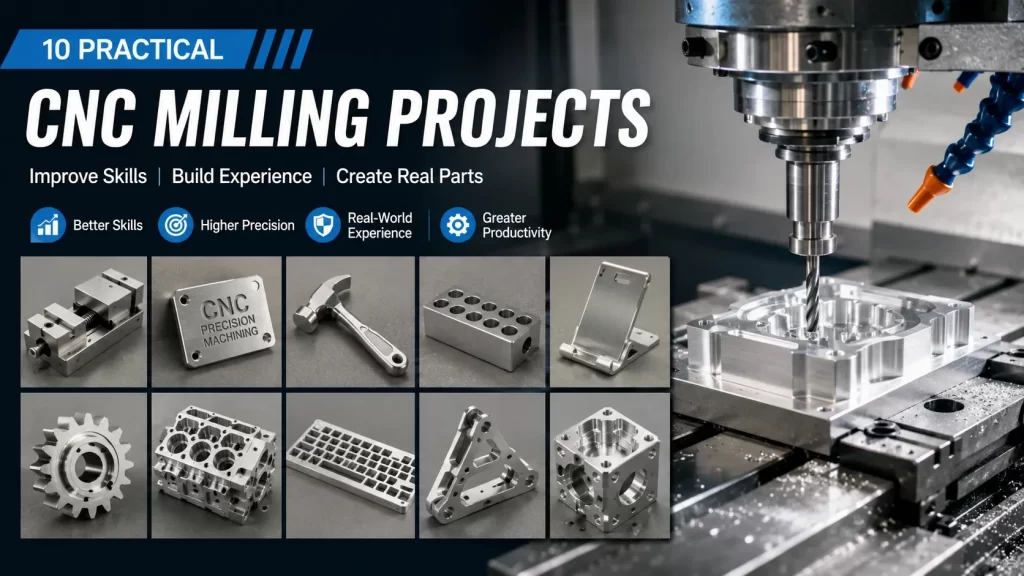
As you work your way through increasingly difficult CNC milling tasks, you'll have the opportunity to learn about using CAD/CAM software, G-code programming, feeds and speeds, surface finish, and dimensional accuracy. Many machining instructors believe in the project-based learning approach, as it helps to build confidence and problem-solving skills.
In this guide, we'll look at 10 of the best CNC milling projects for beginners and experts alike to learn from, from simple to high precision.
Why Practice CNC Milling Projects?
Each machining operation is a learning experience, and more than just about taking material.
You will have a better grasp of the following:
- CAD modeling
- CAM toolpath generation
- Workholding techniques
- Cutter selection
- Material behavior
- Surface finish optimization
- Tolerance control
- Machine setup
- Inspection methods
As opposed to rote learning about machining theory, every project works to reinforce a practical manufacturing knowledge that can be utilized in manufacturing settings.
1. Precision Machine Vise Soft Jaws
One of the first projects all machinists can make is a soft jaw.
Skills Learned
- Pocket milling
- Facing operations
- Drilling and tapping
- Precision locating
- Parallelism control
Soft jaws can be customized for unique workpieces and reused in future machining jobs.
Recommended Material
- Aluminum 6061
- Mild steel
2. Aluminum Nameplate
A custom engraved nameplate introduces beginners to engraving and profile machining.
Skills Learned
- Text engraving
- Contour milling
- Chamfering
- Tool offsets
- Finishing passes
Add logos, serial numbers, QR codes, or decorative patterns to increase project complexity.
3. Machinist Hammer
A CNC-machined hammer combines several machining operations into one project.
Typical features include:
- Curved surfaces
- Pocket milling
- Drilled handle hole
- Edge chamfers
- Surface finishing
Skills Practiced
- 3D contour machining
- Adaptive clearing
- Ball nose finishing
- Multi-tool operations
4. Tool Organizer Block
Every machine shop benefits from organized cutting tools.
Machine a tool holder with holes sized for:
- End mills
- Center drills
- Reamers
- Taps
- Edge finders
Skills Learned
- Hole patterns
- Coordinate positioning
- Peck drilling
- Circular interpolation
This project also improves shop organization.
5. Custom Phone Stand
A phone stand combines functionality with attractive industrial design.
Possible features include:
- Angled support
- Charging cable slot
- Company logo engraving
- Rounded edges
- Lightweight pocketing
Materials
- Aluminum
- Hardwood
- Plastic
- Brass
This project teaches design for manufacturability while producing a useful finished product.
6. Gear or Timing Pulley
Intermediate machinists often practice with gears or pulleys.
These parts require careful attention to dimensional accuracy.
Skills Learned
- Circular pocketing
- Bore machining
- Rotary positioning
- Precision finishing
- Tight tolerances
Although gear profiles may require specialized software, timing pulleys provide excellent machining practice.
7. Engine Cylinder Head Model
Miniature engine components introduce more advanced machining concepts.
Operations may include:
- Multiple setups
- Deep pocket machining
- Thread milling
- Precision drilling
- Surface finishing
Projects like these improve planning and fixture design.
8. Custom Mechanical Keyboard Plate
Mechanical keyboards remain popular among makers and engineers.
A keyboard plate requires:
- Precise switch openings
- USB connector clearance
- Mounting holes
- Decorative chamfers
Skills Learned
- Thin material machining
- Profile cutting
- Fixture design
- Burr control
Laser engraving can also personalize the finished product.
9. Aerospace-Style Bracket
Structural brackets closely resemble production CNC components.
Typical features include:
- Weight reduction pockets
- Precision mounting holes
- Counterbores
- Complex profiles
- Multiple machining operations
Skills Practiced
- Adaptive toolpaths
- High-speed machining
- Corner finishing
- Tolerance inspection
These projects simulate real manufacturing environments.
10. Multi-Sided Machined Cube
One of the most challenging CNC milling projects is a precision cube machined on multiple faces.
Features may include:
- Pockets
- Chamfers
- Slots
- Engraving
- Threaded holes
- Complex geometry
Skills Learned
- Multiple work offsets
- Re-fixturing
- Coordinate systems
- Positional accuracy
- Process planning
Completing this project demonstrates advanced CNC capability.
Best Materials for CNC Milling Practice
Different materials help develop different machining skills.
| Material | Difficulty | Best For |
|---|---|---|
| MDF | Very Easy | Learning toolpaths |
| HDPE | Easy | Plastics machining |
| Delrin (POM) | Easy | Precision practice |
| Aluminum 6061 | Medium | General machining |
| Brass | Medium | Fine finishing |
| Mild Steel | Advanced | Industrial applications |
| Stainless Steel | Advanced | Production machining |
| Titanium | Expert | Aerospace components |
Beginners should master aluminum before moving to harder metals.
Tips for Successful CNC Milling Projects
Regardless of project complexity, following best practices improves both quality and efficiency.
Plan Before Cutting
Always verify:
- CAD model
- CAM simulation
- Tool lengths
- Work offsets
- Material dimensions
Simulation helps identify potential collisions before machining begins.
Choose the Right Cutting Tools
Common tooling includes:
- Flat end mills
- Ball nose end mills
- Chamfer mills
- Spot drills
- Twist drills
- Thread mills
Using the correct tool reduces chatter and improves surface finish.
Optimize Feeds and Speeds
Proper spindle speed and feed rate depend on:
- Material
- Tool diameter
- Number of flutes
- Tool coating
- Machine rigidity
Incorrect parameters can shorten tool life and reduce part quality.
Secure Workpieces Properly
Poor workholding causes vibration, inaccurate dimensions, and broken cutters.
Common options include:
- Machine vises
- Toe clamps
- Fixture plates
- Vacuum tables
- Soft jaws
Common Mistakes Beginners Should Avoid
New machinists frequently encounter these problems:
- Using excessive cutting depth
- Incorrect work offsets
- Poor tool selection
- Forgetting simulation
- Insufficient workholding
- Running aggressive feed rates
- Ignoring chip evacuation
- Measuring only after machining
Learning from these mistakes is part of developing CNC expertise.
How CNC Milling Projects Build Career Skills
Project-based learning is like actual manufacturing process.
For each section completed, the skills reinforced are:
- CAD design
- CAM programming
- CNC operation
- Machine setup
- Quality inspection
- Production planning
- Manufacturing efficiency
If you are looking to launch a machining career, run a prototype shop or establish a CNC manufacturing company, a robust work history and portfolio of finished work proves your practical skills.
Final Thoughts
It's impossible to acquire CNC Milling Knowledge solely through theory, it needs to be practiced regularly. Simple projects like engraved nameplates or tool organizers can help build confidence and expand technical knowledge as they are solved, leading to more complex aerospace brackets or multi-sided precision parts.
The more you practice, the more you will master in regard to machining strategies, fixture design, tool selection, and quality control, which will directly impact productivity and manufacturing outcomes. These CNC milling projects are great for hobbyists, students or even professional machinists to embark on a journey to learn modern CNC manufacturing.
Talk to the Manufacturer, Not a Middleman
Resources & Insights
-
 Hide blog post
CNC Aluminum Components: How Surface Finish Affects Anodizing Quality
2026-08-18By KT Engineering -
 Hide blog post
Stamping Supplier in China: Dongguan Precision Tooling and Metal Stamping Guide
2026-08-18By KT Engineering -
 Hide blog post
Cabinet Cover Components: Lightweight, Modular and Smart Enclosure Design Guide
2026-08-17By KT Engineering -
 Hide blog post
Connector Mold Components for Automotive High-Voltage Connectors
2026-08-16By KT Engineering