Contact Us
  Home /
 CNC Precision Machining


Table of Contents
- What Is CNC Precision Machining?
- How CNC Precision Machining Works
- Types of CNC Precision Machining
- Materials Suitable for CNC Precision Machining
- Industries That Depend on Precision CNC Machining
- Advantages of CNC Precision Machining
- Precision CNC Machining vs Conventional Machining
- Factors That Affect Machining Precision
- How to Choose a CNC Precision Machining Supplier
- Future Trends in CNC Precision Machining
- Frequently Asked Questions
- Conclusion

Precision manufacturing has become a vital asset for businesses that require accuracy, consistency, and reliability. Manufacturers are counting on CNC precision machining to create complex parts with exceptional dimensional accuracy and repeatability across a variety of industries, including aerospace components, medical devices, automotive systems and consumer electronics.
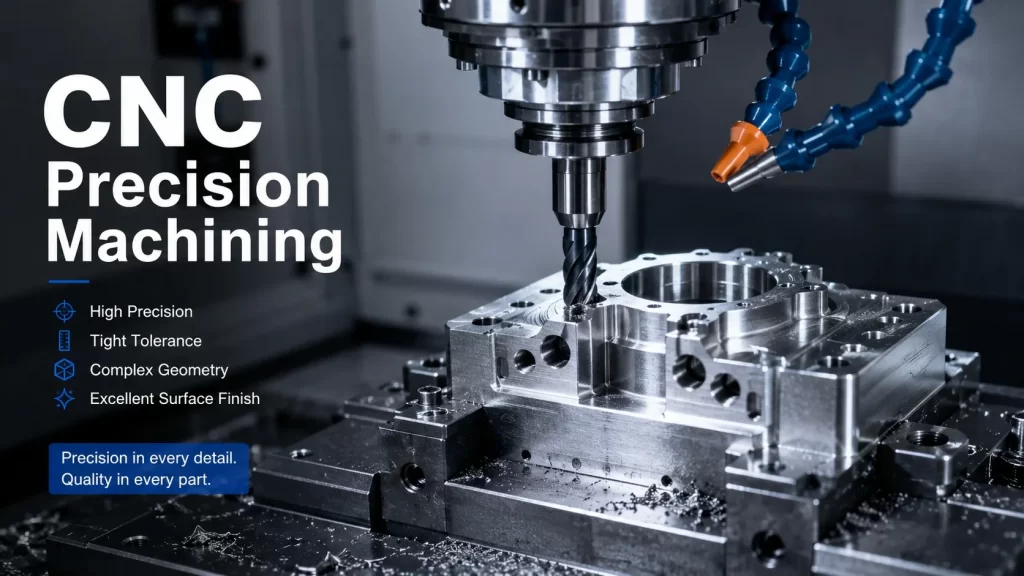
What Is CNC Precision Machining?
CNC precision machining is a subtractive manufacturing method where material is cut from a work piece by a highly accurate cutting tool, which is controlled by a computer. CNC is an acronym for Computer Numerical Control, where all movements made by the machine are controlled by digitally stored instructions that are produced by CAD and CAM software.
Compared to traditional manual processing, the CNC precision machining has the following advantages:
- Extremely tight dimensional tolerances
- High repeatability
- Superior surface finishes
- Automated production
- Consistent quality across production runs
The first aim is to produce parts to strict engineering tolerances with little variation even at high production volumes.
How CNC Precision Machining Works
A well-defined process is used in modern CNC machining to convert a digital design into a finished product.
1. CAD Design
The engineers develop a 2D or 3D design on Computer-Aided Design (CAD) software. All dimensions, holes, radius and features are clearly specified.
2. CAM Programming
The CAD file is then transferred to the Computer-Aided Manufacturing (CAM) software program, where machining strategies, cutting speeds, toolpaths, and the selection of tools are created.
The CAM software generates G code which is the programming language that is used to control the CNC machine.
3. Machine Setup
Before machining begins, operators prepare the machine by:
- Installing cutting tools
- Securing the workpiece
- Setting work offsets
- Calibrating the spindle
- Checking coolant systems
Proper setup is essential for maintaining precision.
4. Machining Process
Automatic operations are performed in the CNC machine such as Milling, drilling, boring, tapping, contouring, and finishing, the automatic operation is based on the programmed operation.
5. Inspection and Quality Control
Finished components are inspected using advanced measuring equipment such as:
- Coordinate Measuring Machines (CMM)
- Digital calipers
- Micrometers
- Optical inspection systems
- Surface roughness testers
Only parts meeting specification proceed to delivery.
Types of CNC Precision Machining
Different machining methods are selected depending on the geometry and functional requirements of the component.
CNC Milling
CNC milling uses rotating cutting tools to remove material from a stationary workpiece.
Typical milling operations include:
- Face milling
- End milling
- Pocket milling
- Slot milling
- Surface profiling
- 3-axis machining
- 4-axis machining
- 5-axis machining
Milling is ideal for producing complex shapes with excellent dimensional accuracy.
CNC Turning
Turning rotates the workpiece while a cutting tool shapes the outer or inner diameter.
Common turning operations include:
- Facing
- Grooving
- Threading
- Boring
- Parting
Turning is commonly used for shafts, bushings, fittings, and cylindrical components.
CNC Drilling
Drilling creates highly accurate holes using rotating drill bits.
Additional hole-making operations include:
- Reaming
- Countersinking
- Counterboring
- Tapping
Multi-Axis Machining
Modern machining centers often feature:
- 4-axis machining
- 5-axis machining
Multi-axis systems reduce setup time while improving accuracy for highly complex parts.
Materials Suitable for CNC Precision Machining
One of CNC machining's greatest strengths is material flexibility.
Metals
- Aluminum
- Stainless Steel
- Carbon Steel
- Tool Steel
- Brass
- Copper
- Titanium
- Magnesium
Plastics
- ABS
- POM (Delrin)
- Nylon
- PTFE
- Acrylic
- Polycarbonate
- PEEK
- PVC
Specialty Materials
- Carbon Fiber Composites
- Engineering Ceramics
- Graphite
Material selection depends on strength requirements, corrosion resistance, thermal performance, weight, and manufacturing cost.
Industries That Depend on Precision CNC Machining
Aerospace
Aircraft components require lightweight materials and strict tolerances to ensure safety and reliability.
Typical aerospace parts include:
- Engine components
- Structural brackets
- Sensor housings
- Landing gear components
Medical Devices
Medical manufacturers require precision parts with outstanding surface quality.
Applications include:
- Surgical instruments
- Orthopedic implants
- Dental equipment
- Diagnostic devices
Automotive
Automotive manufacturers use CNC machining for:
- Engine blocks
- Transmission parts
- Suspension components
- Brake systems
- Electric vehicle components
Electronics
Miniaturized electronic products demand extremely accurate machining.
Examples include:
- Heat sinks
- Connectors
- Semiconductor fixtures
- Enclosures
Industrial Equipment
Precision machining supports:
- Robotics
- Automation equipment
- Packaging machinery
- Hydraulic systems
- Pneumatic equipment
Advantages of CNC Precision Machining
Outstanding Accuracy
Modern CNC equipment can consistently maintain extremely tight tolerances, making it suitable for mission-critical components.
Excellent Repeatability
Thousands of identical parts can be manufactured with virtually identical dimensions.
High Productivity
Automated machining significantly reduces production time while increasing throughput.
Superior Surface Finish
Advanced cutting strategies minimize secondary finishing operations.
Lower Manufacturing Costs
Although machine investment is high, automation reduces labor costs and material waste over time.
Greater Design Flexibility
Complex geometries that would be difficult or impossible to produce manually become achievable.
Enhanced Safety
Operators supervise the machining process rather than manually controlling cutting tools, reducing workplace risks.
Precision CNC Machining vs Conventional Machining
| Feature | CNC Precision Machining | Conventional Machining |
|---|---|---|
| Accuracy | Extremely high | Moderate |
| Repeatability | Excellent | Operator dependent |
| Automation | Fully programmable | Mostly manual |
| Production Speed | High | Lower |
| Complex Geometry | Excellent | Limited |
| Labor Requirement | Lower | Higher |
| Quality Consistency | Excellent | Variable |
Factors That Affect Machining Precision
Several variables influence the final quality of machined components:
- Machine rigidity
- Spindle accuracy
- Cutting tool quality
- Tool wear
- Fixture stability
- Programming strategy
- Thermal expansion
- Coolant management
- Material properties
- Operator experience
Professional machining shops continuously monitor these factors to maintain consistent results.
How to Choose a CNC Precision Machining Supplier
Selecting the right manufacturing partner is essential for achieving consistent quality.
Consider the following:
- Experience with your industry
- ISO-certified quality management systems
- Advanced CNC equipment
- Multi-axis machining capabilities
- Material expertise
- Inspection equipment
- Rapid prototyping services
- Flexible production volumes
- Engineering support
- Reliable delivery performance
A supplier with strong technical expertise can help optimize part design, reduce manufacturing costs, and improve production efficiency.
Future Trends in CNC Precision Machining
The manufacturing industry continues to evolve through digital technologies.
Emerging trends include:
- AI-assisted machining optimization
- Smart factory integration
- Industrial IoT monitoring
- Automated tool management
- Digital twins
- Predictive maintenance
- Advanced CAM software
- Hybrid manufacturing combining CNC and additive manufacturing
These innovations improve efficiency, reduce downtime, and enable even greater machining precision.
Frequently Asked Questions
What is CNC precision machining?
It is a computer-aided manufacturing process whereby material is removed from a part to generate a part which has very narrow tolerances and a high degree of accuracy.
What industries use CNC precision machining?
The key industries include aerospace, medical, automotive, electronics, robotics, industrial equipment, defense, and energy.
What materials can be machined?
These are commonly made from aluminum, stainless steel, brass, titanium, engineering plastics, carbon fiber composites and specialty alloys.
What is the difference between CNC milling and CNC turning?
CNC Milling: The cutting tool is rotated while the workpiece is stationary. In the CNC turning process, the cutting tool is stationary, and the workpiece is rotated.
Why is precision machining important?
Precision machining guarantees the components are produced to the necessary specifications, which can boost the quality of the products, the accuracy of their assembly, their reliability during operation and their performance in the long term.
Conclusion
CNC precision machining has revolutionized modern manufacturing with its unparalleled accuracy, repeatability and production efficiency. From one piece to thousands of production parts, CNC technology can make complex parts consistently in a wide variety of industries, including aerospace, medical, automotive, electronics and industrial automation.
With ongoing innovations in manufacturing technologies, CNC precision machining will continue to play a pivotal role in high-performance production processes, allowing companies to create higher quality products, accelerate product development, and remain competitive in a global marketplace that demands top-notch quality.
Talk to the Manufacturer, Not a Middleman
Resources & Insights
-
 Hide blog post
CNC Aluminum Components: How Surface Finish Affects Anodizing Quality
2026-08-18By KT Engineering -
 Hide blog post
Stamping Supplier in China: Dongguan Precision Tooling and Metal Stamping Guide
2026-08-18By KT Engineering -
 Hide blog post
Cabinet Cover Components: Lightweight, Modular and Smart Enclosure Design Guide
2026-08-17By KT Engineering -
 Hide blog post
Connector Mold Components for Automotive High-Voltage Connectors
2026-08-16By KT Engineering