Contact Us
  Home /
 Precision Tolerances in LED Mold Components: How Micron-Level Accuracy Improves Light Quality


Table of Contents
- Importance of Precision in LED Optical Components
- The Relationship Between Mold Precision and LED Optical Performance
- Typical Precision Requirements for LED Mold Components
- KT's Manufacturing Approach for LED Mold Components
- Maintaining Optical Consistency for Mass Production
- Integration of Secondary Processes Without Compromising Quality

The effectiveness of an LED lighting system is determined by its chip and by plastic optical components such as lenses, reflectors, and light guides. These components are manufactured using precision injection molding and require strict stability in geometry, surface quality, and consistency in production.
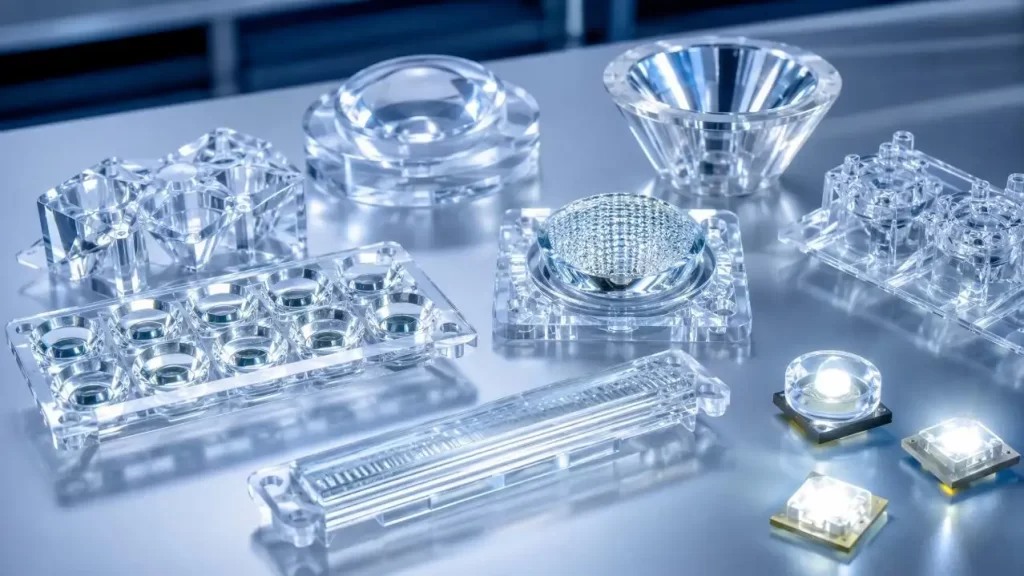
Dimensional tolerances are critical in controlling efficiency in optics, uniformity and distribution of illumination, and consistency in performance of the LED across its life cycle and in all produced samples.
Importance of Precision in LED Optical Components
Control of light in an optical system is achieved by molding, reflecting, and transmitting light, and is dependent on the accuracy of the geometry of the molding.
That accuracy also defines the performance of the optical system.
Optical Surface Accuracy
The distribution of the light beam is determined by the surface profile and the curvature of the lens.
A deviation from the ideal lens geometry will result in a change in the designed light distribution and will have the following effects:
• Variation in the consistency of the beam angle
• Coverage of illumination will be uneven
• Variation in the distribution of light intensity
• Visual comfort will be compromised
Consistency in cavity machining and polishing is critical to achieve the design of precision optical lenses.
Wall Thickness Control
The effective guidance of light in a light guide or planar optical element requires precise control of the element's wall thickness.
• Brightness may vary
• Dark spots may appear
• Light transmission will be compromised
• The appearance will be uneven
Consistent molding conditions and an optimized cooling design help reduce thickness variation during production.
Micro-Feature Position Accuracy
State-of-the-art LED products often have micro- lenses, patterns, or structures in the products.
In multi-component optical arrays, small positional differences can adversely affect:
• Uniformity of the beam,
• Light mixing, and
• Variations in the consistency of the product.
Consistent high precision of molding technology enables replication of features in a consistent manner across all produced items.
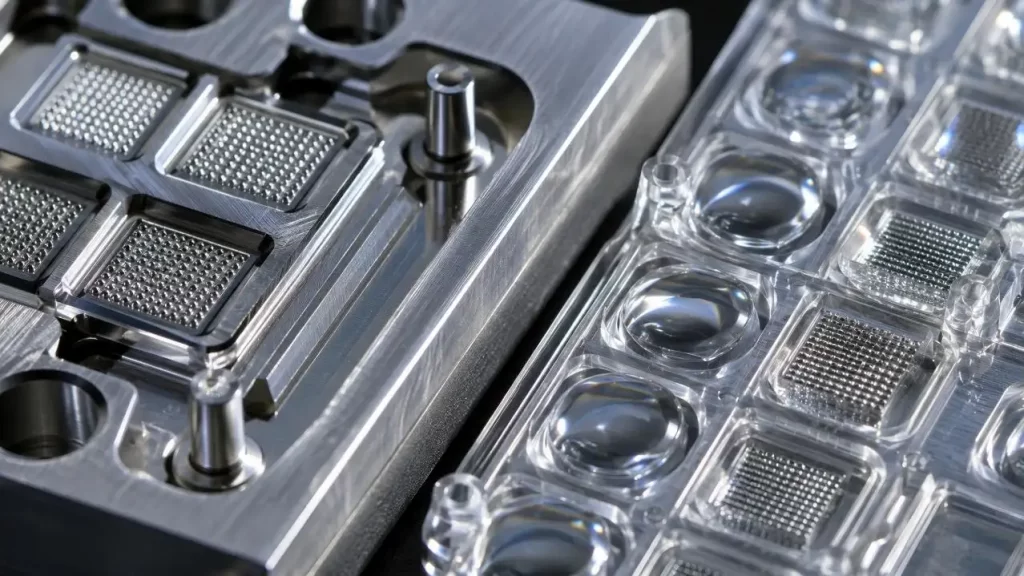
Surface Defects Control
As for all production processes, there are defects in molding. These are often difficult to see and are small, but in optics, these defects scatter light and reduce transmission and therefore, clarity in optics.
Common defects include:
• Flash
• Gate marks
• Flow marks
• Scratches
• Mold contamination.
The quality of an optical product requires the coordination of molding design and parameters and post molding handling.
The Relationship Between Mold Precision and LED Optical Performance
The quality of LED optical components is directly linked to the precision of the injection molding.
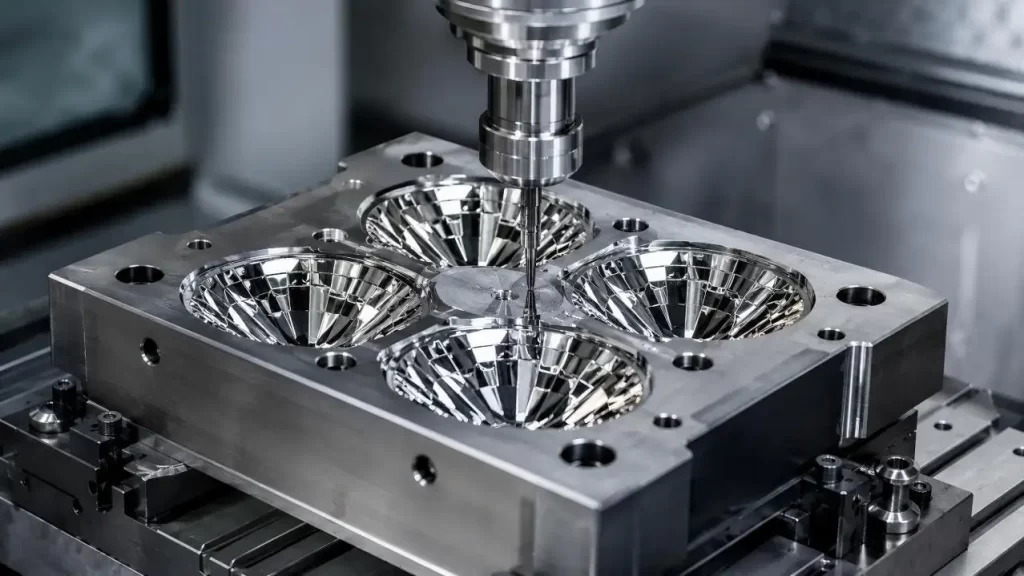
High-Accuracy Mold Cavity Manufacturing
To be an optical-grade molding, the extreme surfaces have to undergo the advanced process of machining and polishing.
Some of the processes include:
• CNC machining,
• EDM machining, and
• Optical polishing.
Surface quality of a mold is imperative if the optical lens is to be clear, otherwise transmission of light will also be imperfect.
Thermal Control During Injection Molding
The quality of an optical component is directly related to evenness of cooling.
If the cooling is uneven, one can expect warpage, internal tension, distortion and variation in the dimensions of the optical component.
The quality of an optical component is directly related to evenness of cooling. The design and the parameters of the cooling channels are extremely crucial in the molding of optical components.
Balanced Filling and Stress Control
When polycarbonate and PMMA are used in transparent application, they need careful handling as they are sensitive to molding conditions
An unbalanced filling can lead to:
• Residual stresses
• Flow defects
• Variations in the material caused by differences in refractive index.
Mold flow analysis and optimization of the process allow the engineers to define the best location for the gates and the best processing conditions even before the start of the production.
Typical Precision Requirements for LED Mold Components
The degree of required precision for LED mold components varies based on the component's optical function, structure, material, and the requested production quantity.
| Component Type | Typical Application | Common Manufacturing Tolerance | Optical Impact |
| Standard Injection Molded Parts | Housings, Covers, Brackets | ± 0.1 mm to ± 0.5 mm | Primarily Mechanical Function |
| Precision Plastic Components | Mounting Parts, Holders, Supports | ± 0.05 mm to ± 0.1 mm | Allows for Assemblies |
| Optical Plastic Parts | LED Lenses, Light Guides | ± 0.02 mm to ± 0.05 mm | Perturbation of Light Guides, Light Distribution, and Uniformity |
| Optical Alignment Features | Lens Positioning Structures | ± 0.03 mm and Tighter | Affects Optical Alignment |
The most distinguishing characteristic of manufacturing optical components as compared to conventional plastic molding is the ability to maintain stable performance in large scale manufacturing while meeting specified tolerances.
KT's Manufacturing Approach for LED Mold Components
KT combines Integrated Precision Injection Molding services for LED components which entails the entire process of mold design through to production for high volumes.
For LED components, the emphasis is on stable and repeatable manufacturing processes, rather than focusing on the accuracy of the first few samples.
Advanced Mold Design and Simulation
Pre-production, KT analyzes different features of the mold in an effort to design the optimal mold. As part of this analysis, the following is performed:
• Mold Flow Simulations
• Cooling Simulations
• Shrinkage Predictions
• Warpage Evaluations
The focus of this analysis is to optimally design the cavity to minimize the dimensional variation inherent to the nature of the injection molding process.
Multi-Cavity Mold and Hot Runner Technology
For LED components produced in high volumes, multi-cavity tooling in combination with hot runner technology ensures both manufacturer efficiency and product uniformity.
Benefits include:
• More balanced material distribution
• Reduced material waste
• Improved cavity-to-cavity consistency
• Stable cycle-to-cycle production
These advantages are especially valuable for LED components requiring millions of repeated parts.
Material Expertise for Optical Applications
Different optical plastics have different processing characteristics.
KT has a variety of engineering plastics that include:
• PMMA: Great choice for superior transparency and clarity.
• PC: High level of resistance to impacts and superior high temperature stability.
• ABS: Excellent choice for structural applications.
• PA and POM: Good choice for the production of functional components.
The selection of engineering materials depends on optical, mechanical, and environmental considerations, as well as the objectives of the manufacturing process.
Quality and Process Control
Quality control of the production process is essential for mass production.
KT implements:
• Control of Injection parameters
• Maintenance of Molds
• Dimensional Controls
• First Article Inspection (FAI)
• Control of Quality of Molds
These controls guarantee the quality of LED molds within specified limits of the production process.
Maintaining Optical Consistency for Mass Production
For manufacturers of LED products, the consistency of production is just as critical as the precision of the individual components. When small variations accumulate, it can adversely affect the appearance of the product and the satisfaction of the customer.
Stable production at KT relies on:
Control of Key Production Parameters
For Injection of Molding:
• Injection pressure
• Melt temperature
• Cooling time
• Holding pressure
Consistency of the production process relies on control of the above parameters.
Preventive Maintenance of Molds
Gradual changes can be caused by:
• Surface wear
• Polishing deterioration
• Fatigue of materials
Long production runs can be adversely affected if the condition of the tools is not maintained.
Verification of Quality
Visual inspection is combined with dimensional checks to ensure:
• Optical surface quality
• Component dimensions
• Assembly compatibility
• Consistency of appearance
Integration of Secondary Processes Without Compromising Quality
Some LED molding components require additional processes such as:
• Vacuum metallization
• Anti-reflective coatings
• Painting
• Surface treatments
These must be precisely coordinated with the molding process.
As an example, there are components of a reflector that will need specific precision of a substrate geometry to optimize the performance of light reflection and ensure an even coating during metallization.
KT balances post process requirements along with molding parameters to optimize the quality of the component.
Precision Manufacturing Delivers Superior LED Solutions
Superior LED systems derive from precise control over the design and fabrication of molds and selecting materials for LEDs, as well as the systems used for Injection and Quality Control. Lamp manufacturers depend heavily on optical components to achieve desired uniformity in lighting, and consistency over large manufacturing throughput.
With the combination of mold engineering and advanced injection molding, KT successfully offers lighting manufacturers optical plastic components with stability in dimensions and appearance, as well as quality fit for immediate production. This ultimately supports the transition from product development to the stages of mass production.
FAQs
Q1. What materials are typical for components of LED molds?
Typical materials used for components of LED molds are PMMA, PC, ABS, and other optical plastics that may be chosen based on application, as well as strength and transparency.
Q2. What is the importance of precision for components of LED molds?
The importance of precision for components of LED molds is for the correct distribution of light, and for achieving an evenness of brightness and a stability of performance for the process of production.
Q3. What is the tolerance for components of LED molds?
The tolerance for components of LED molds is based on the design and the requirements of the material and the tooling. However, in general, precision optical components of LEDs require a higher tolerance than a standard component of plastic.
Q4. Is it possible for KT to make custom LED optical components?
It is possible for KT to make custom LED optical components.
Q5. What are the typical processes for component LED optical injection molding at KT?
The typical processes for component LED optical injection molding at KT are precision injection molding, along with multi-cavity and hot runner systems, for consistent production at high volumes.
Talk to the Manufacturer, Not a Middleman
Resources & Insights
-
 Industry Insights
CNC Aluminum Components: How Surface Finish Affects Anodizing Quality
2026-08-18By KT Engineering -
 Industry Insights
Stamping Supplier in China: Dongguan Precision Tooling and Metal Stamping Guide
2026-08-18By KT Engineering -
 Industry Insights
Cabinet Cover Components: Lightweight, Modular and Smart Enclosure Design Guide
2026-08-17By KT Engineering -
 Industry Insights
Connector Mold Components for Automotive High-Voltage Connectors
2026-08-16By KT Engineering