Contact Us
  Home /
 Key Advantages of Rapid Prototyping


Table of Contents
- What Is Rapid Prototyping?
- Why Rapid Prototyping Matters
- 1. Faster Product Development
- 2. Lower Development Costs
- 3. Better Design Validation
- 4. Supports Multiple Design Iterations
- 5. Improved Team Collaboration
- 6. Greater Design Freedom
- 7. Easier Product Customization
- 8. Reduced Material Waste
- 9. Better Functional Testing
- 10. Lower Manufacturing Risk
- Common Applications of Rapid Prototyping
- Choosing the Right Rapid Prototyping Method
- The Future of Rapid Prototyping
- Conclusion

The manufacturing sector today is very competitive where businesses require to come up with products in a faster rate, lower costs and high-quality solutions without sacrificing the innovation. One of the most valuable technologies that can help achieve these goals is rapidly prototyping. This rapid translation of digital CAD designs into tangible prototypes can help businesses test and refine their concepts, speed up product development, and reduce costs.
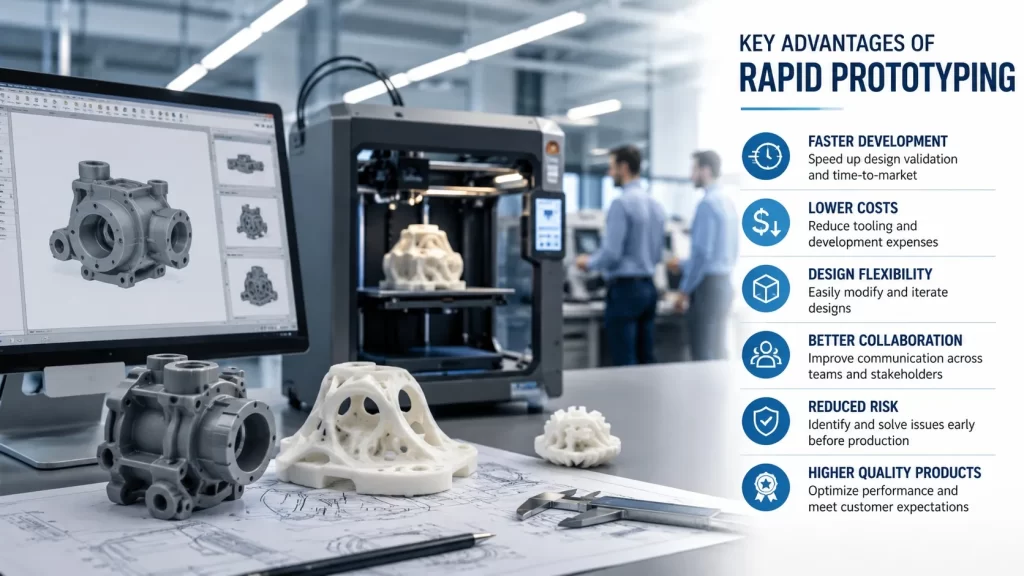
From consumer electronics to automotive components, medical devices to aerospace parts and industrial equipment, rapid prototyping can help you get your designs off the ground and make decisions quicker, without the cost of expensive design errors. Prototype production is more accessible than ever before with modern technologies like 3D printing, CNC machining, vacuum casting and rapid tooling.
What Is Rapid Prototyping?
Rapid Prototyping is the rapid manufacture of a physical model directly from 3D CAD models using advanced manufacturing technologies. While prototype manufacturing is usually an involved process that utilizes complex equipment and tools, rapid prototyping focuses on the ability to make prototypes quickly, with flexibility, and by constantly improving the design.
There are common rapid prototyping technologies such as:
- 3D Printing (FDM, SLA, SLS, MJF, PolyJet, DMLS)
- CNC Machining
- Vacuum Casting
- Urethane Casting
- Sheet Metal Prototyping
- Rapid Injection Molding
They each have their own merits and drawbacks, and they are selected based on the materials, precision, mechanical properties, production volume and cost.
Why Rapid Prototyping Matters
When designing a traditional way, many changes in the product design, modification in expensive tools and long production lead time are common. Each engineering change may be a barrier to product releases, and it can cost more to develop.
Rapid prototyping changes the game by enabling engineers to test physical prototypes at all stages of a product's development. Design issues can be identified early and minimised the technical risks and financial investments required for mass production.
1. Faster Product Development
The most obvious benefit of using rapid prototyping is that of speed.
Companies don't have to wait weeks or months for conventional tooling when they can receive functional prototypes in a matter of days. When designing, designers instantly consider the dimensions, assembling process, ergonomics, and functions before making improvements.
This speeded-up process enables companies to:
- Validate concepts quickly
- Reduce engineering delays
- Increase development efficiency
- Launch products sooner
- Respond faster to changing market demands
Being able to speed up time-to-market can be a large competitive advantage for startups and manufacturers.
2. Lower Development Costs
In most cases, traditional prototype manufacturing methods involve high tooling, mold or fixture expenses.
Many of these front-end investments are avoided with rapid prototyping.
Rather than spending big money with a multibillion dollar commitment to a design before it has been tested, manufacturers can create the minimum number of prototypes required for testing. If the changes are in the engineering, it is only necessary to update the CAD model, rather than to rebuild expensive production tools.
The following are ways to achieve cost savings:
- Fewer tooling expenses
- Reduced labor
- Less material waste
- Shorter engineering cycles
- Fewer production errors
Total development cost can drop significantly without affecting the quality of the products.
3. Better Design Validation
Digital models can be helpful, but physical prototypes can show problems that the computer models might not.
Rapid prototypes can be used to assess:
- Product dimensions
- Part fit and assembly
- Surface finish
- User ergonomics
- Functional performance
- Mechanical movement
- Structural integrity
Early testing of the physical parts can address design issues before costly production volumes are used.
4. Supports Multiple Design Iterations
Few if any successful products come out of the first design.
Rapid prototyping is useful because it helps product development to be iterative; that is, many different versions of a product can be created in quick succession.
Engineers can investigate multiple design options at once and enhance:
- Mechanical performance
- Weight reduction
- User experience
- Manufacturing efficiency
- Material selection
Development teams analyse real components instead of debating theoretical improvements and make data-driven decisions.
5. Improved Team Collaboration
Physical prototypes increase inter-departmental communication.
No longer need the review be limited to CAD drawings or technical specs, everyone involved—engineers, designers, marketing teams, suppliers and customers—can see the same actual product.
This leads to:
- Faster approvals
- Better design discussions
- Reduced misunderstandings
- More effective stakeholder feedback
- Stronger collaboration throughout development
Physical models help to communicate across technical and non-technical teams.
6. Greater Design Freedom
With the advancement of modern additive manufacturing technologies, it is possible to develop very complex geometries that are hard or even unfeasible to obtain by conventional manufacturing processes.
Examples include:
- Internal cooling channels
- Lightweight lattice structures
- Organic shapes
- Complex assemblies
- Customized components
- Topology-optimized designs
Rapid prototyping allows innovation to happen where there is no manufacturing constraint.
7. Easier Product Customization
Customized products are going to play an ever more prominent role as customer expectations increase.
Rapid prototyping facilitates mass customization because of the ability of manufacturers to make changes in the digital design without the need for new tooling.
Some industries that can benefit from custom prototypes include:
- Medical devices
- Consumer electronics
- Automotive accessories
- Aerospace components
- Industrial equipment
- Robotics
Each customer-specific design can be validated before production begins.
8. Reduced Material Waste
In traditional subtractive manufacturing, material is cut from a larger piece of stock creating a lot of waste.
Many rapid prototyping technologies, particularly additive manufacturing, make parts one layer at a time, using only the material needed.
Benefits include:
- Lower raw material consumption
- Reduced scrap
- Improved sustainability
- Lower manufacturing costs
- More environmentally friendly production
With sustainability being a significant business goal, waste minimization offers a dual benefit of environmental and economic benefits.
9. Better Functional Testing
Rapid prototypes aren't just for appearance models anymore.
With the use of today's high-tech manufacturing techniques, engineers can create working prototypes with engineering quality materials that can be used for:
- Mechanical testing
- Thermal testing
- Assembly verification
- Load testing
- Fluid flow evaluation
- Electrical enclosure validation
These prototypes closely simulate production parts, improving confidence before manufacturing investments are made.
10. Lower Manufacturing Risk
One of the biggest investments in manufacturing may be the production tooling.
Rapid prototyping helps to reduce the chances of:
- Tooling modifications
- Production defects
- Customer complaints
- Product recalls
- Costly engineering changes
Early problem detection protects both project budgets and product quality.
Common Applications of Rapid Prototyping
Rapid prototyping is now widely used across many industries.
Automotive
Manufacturers create prototypes for:
- Interior components
- Dashboard assemblies
- Engine parts
- Air ducts
- Lighting systems
- Functional testing
Aerospace
Engineers develop:
- Lightweight brackets
- Airflow components
- Structural parts
- Cabin interiors
- UAV components
Medical
Applications include:
- Surgical guides
- Anatomical models
- Prosthetics
- Orthotics
- Medical device housings
Consumer Products
Companies rapidly develop:
- Wearables
- Smart devices
- Home appliances
- Sporting goods
- Packaging prototypes
Industrial Equipment
Manufacturers prototype:
- Machine components
- Fixtures
- Jigs
- Automation parts
- Production tools
Choosing the Right Rapid Prototyping Method
The best prototyping process depends on project requirements.
| Technology | Best For | Advantages |
|---|---|---|
| FDM 3D Printing | Concept models | Low cost, fast production |
| SLA Printing | High-detail prototypes | Excellent surface finish |
| SLS Printing | Functional plastic parts | Strong, durable components |
| CNC Machining | Precision metal or plastic parts | High accuracy |
| Vacuum Casting | Small production runs | Production-like appearance |
| Rapid Injection Molding | Bridge production | High-quality functional parts |
| Sheet Metal Fabrication | Metal enclosures | Production-grade sheet components |
Selecting the appropriate manufacturing process helps balance speed, quality, and cost.
The Future of Rapid Prototyping
The continuous evolution of rapid prototyping is driven by the development of additive manufacturing, automation, artificial intelligence, and digital manufacturing processes.
Emerging trends include:
- AI-assisted product optimization
- Multi-material 3D printing
- High-speed industrial additive manufacturing
- Digital twins
- Automated design validation
- Cloud-based manufacturing platforms
These innovations will further cut down the development time, enhance the product quality and manufacturing efficiency.
Conclusion
Rapid prototyping has revolutionized the product development process, allowing companies to create, test and improve products quicker than ever. The benefits span from cost reduction, speeding up development times, facilitating collaboration, to enabling innovative designs.
As a single proof-of-concept prototype or for product development and scale up, rapid prototyping can help minimise risk and speed up innovation. In today's fast-changing manufacturing environment, companies that adopt rapid prototyping into their development processes can be more responsive to market requirements, enhance product quality and achieve a sustainable competitive edge.
Talk to the Manufacturer, Not a Middleman
Resources & Insights
-
 Hide blog post
CNC Aluminum Components: How Surface Finish Affects Anodizing Quality
2026-08-18By KT Engineering -
 Hide blog post
Stamping Supplier in China: Dongguan Precision Tooling and Metal Stamping Guide
2026-08-18By KT Engineering -
 Hide blog post
Cabinet Cover Components: Lightweight, Modular and Smart Enclosure Design Guide
2026-08-17By KT Engineering -
 Hide blog post
Connector Mold Components for Automotive High-Voltage Connectors
2026-08-16By KT Engineering