Contact Us
  Home /
 Best Rapid Sheet Metal Prototyping Methods


Table of Contents
- What Is Rapid Sheet Metal Prototyping?
- Why Rapid Sheet Metal Prototyping Matters
- Common Rapid Sheet Metal Prototyping Processes
- Best Materials for Sheet Metal Prototypes
- Design Tips for Better Sheet Metal Prototypes
- Industries That Use Rapid Sheet Metal Prototyping
- Rapid Sheet Metal vs Other Prototyping Methods
- How to Choose a Rapid Sheet Metal Prototyping Partner
- Future Trends in Rapid Sheet Metal Prototyping
- Final Thoughts

Speed is as essential as quality, in today's competitive manufacturing world. From designing a new electronic enclosure, vehicle brackets, medical devices housings and industrial parts, engineers can test models and make validations quickly and efficiently without spending significant amounts of time and money on costly production tooling.
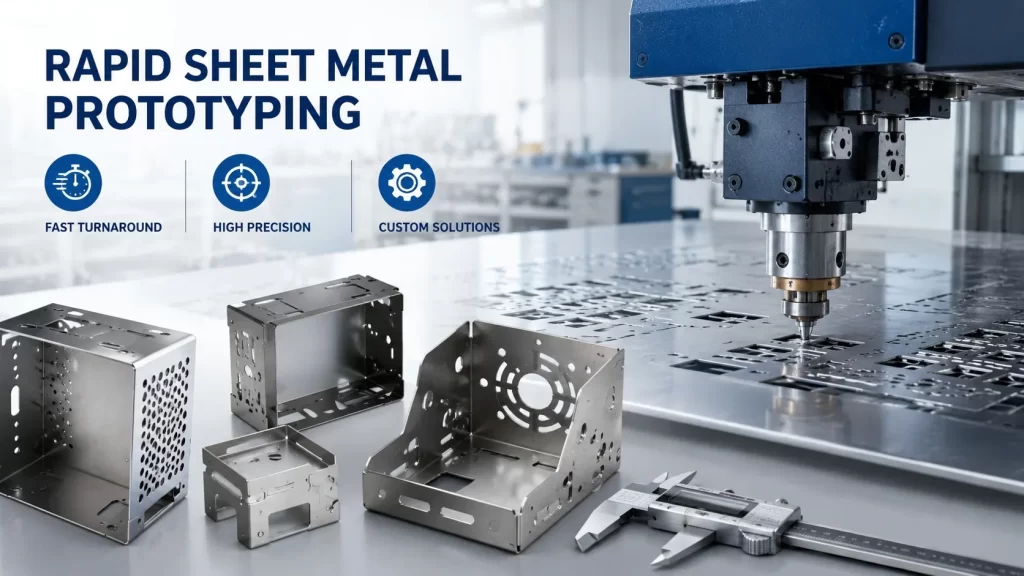
The traditional manufacturing process takes weeks of preparation before the components are created, but with rapid prototyping, companies can manufacture functional metal parts in just days, which can speed up the product development process and minimise risks and overall costs. Sheet metal prototypes are more precise and cost-effective than ever thanks to modern technologies like laser cutting, CNC bending, welding and digital manufacturing.
From processes and materials to design tips and choosing a manufacturing partner, this guide will cover everything you need to know about rapid sheet metal prototyping.
What Is Rapid Sheet Metal Prototyping?
Rapid Sheet Metal Prototype (RSMP) is the production of small quantities of metal sheet parts without the need for an expensive hard tool.
Manufacturers make parts without the need to invest in stamping dies or progressive stamping tools but with the use of a CNC controlled machine. By doing so, the engineers can:
- Verify product dimensions
- Test mechanical performance
- Evaluate assembly compatibility
- Improve product aesthetics
- Detect design issues early
From one to several hundred parts are the typical number of parts required for a prototype project before entering full scale production.
Why Rapid Sheet Metal Prototyping Matters
The product development cycles are getting shorter in many sectors. Businesses that prove designs sooner have a huge edge over the competition.
Major benefits include:
Faster Product Development
Prototype parts can be delivered in a few business days, not weeks, as is possible with production tooling.
Lower Development Costs
If a lot of re-designs occur, the initial investment in hard tooling is greatly minimized.
Better Design Validation
There are several things that are not represented in the CAD simulation that will be identified through physical prototypes:
- Assembly interference
- Structural weaknesses
- Material deformation
- Manufacturing feasibility
Easier Design Iterations
Engineers can quickly modify CAD files and receive updated parts without restarting an expensive tooling process.
Reduced Production Risk
Testing functional prototypes before mass production minimizes costly manufacturing mistakes later.
Common Rapid Sheet Metal Prototyping Processes
Modern manufacturers combine multiple fabrication technologies depending on project requirements.
1. Laser Cutting
Laser cutting is usually the first manufacturing step.
High-powered fiber lasers precisely cut flat sheet metal into complex geometries with excellent edge quality.
Advantages include:
- Extremely high accuracy
- Fast production speed
- Minimal material waste
- Suitable for intricate designs
- Excellent repeatability
Laser cutting works with:
- Stainless steel
- Aluminum
- Carbon steel
- Copper
- Brass
2. CNC Punching
For designs containing numerous holes, slots, or embossed features, CNC turret punching offers excellent productivity.
Benefits include:
- Fast cycle times
- High consistency
- Lower cost for repetitive features
- Excellent dimensional accuracy
3. CNC Press Brake Bending
After cutting, flat blanks are formed into three-dimensional components using CNC press brakes.
Modern bending systems provide:
- Accurate bend angles
- Tight tolerances
- Repeatable results
- Complex multi-bend geometries
Proper bend sequencing ensures dimensional stability throughout manufacturing.
4. Welding and Assembly
Many sheet metal prototypes consist of multiple components joined together.
Common joining methods include:
- TIG welding
- MIG welding
- Spot welding
- Riveting
- PEM fasteners
- Threaded inserts
The appropriate joining process depends on structural requirements and intended production methods.
5. Surface Finishing
Prototype appearance often matters as much as functionality.
Popular finishing options include:
- Powder coating
- Sandblasting
- Anodizing
- Electroplating
- Brushing
- Polishing
- Passivation
Surface treatments improve corrosion resistance while providing production-like aesthetics.
Best Materials for Sheet Metal Prototypes
Selecting the proper material significantly impacts prototype performance.
Aluminum
Ideal for:
- Electronic enclosures
- Aerospace components
- Consumer products
Advantages:
- Lightweight
- Corrosion resistant
- Easy to machine
- Excellent strength-to-weight ratio
Common grades:
- 5052
- 6061
Stainless Steel
Perfect for:
- Medical equipment
- Food processing
- Industrial machinery
Benefits:
- Outstanding corrosion resistance
- High strength
- Excellent durability
- Attractive finish
Popular grades include 304 and 316 stainless steel.
Mild Steel
Often selected for:
- Structural components
- Machinery
- Equipment frames
Advantages:
- Cost-effective
- Easy to weld
- Strong
- Readily available
Copper
Best suited for:
- Electrical applications
- Heat exchangers
- Conductive components
Offers exceptional electrical and thermal conductivity.
Brass
Frequently used for:
- Decorative products
- Instrumentation
- Architectural components
Provides attractive appearance with good corrosion resistance.
Design Tips for Better Sheet Metal Prototypes
Good design practices reduce manufacturing costs while improving quality.
Keep Bend Radii Consistent
Using uniform bend radii simplifies manufacturing and improves repeatability.
Minimize Tight Tolerances
Only specify critical tolerances where necessary.
Overly tight tolerances increase machining time and cost.
Avoid Small Internal Features
Very narrow slots or tiny holes may require additional machining processes.
Consider Material Thickness
Standard sheet thicknesses reduce material costs and improve availability.
Design for Manufacturability (DFM)
Collaborating with manufacturers early helps optimize:
- Bend locations
- Hole placement
- Part orientation
- Material selection
- Manufacturing efficiency
Design for Manufacturability (DFM) reduces production risks while shortening lead times.
Industries That Use Rapid Sheet Metal Prototyping
Rapid sheet metal fabrication supports numerous industries.
Electronics
- Control cabinets
- Server racks
- Enclosures
- Mounting brackets
Automotive
- Chassis components
- Battery housings
- Engine brackets
- Interior structures
Aerospace
- Lightweight panels
- Mounting hardware
- Aircraft interiors
Medical
- Equipment housings
- Surgical device components
- Diagnostic equipment
Industrial Equipment
- Machine guards
- Control boxes
- Frames
- Conveyor components
Rapid Sheet Metal vs Other Prototyping Methods
| Method | Best For | Advantages | Limitations |
|---|---|---|---|
| Sheet Metal Fabrication | Functional metal parts | Production materials, fast turnaround | Limited to formed sheet components |
| CNC Machining | Complex solid parts | High precision | Higher material waste |
| 3D Printing | Concept models | Extremely fast | Lower strength for many applications |
| Injection Molding | Plastic production | Excellent for volume | High tooling cost |
For metal enclosures and structural parts, sheet metal prototyping offers one of the best balances of cost, speed, and production realism.
How to Choose a Rapid Sheet Metal Prototyping Partner
Not all manufacturers provide the same capabilities.
Consider the following factors:
- Advanced laser cutting equipment
- CNC bending expertise
- In-house welding
- Surface finishing services
- Engineering support
- DFM consultation
- Material availability
- Quality inspection systems
- Fast quotation process
- Short lead times
A vertically integrated manufacturer is able to control the entire process of the production, from the design review stage until the final assembly stage, which in turn allows for a more timely delivery and better quality control.
Future Trends in Rapid Sheet Metal Prototyping
Manufacturing technologies continue to evolve.
Emerging trends include:
- AI-assisted manufacturing optimization
- Automated quoting systems
- Digital twins
- Smart factory integration
- Advanced fiber laser technology
- Robotic bending cells
- Real-time production monitoring
- Hybrid manufacturing combining sheet metal and additive manufacturing
Such innovations are still further cutting prototype development times and enhancing consistency and production efficiency.
Final Thoughts
Rapid sheet metal prototyping is a must-have tool for the modern product development. Welding is just one of the many processes that can be performed using precision laser cutting and CNC bending to provide functional prototypes in days not weeks.
From consumer electronics to industrial equipment, automotive parts to medical devices, rapid sheet metal prototyping can save development costs, boost innovation and enhance the quality of the final product.
Partnering with a reputable manufacturing company with extensive in-house capabilities guarantees a quicker turnaround time, higher production precision and a seamless shift from prototyping to mass production.
Talk to the Manufacturer, Not a Middleman
Resources & Insights
-
 Hide blog post
CNC Aluminum Components: How Surface Finish Affects Anodizing Quality
2026-08-18By KT Engineering -
 Hide blog post
Stamping Supplier in China: Dongguan Precision Tooling and Metal Stamping Guide
2026-08-18By KT Engineering -
 Hide blog post
Cabinet Cover Components: Lightweight, Modular and Smart Enclosure Design Guide
2026-08-17By KT Engineering -
 Hide blog post
Connector Mold Components for Automotive High-Voltage Connectors
2026-08-16By KT Engineering