Contact Us
  Home /
 rapid prototyping manufacturing


Table of Contents
- What Is Rapid Prototype Manufacturing?
- 1. Significantly Faster Product Development
- 2. Lower Product Development Costs
- 3. Better Design Validation
- 4. Improved Product Quality
- 5. Greater Manufacturing Flexibility
- 6. Easier Functional Testing
- 7. Reduced Risk Before Mass Production
- 8. Faster Time-to-Market
- Common Rapid Prototype Manufacturing Technologies
- Industries That Benefit from Rapid Prototype Manufacturing
- Tips for Choosing a Rapid Prototype Manufacturer
- Frequently Asked Questions
- Conclusion

The modern manufacturing world is extremely competitive, and rushing and innovation are key. As the ability to turn ideas into working products becomes a competitive edge and a key priority for companies, it is a trend that is likely to become much faster.The ability to convert ideas into working products is a competitive advantage and a priority for companies, and is expected to accelerate even more. That's where rapid prototype manufacturing is crucial in today's product development.
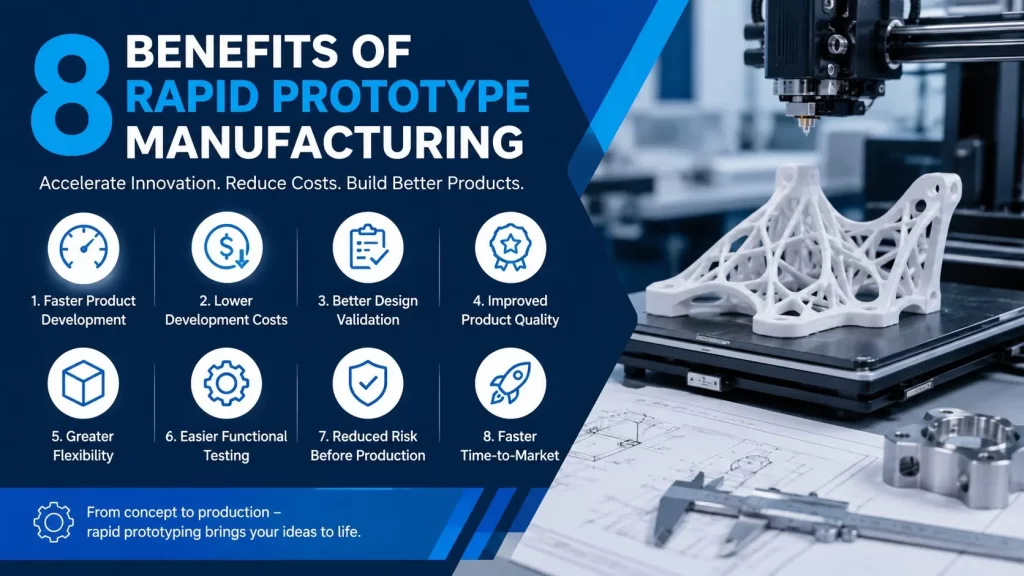
Such innovative technologies as 3D printing, CNC machining, rapid injection molding, sheet metal fabrication, and vacuum casting allow manufacturers to produce accurate prototypes in days, rather than weeks. Rapid prototyping helps engineers test designs, cut development expenses, enhance product quality and get to market faster. Today, manufacturing service providers are providing more and more integrated prototype-to-production services which cater to all the stages of the product development.
Whether you are in the manufacturing sector or another industry, this guide will dive into the top eight advantages of rapid prototype manufacturing and why companies in various industries are turning to it in order to get their innovative products to market quickly.
What Is Rapid Prototype Manufacturing?
Rapid prototype manufacturing is the production of physical models or functional prototypes with the aid of advanced manufacturing technologies in a rapid manner. Rapid Manufacturing emphasizes flexibility, speed and design validation in contrast to traditional prototyping, which can be costly and time consuming.
Manufacturers can choose from:
- CNC machining
- 3D printing
- Rapid injection molding
- Sheet metal fabrication
- Urethane casting
- Vacuum casting
The respective processes are each suitable for certain materials, for different production volumes, for different tolerances and for different mechanical properties.
1. Significantly Faster Product Development
The one thing that is best about rapid prototype manufacturing is speed.
With the traditional prototype manufacturing, it takes weeks or even months to complete because of the limitation of tooling, setup and machining. This can be drastically reduced with rapid manufacturing technologies.
Benefits include:
- Faster design iterations
- Shorter engineering cycles
- Quicker customer feedback
- Accelerated product launches
Multiple design concepts can be assessed in a matter of days, instead of the days required for production.
This rapid pace can be the difference for startups and innovative companies in getting products to market first.
2. Lower Product Development Costs
A new product development is costly, particularly when defects are found at late stage of production.
Rapid prototyping minimises costs because it allows you to see the problems early.
Manufacturers can:
- Test multiple concepts without investing in production tooling
- Eliminate unnecessary redesign costs
- Reduce engineering hours
- Avoid expensive manufacturing mistakes
Engineers do not make a lot of bad parts, but instead make changes to the design before making a full batch.
This significantly increases ROI of a product development process.
3. Better Design Validation
It is not always possible to accurately forecast real-world performance with digital CAD models.
By using physical prototypes, engineers are able to assess:
- Component fit
- Assembly compatibility
- Mechanical strength
- Ergonomics
- Surface finish
- Functional performance
It is sometimes difficult to find problems on a simulation when having a real prototype is crucial.
Design validation is more accurate prior to mass production.
4. Improved Product Quality
Rapid prototype manufacturing helps with continuous improvement.
Each prototype yields useful data which aids the engineers in optimizing:
- Material thickness
- Structural integrity
- Weight reduction
- Manufacturing efficiency
- Product appearance
- User experience
Companies can test their products several times to obtain the desired performance without entering into production.
This yields a better quality product in the end, and fewer errors in production.
5. Greater Manufacturing Flexibility
Today's rapid manufacturing can encompass a vast array of materials and manufacturing techniques.
To prototype, manufacturers can use:
Metals
- Aluminum
- Stainless steel
- Brass
- Copper
- Titanium
Plastics
- ABS
- Nylon
- Polycarbonate
- POM
- Acrylic
Elastomers
- Silicone
- TPU
- Rubber-like resins
The flexibility enables engineers to choose materials that closely align with the material requirements for the final production.
Several different manufacturing processes can also be integrated in the development process for optimum efficiency.
6. Easier Functional Testing
While visual prototypes can be beneficial, functional prototypes can offer much more insight.
Rapid prototype manufacturing enables engineers to test:
- Load capacity
- Heat resistance
- Wear performance
- Moving components
- Mechanical assemblies
- User interaction
With functional testing, weaknesses are identified prior to the production tooling is made.
This capability is especially well suited to industries like automotive, aerospace, medical devices, robotics or consumer electronics.
7. Reduced Risk Before Mass Production
Production tooling has been made and the manufacturing errors become much more expensive.
Rapid prototyping can minimize project risks because it "tests":
- Product functionality
- Assembly procedures
- Manufacturability
- Material compatibility
- Customer acceptance
Early testing of prototypes reduces the probability of quality problems and unwanted delays in production.
This risk mitigation is one of the key factors that makes companies invest in rapid manufacturing services.
8. Faster Time-to-Market
Early product launches are huge competitive advantages.
Nearly all phases of development are cut down using rapid prototype manufacturing:
- Design verification
- Engineering approval
- Customer evaluation
- Manufacturing preparation
- Product testing
Faster ability to adapt to market changes and better innovation cycles for businesses.
In industries in which technology changes quickly, the ability to cut down the development time can translate into higher market share and profitability.
Common Rapid Prototype Manufacturing Technologies
The selection of manufacturing technique should be based on the geometry, material, volume and function of the parts.
| Technology | Best For | Advantages |
|---|---|---|
| CNC Machining | Precision metal & plastic parts | Excellent accuracy and strength |
| 3D Printing | Complex geometries | Fast, affordable, no tooling |
| Rapid Injection Molding | Low-volume production | Production-grade plastic parts |
| Sheet Metal Fabrication | Enclosures & brackets | High strength and quick turnaround |
| Vacuum Casting | Small plastic batches | Excellent surface finish |
| Urethane Casting | Functional prototypes | Cost-effective short-run production |
A number of manufacturers integrate these technologies into an end-to-end solution that assists customers to get from concept to finished part quickly.
Industries That Benefit from Rapid Prototype Manufacturing
Rapid prototyping has become an essential tool across many industries, including:
- Automotive
- Aerospace
- Medical devices
- Consumer electronics
- Industrial equipment
- Robotics
- Telecommunications
- Renewable energy
- Consumer products
- IoT devices
These sectors require frequent product improvements, fast innovation, and reliable engineering validation before production.
Tips for Choosing a Rapid Prototype Manufacturer
Not every supplier offers the same capabilities.
Consider these factors when selecting a manufacturing partner:
- Multiple manufacturing technologies under one roof
- Engineering and design support
- Material selection expertise
- Fast lead times
- Strict quality control
- Global production capabilities
- Ability to scale from prototype to production
A manufacturer that supports the complete product lifecycle can simplify project management while reducing overall development costs.
Frequently Asked Questions
How long does rapid prototype manufacturing take?
Simple prototypes can often be completed within 1–5 days, while more complex projects may require one to three weeks depending on the manufacturing process and material.
Is rapid prototyping suitable for production parts?
Yes. Processes such as CNC machining and rapid injection molding can produce functional, production-quality components for low- to medium-volume manufacturing.
Which materials can be used?
Common materials include aluminum, stainless steel, ABS, nylon, polycarbonate, POM, acrylic, titanium, brass, and engineering-grade resins.
What industries use rapid prototype manufacturing the most?
Rapid prototyping technologies are used by a wide variety of industries, including automotive, aerospace, medical, electronics, robotics, consumer products and industrial manufacturing.
Conclusion
Rapid prototype manufacturing has revolutionized the process of modern Product development where companies can become more innovative, cost-saving and gain quality in their products. Rapid prototyping can be used to validate a new idea, test functionality or ready for mass production in order to be competitive.
With the help of emerging technologies including CNC machining, 3D printing, rapid injection molding and sheet metal fabrication, companies can accelerate development time, minimize production risks, and provide their customers with quality products in a timely manner. Rapid prototyping will continue to be one of the best techniques used to develop new ideas into commercially successful products in the fast-changing manufacturing world.
Talk to the Manufacturer, Not a Middleman
Resources & Insights
-
 Hide blog post
CNC Aluminum Components: How Surface Finish Affects Anodizing Quality
2026-08-18By KT Engineering -
 Hide blog post
Stamping Supplier in China: Dongguan Precision Tooling and Metal Stamping Guide
2026-08-18By KT Engineering -
 Hide blog post
Cabinet Cover Components: Lightweight, Modular and Smart Enclosure Design Guide
2026-08-17By KT Engineering -
 Hide blog post
Connector Mold Components for Automotive High-Voltage Connectors
2026-08-16By KT Engineering