Contact Us
  Home /
 Precision CNC for Storage Enclosure Components: Tolerances and Finishing


Table of Contents

Storage systems handle an increasing amount of data requiring a shift in design from basic protective systems to complex, integrated chassis systems. Modern components such as NAS chassis, external SSD housings, server drive trays, and industrial storage systems require more than basic protective functions. These components require design precision and Thermo and electro-technical integration and must be aesthetically pleasing.
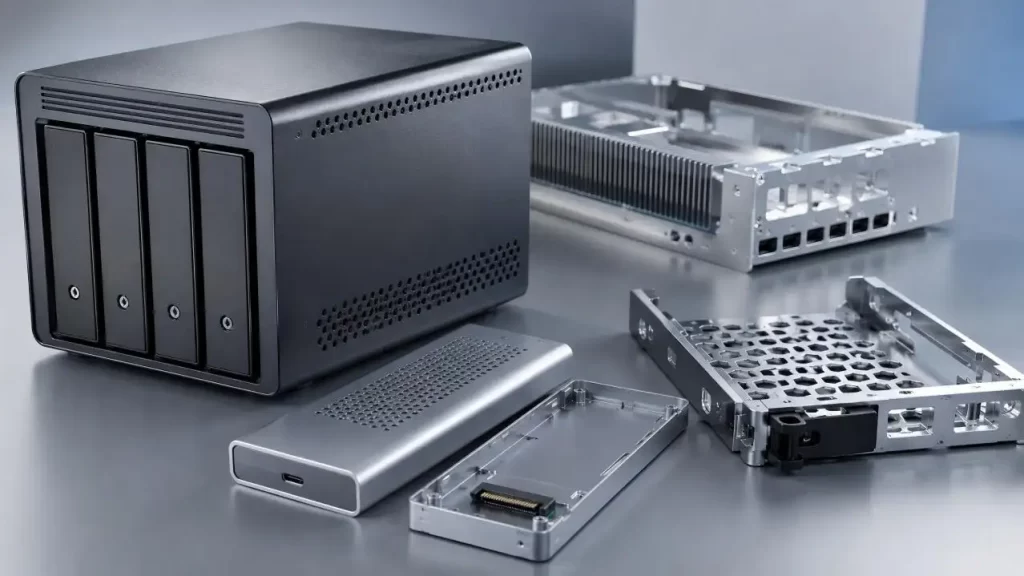
Due to the complexity of modern storage systems, the precision of CNC machining is necessary in the development of these systems. CNC machining allows for the elimination of material with precision for controlled tolerances to enhance the functionality of the protective storage systems.
Material Selection for Storage Enclosure Components
Material selection influences the strength, weight, and thermal performance of the protective storage enclosure. Before choosing a material, engineers evaluate the requirements for protection, heat dissipation and the environment.
1. Aluminum Alloys for Lightweight and Thermal Performance
Examples: 6061 aluminum, 6063 aluminum, 7075 aluminum
Alloys of aluminum effectively form the outer enclosures, the inner frames, as well as other supporting and assembly parts of modern day storage systems.
Some benefits are:
•Lightweight construction: With a high strength-to-weight ratio, aluminum makes the storage systems portable and compact.
•Outstanding machinability: Milling of aluminum alloys can be done with high speed and accuracy.
•Thermal conductivity: Aluminum transfers heat away from the storage and electronic systems.
For thin wall designs, the engineering team has to consider the machining strategy and the material stress. Since the stress is design determined, the deformation is machining determined and can be optimized using appropriate tool paths.
2. Stainless Steel for Strength and Durability
Common Materials: 304 SS, 316 SS
For components that need the additional strength and resistance to wear and corrosion, stainless steels are used.
Common Uses:
•Structural brackets
•Locking mechanisms
•Reinforcement parts
•High-wear contact components
Stainless Steel is more difficult to machine than aluminum, so it requires more time to setup and complete a job when machining. However, when working with a demanding application, stainless steel outperforms aluminum.
3. Engineering Plastics for Electrical Isolation
Common Materials: PEEK, PC, ABS, Nylon
Where electrical insulation, impact resistance and low weight construction are required, engineering plastics are the preferred choice.
Common Uses:
•PCB mounting supports
•Insulating spacers
•Protective components
•Light transmission elements
Deciding on a material depends on the operating temperature, exposure to chemicals, and the required stability of the dimensions over time.
Precision Tolerance Control for Storage Enclosure Components
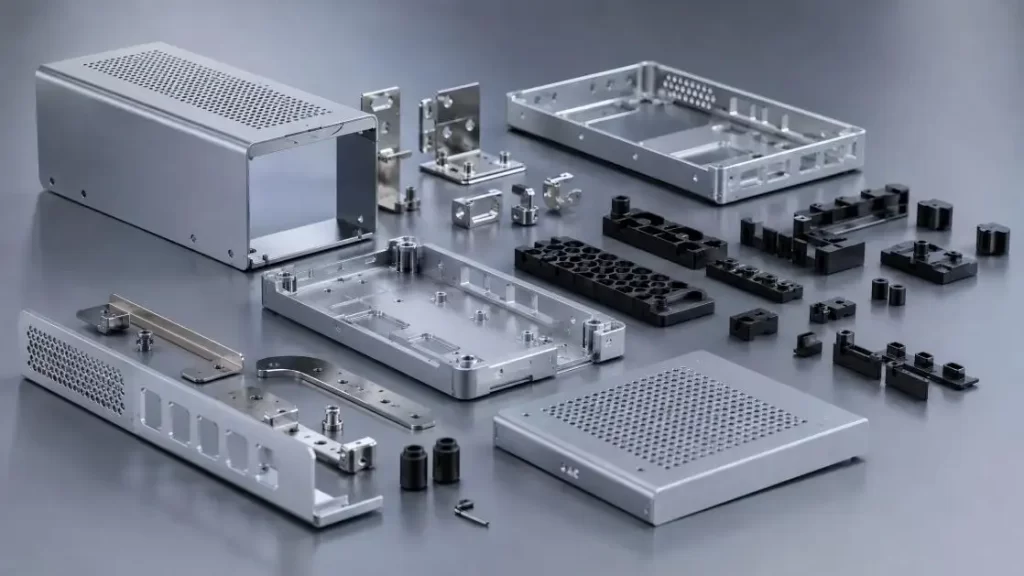
Storage enclosure components are characterized by many precision interfaces. The interfaces affect how well the component assembles. Drive tray sliding systems, connector openings, PCB mounting locations, and sealing structures are a few examples.
Maintenance of optimal tolerance will yield:
•Efficient assembly of all parts
•Correct and complete alignment of all connectors
•Adequately and mechanically stable positions
•Uniform appearance of all products
The tolerance limits achievable by typical CNC machining for the components of storage enclosures is presented below:
| Feature Area | Typical Machining Tolerance | Engineering Considerations |
| Drive tray mating surfaces | ±0.03 mm to ±0.05 mm | Implies that the machining needs to be controlled such that the surfaces of the drive tray are able to be aligned and inserted with ease |
| Connectors and port openings | ±0.05 mm | Ensures that the openings in the enclosure align with the electronic interfaces that are internals |
| Holes for mounting PCBs and threaded features | ±0.05 mm | Ensures that the features are able to be fastened without apply stress to the PCBs |
| External cosmetic dimensions | ±0.10 mm | Ensures that the product appearance is optimal while considering the manufacturing process |
| Thin wall enclosure sections | Flatness in the range of 0.05 mm to 0.10 mm, depending on the geometry | Implies that the machining needs to be controlled such that the part is also stable |
High-end CNC equipment alone is not sufficient to ensure consistent accuracy. Enhanced process control includes:
•Measurement and probing during processing
•Monitoring tool wear
•Machining in a controlled temperature environment
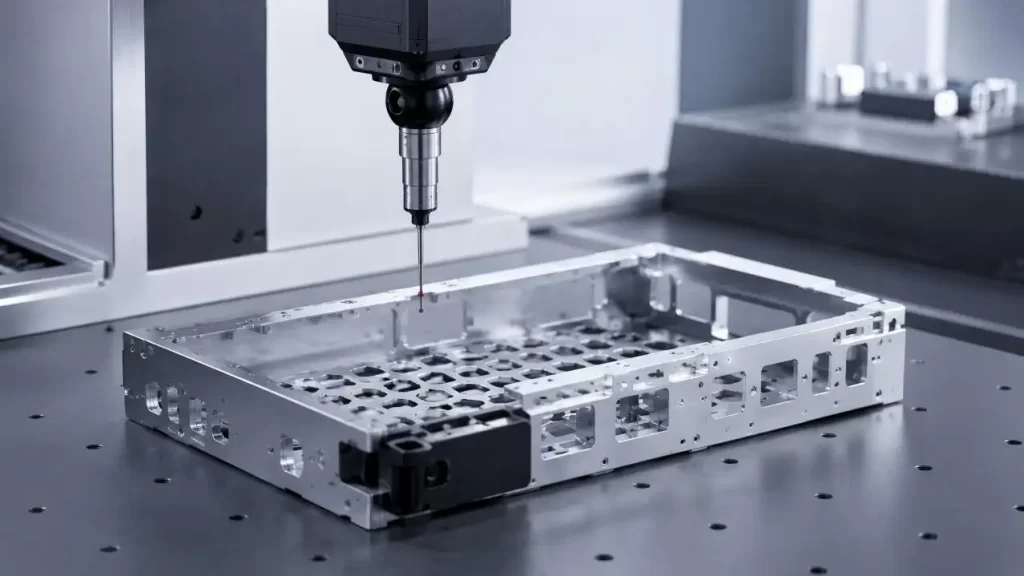
•CMM inspection
•Standardized machining parameters
When working on complex enclosure designs having several precision surfaces, 5-axis CNC machining is optimal and significantly reduces errors due to repositioning by allowing machining of several features, thus minimizing the number of required setups.
Surface Finishes for Premium Storage Enclosure Components
Surface finish is one of the most important aspects of high quality storage enclosure manufacturing. The finish should be aesthetically pleasing, enhance the product durability, and improve the overall user experience.
Our surface finishing services incorporate:
Bead Blasting + Anodizing
Finishes with a matte surface can be achieved through bead blasting. When bead blasting is used in conjunction with anodizing, surface hardening is achieved in addition to increasing corrosion resistance.
Typical applications include:
•Anodized aluminum SSD housings
•NAS chassis covers
•Consumer electronic enclosures
Anodizing options may include:
•Type II anodizing where the finish is Decorative and provides protection.
•Type III hard anodizing which is an improvement over Type II and provides surface hardening and increased wear resistance.
Brushing and Hairline Finishing
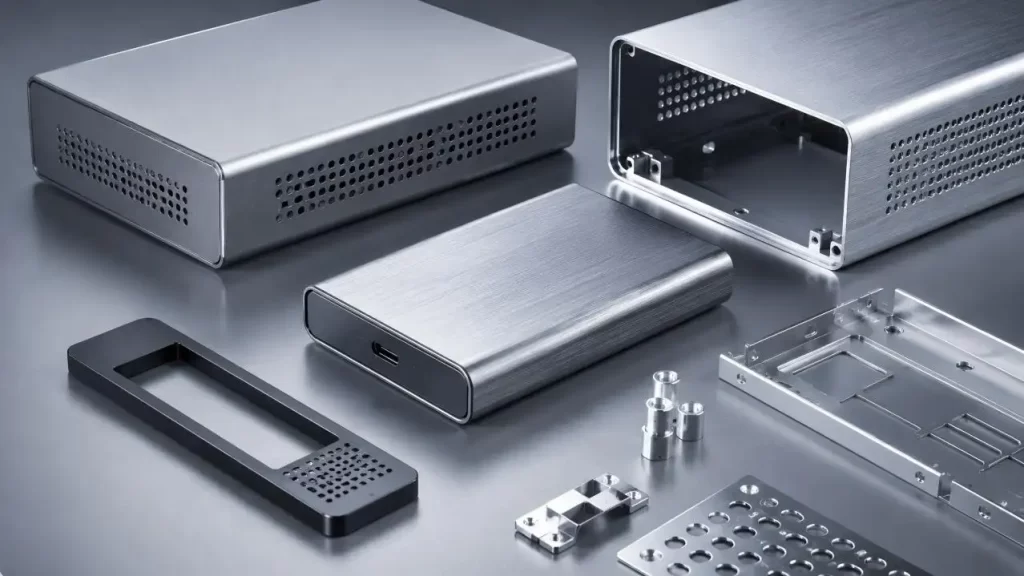
Brushing is a surface finishing technique which provides a directional finish with a professional appearance and also serves to disguise the appearance of handling marks.
This technique is commonly used on:
•High end outer covers
•Decorative panels
•Trim components
Laser Marking and Engraving
Laser processing is a technique used to permanently provide identification that does not add to the thickness of the component.
Common applications include:
•Logos
•Product serial numbers
•Safety instructions
•Interface markings
PVD Coating
Physical Vapor Deposition (PVD) coating is commonly used to enhance the surface of components to improve both the function and the quality of the finish, while also providing color options to metal parts.
PVD coating provides:
•Improved scratch resistance
•Surface hardening
•Color options
Polishing and Electropolishing
Polishing processes can also be employed to achieve high quality finishes on selected components.
To ensure uniformity across production batches, these finishes necessitate careful control of the production process.
Complications in Manufacturing Storage Enclosure Solutions
The innovation of highly sophisticated storage enclosure components calls for a new level of partnership for the design, machining, finishing, and scalable manufacturing of the products.
As a manufacturing partner, our team is able to help with all the necessary stages.
1. Design for Manufacturing Optimization
Analysis of design for manufacturing includes identifying issues in the enclosure design related to:
•Surface finshing
•Complexity in machining
•Accessibility of tools
•Risks of thin wall sections deforming
Feedback from engineering at this stage helps protect the integrity of the design while improving the manufacturability of the storage enclosures.
2. Capability of Integrated Manufacturing
The integration of several manufacturing capabilities reduces the complexity of managing several processes, while increasing the uniformity of the end products.
Common integrations include:
•Support for assembly
•Surface finishing
•Prototyping
•Die casting
•Fabrication of sheet metal
•Machining (turning and milling)
This capability sets the benchmark for quality for all storage enclosure elements.
3. Scaling from Prototyping to Manufacturing
The quality of a manufacturing system is evident in its capability of scaling production from prototypes to manufacturing.
This is largely supported by:
•Batch traceability
•Process documentation
•Measurement reports from CMM
•First article inspection
•Certification of materials
These controls help ensure defined tolerances throughout the manufacturing process.
4. Management of Surface Finishing
Cosmetic appearance of consumer facing storage products is crucial and our manufacturing partners should consider:
•Edge treatment
•Alloy selection
•Coating and finishing
•Consistent appearance in the different manufacturing runs
Stable results in finish appearance require close collaboration with machining.
Final Thoughts
The extensive capabilities in precision CNC milling and machining allow for control of the dimensions, assembly, and finishing of the advanced storage enclosures.
The use of appropriate materials, selection of cost efficient machining, and suitable finishing, allows for manufacture of storage enclosures that satisfy consumer needs and protect sensitive electronic components.
For businesses creating cutting edge storage technology, aligning with a manufacturer with the capabilities to streamline the entire storage solution development process through prototyping, precision machining, inspection, and finishing can facilitate design refinement and accelerate the pace of bringing the solution to market.
FAQs
Q1. What materials are typically used for storage enclosure components?
Common materials used for the components of storage enclosures include aluminum alloys, stainless steel and engineering plastics. Choices among these materials are made based on the component requirements for weight, strength, thermal performance, and the need for insulation.
Q2. What are the CNC machining tolerances for storage enclosures?
Depending on the feature size and complexity, the machining tolerances for storage enclosure components via CNC are typically within ±0.03 mm to ±0.10 mm.
Q3. What are the advantages of aluminum for storage enclosures?
Light weight, excellent thermal performance, good corrosion resistance, and superior machinability by CNC.
Q4. Are thin-wall storage enclosure designs possible with CNC machining?
Certainly. Choice of material and thin wall design optimization, along with appropriate tool path and machining strategies, can reduce the effects of deformation.
Q5. What are the available surface finishes for aluminum storage housings?
Bead blasting, anodizing, brushing, and hard anodizing among others.
Talk to the Manufacturer, Not a Middleman
Resources & Insights
-
 Industry Insights
CNC Aluminum Components: How Surface Finish Affects Anodizing Quality
2026-08-18By KT Engineering -
 Industry Insights
Stamping Supplier in China: Dongguan Precision Tooling and Metal Stamping Guide
2026-08-18By KT Engineering -
 Industry Insights
Cabinet Cover Components: Lightweight, Modular and Smart Enclosure Design Guide
2026-08-17By KT Engineering -
 Industry Insights
Connector Mold Components for Automotive High-Voltage Connectors
2026-08-16By KT Engineering