Contact Us
  Home /
 What Is High Pressure Die Casting?


Table of Contents
- What Is High Pressure Die Casting?
- How Does High Pressure Die Casting Work?
- Hot Chamber vs. Cold Chamber Die Casting
- Common Materials Used in HPDC
- Advantages of High Pressure Die Casting
- Limitations of High Pressure Die Casting
- Industries That Use High Pressure Die Casting
- High Pressure vs. Low Pressure Die Casting
- Is High Pressure Die Casting Right for Your Project?
- Conclusion

Among the most efficient manufacturing processes for the production of complex metal components with excellent dimensional accuracy and surface quality is High Pressure Die Casting (HPDC). Its use has grown as the manufacturing method of choice for industries that demand lightweight, strong, and large quantities of metal parts in such things as automobiles, aircraft, electronics, telecommunication, and medical equipment.
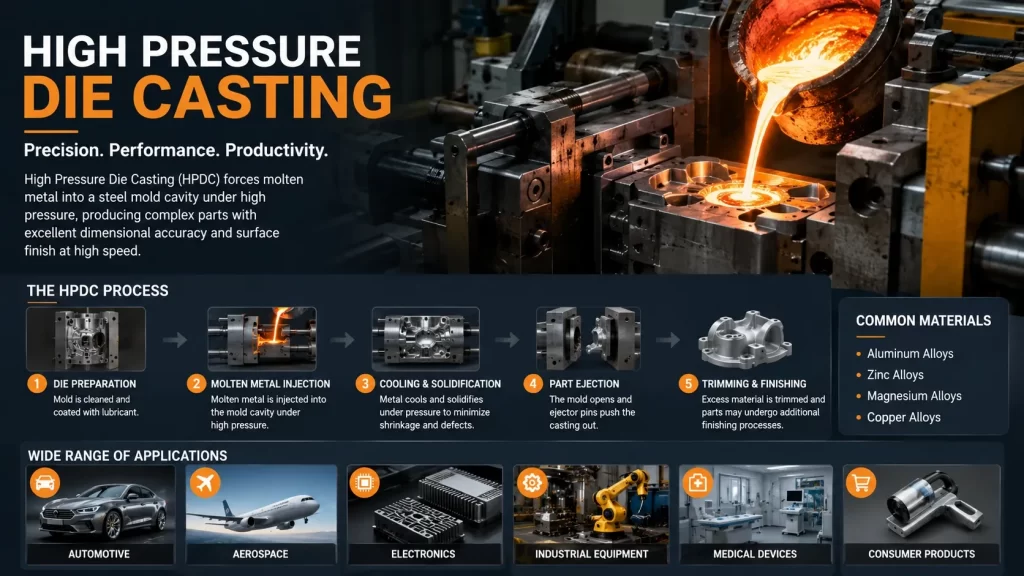
With the ever-shortening production cycles and precision requirements of manufacturers, HPDC has become a key technology in today's metal production.
This guide provides an overview of the process of high pressure die casting, its benefits and its uses, limitations and comparison with other casting methods.
What Is High Pressure Die Casting?
High pressure die casting is an extremely high pressure metal casting method that squirts molten metal into a hardened steel mold (die). The molten alloy quickly flows through the mold cavity into all areas before it cools and hardens into the final form.
When the casting is set, the mold opens up automatically, the casting is removed by the ejector pins and the mold is closed for the next casting process.
HPDC can be used thousands, or even hundreds of thousands, of times by the same mold making it ideal for large volume manufacturing where consistency and productivity are paramount.
How Does High Pressure Die Casting Work?
The basic HPDC process is composed of several important steps although process adjustments may be needed for different products.
1. Die Preparation
Before each production cycle, the steel mold is thoroughly cleaned and coated with a release lubricant.
There are a number of functions for this lubrication:
- Controls mold temperature
- Prevents molten metal from sticking
- Extends mold life
- Improves part removal
Consistent quality over long production runs is maintained with good die preparation.
2. Molten Metal Injection
Once the alloy has achieved the desired melt temperature it is fed into the injection system.
The molten metal is pumped at very high speeds and pressures through a hydraulic plunger to completely fill the intricate features as the metal cools down in the die cavity.
Depending on the alloy, machine and component design, injection pressures can be several thousand PSI up to much more than 20,000 PSI.
3. Cooling and Solidification
After the mold has been filled, pressure is kept as the metal cools.
Holding pressure helps:
- Minimize shrinkage
- Improve dimensional stability
- Reduce internal defects
- Produce dense metal structures
The time for cooling depends on the material, thickness of the wall and the design of the mold.
4. Part Ejection
Once solidified, the die opens on its own.
The casting is pushed out of the mold by the built-in ejector pins, which will not harm delicate features.
Today's die casting machines can do all this in just a few seconds.
5. Trimming and Finishing
Once removed, excess material, like runners, gates and flash, are cut off.
Other finishing processes that can be added:
- CNC machining
- Drilling
- Tapping
- Powder coating
- Polishing
- Anodizing
- Painting
A significant number of the parts of HPDC have excellent dimensional accuracy and require minimal secondary machining.
Hot Chamber vs. Cold Chamber Die Casting
High pressure die casting generally uses one of two machine types.
Hot Chamber Die Casting
Hot chamber machines keep the injection mechanism immersed in molten metal.
Advantages include:
- Extremely fast cycle times
- High productivity
- Lower maintenance
- Excellent for small components
Common materials include:
- Zinc
- Magnesium
- Lead alloys
Cold Chamber Die Casting
Cold chamber machines transfer molten metal into the injection chamber for every cycle.
This process is suitable for alloys with higher melting temperatures.
Common materials include:
- Aluminum
- Brass
- Copper alloys
- Some magnesium alloys
Cold chamber casting dominates automotive and structural aluminum manufacturing because it can handle high-temperature metals efficiently.
Common Materials Used in HPDC
Several non-ferrous metals perform exceptionally well in high pressure die casting.
Aluminum
Aluminum is the most widely used HPDC material because it offers:
- Excellent strength-to-weight ratio
- Good corrosion resistance
- High thermal conductivity
- Outstanding machinability
Common applications include:
- Engine housings
- Electric vehicle components
- Electronic enclosures
- Heat sinks
Zinc
Zinc alloys provide:
- Outstanding dimensional precision
- Excellent surface finish
- High strength
- Long die life
Ideal for:
- Consumer products
- Hardware
- Electrical connectors
- Decorative parts
Magnesium
Magnesium is valued for its extremely low weight.
Typical applications include:
- Aerospace parts
- Automotive interiors
- Portable electronics
- Power tools
Advantages of High Pressure Die Casting
Exceptional Production Speed
HPDC is one of the fastest metal manufacturing processes available.
Cycle times are often measured in seconds, making it ideal for mass production.
Outstanding Dimensional Accuracy
Precision steel tooling allows manufacturers to produce repeatable components with tight tolerances.
Many castings require little or no additional machining.
Excellent Surface Finish
Die cast components often have smooth, attractive surfaces that are suitable for painting, powder coating, plating, or anodizing.
Complex Geometry
HPDC easily produces features such as:
- Thin walls
- Internal ribs
- Bosses
- Mounting holes
- Threads
- Complex curves
These features would be difficult or expensive using traditional machining.
Reduced Manufacturing Costs
Although tooling costs are relatively high, unit costs become very low during high-volume production.
Manufacturers benefit from:
- Reduced labor
- Faster production
- Less material waste
- Lower finishing costs
Excellent Repeatability
Because production is highly automated, every casting closely matches the previous one, ensuring consistent product quality.
Limitations of High Pressure Die Casting
While HPDC offers many advantages, it may not suit every manufacturing project.
Potential limitations include:
- High initial tooling investment
- Less economical for low-volume production
- Limited to non-ferrous alloys
- Possible porosity in certain designs
- Tooling modifications can be expensive after production begins
For prototypes or small production quantities, CNC machining or investment casting may be more cost-effective.
Industries That Use High Pressure Die Casting
HPDC serves numerous industries requiring precision metal components.
Automotive
The automotive industry is the largest user of HPDC technology.
Common parts include:
- Transmission housings
- Engine blocks
- Oil pans
- Motor housings
- Suspension components
- EV battery enclosures
Aerospace
Manufacturers use lightweight aluminum and magnesium castings for:
- Structural brackets
- Engine components
- Aircraft housings
- Precision mechanical parts
Medical Equipment
Medical manufacturers rely on HPDC for:
- Surgical instruments
- Diagnostic equipment
- Imaging device housings
- Precision hardware
Electronics
HPDC produces many electronic products including:
- Heat sinks
- LED lighting housings
- Communication equipment
- Power supply enclosures
- Industrial controllers
Industrial Machinery
Industrial equipment often includes die cast:
- Pump housings
- Motor covers
- Gearbox casings
- Machine brackets
High Pressure vs. Low Pressure Die Casting
Although both processes produce quality metal components, they serve different manufacturing requirements.
| Feature | High Pressure Die Casting | Low Pressure Die Casting |
|---|---|---|
| Production Speed | Very High | Moderate |
| Surface Finish | Excellent | Good |
| Dimensional Accuracy | Excellent | Good |
| Tooling Cost | High | Moderate |
| Production Volume | High | Medium |
| Thin Wall Capability | Excellent | Limited |
| Cycle Time | Seconds | Several minutes |
Manufacturers typically choose HPDC when productivity, precision, and high-volume output are top priorities.
Is High Pressure Die Casting Right for Your Project?
HPDC is an excellent choice if your project requires:
- Large production quantities
- Tight dimensional tolerances
- Lightweight metal components
- Smooth surface finishes
- Complex geometries
- Reduced machining costs
- Consistent quality
Other production methods might be more flexible if you're making just a few parts or if you're constantly making changes to designs.
Conclusion
High Pressure Die Casting is still one of the most advanced manufacturing processes of producing precision metal parts on a large scale. This versatility in speed, precision, repeatability, and cost-effectiveness makes it essential in sectors such as automotive, aerospace, electronics, and the medical devices industry.
In long production runs, by choosing the right alloy, machine and design of the die, manufacturers can obtain excellent product quality at low cost. From making lightweight parts for automobiles to precision industrial housings, HPDC offers a dependable answer to challenging applications and mass production.
Talk to the Manufacturer, Not a Middleman
Resources & Insights
-
 Hide blog post
CNC Machining Robotic Parts: How GD&T Controls Robot Assembly Accuracy
2026-09-24By KT Engineering -
 Hide blog post
Hardware Stamping Springback Control for High-Strength Steel Parts
2026-09-24By KT Engineering -
 Hide blog post
Spring Stamping Fatigue Life: How Geometry, Material and Edge Quality Affect Cycle Life
2026-09-24By KT Engineering -
 Hide blog post
Mechanical Automation Parts for Robot End Effectors and Positioning Accuracy
2026-09-23By KT Engineering