Contact Us
  Home /
 how much is a cnc machine


Table of Contents

Purchasing a CNC (Computer Numerical Control) machine is a significant investment for manufacturers, machine shops and entrepreneurs. Whether you are starting a new machining company or you want to increase your production space, it is crucial to know how to price CNC machines.
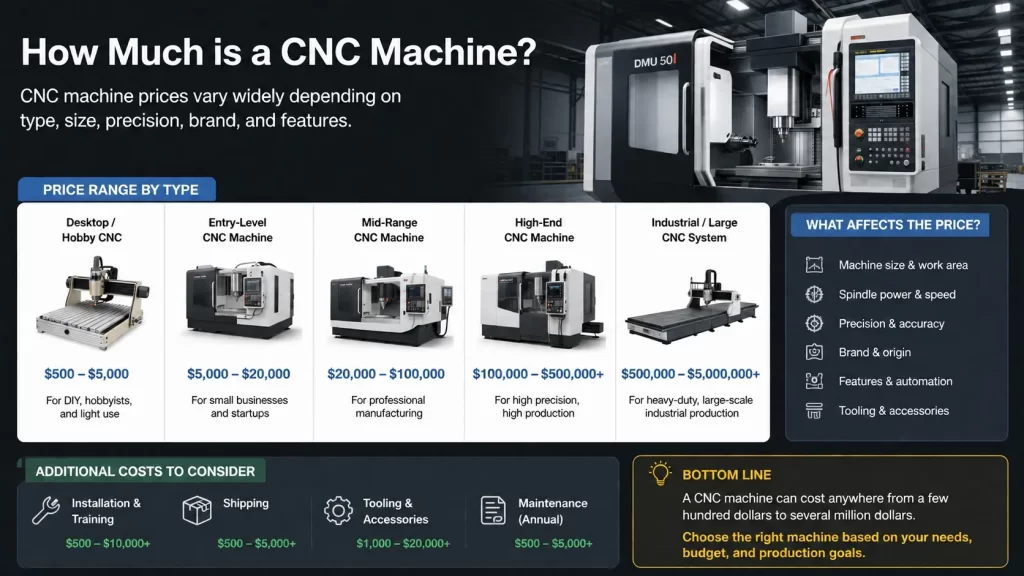
Given that, how much is the cost of a CNC machine?
The answer is related to the following factors: machine type, machine size, precision, level of automation, spindle power and brand. Entry-level desktop CNC routers range in cost from just a few hundred dollars up, while there are 5-axis machining centers available for industrial use that can cost more than $500,000.
This guide tells you the ranges of CNC machine prices, what factors affect the price and what other costs may be hidden, and advises you on how to choose the best machine for your business.
Average CNC Machine Price by Type
Below are the typical investment ranges for various CNC machines.
| CNC Machine Type | Typical Price Range |
|---|---|
| Desktop CNC Router | $300 – $3,000 |
| Hobby CNC Machine | $1,000 – $5,000 |
| CNC Wood Router | $3,000 – $30,000 |
| Entry-Level CNC Mill | $25,000 – $80,000 |
| Vertical Machining Center (VMC) | $60,000 – $200,000 |
| CNC Lathe | $30,000 – $180,000 |
| Horizontal Machining Center | $150,000 – $500,000 |
| 5-Axis CNC Machine | $180,000 – $1,000,000+ |
These prices are representative of the market prices. The final product price depends upon machine specifications, automation, tooling package, installation and manufacturer support.
What Determines CNC Machine Cost?
Several technical and business factors directly affect the final purchase price.
1. Machine Type
Different CNC machines are designed for different manufacturing applications.
For example:
- CNC routers are ideal for wood, plastics, and composites.
- CNC mills are built for precision metal machining.
- CNC lathes specialize in cylindrical parts.
- Multi-axis machining centers handle highly complex aerospace and medical components.
Machines capable of processing harder materials with tighter tolerances generally cost more.
2. Number of Axes
One of the biggest pricing factors is the number of controlled axes.
- 3-axis CNC machines are the most affordable.
- 4-axis machines improve productivity.
- 5-axis machines dramatically reduce setups while machining complex geometries.
- Advanced multi-tasking systems combine milling and turning functions.
For other axes, the controller and servo system as well as the software must become more complex, resulting in a higher price and maintenance costs.
3. Machine Size
The machine's working envelope significantly affects pricing.
Larger machines require:
- Stronger frames
- Longer guideways
- More powerful motors
- Higher structural rigidity
The larger the mold, the more expensive the machine is likely to be, and most manufacturers that machine large molds, aircraft components or oversized aluminum parts use larger machines.
4. Precision Requirements
Higher precision demands better machine construction.
Premium CNC machines feature:
- High-quality linear guides
- Ball screws
- Thermal compensation
- High-resolution encoders
- Superior spindle accuracy
When your business is in the aerospace, automotive, or medical industry, higher accuracy can frequently pay off in the long-term.
5. Spindle Performance
The spindle largely determines cutting capability.
Important specifications include:
- Horsepower
- Torque
- Maximum RPM
- Cooling system
The high performance spindle allows faster material removal, significantly reduced cycle times and better surface finishes.
6. Automation Features
Modern CNC machines increasingly include automation options such as:
- Automatic tool changers (ATC)
- Pallet changers
- Robotic loading systems
- Automatic probing
- Tool monitoring
Automation may require a higher start-up cost, but it will make for more productive and less costly work.
Hidden Costs Beyond the Purchase Price
When purchasing their first rod mill, many buyers are only interested in what the machine will cost them when they buy it.
Tooling
Additional expenses include:
- End mills
- Drill bits
- Tool holders
- Collets
- Inserts
High-quality tooling is essential for maintaining machining accuracy.
CAD/CAM Software
It is a fact that most of the CNC processes will necessitate the use of programming software.
Often, popular CAM packages demand an annual subscription or license fee.
Software prices vary from a few hundred dollars to a few thousand dollars per year, depending on their features.
Installation
Industrial CNC machines often require:
- Freight
- Rigging
- Foundation preparation
- Electrical upgrades
- Compressed air systems
Installation costs can add thousands of dollars to the project budget.
Operator Training
Even user-friendly CNC systems require skilled operators.
Training improves:
- Machine utilization
- Programming efficiency
- Safety
- Production quality
Investing in operator education reduces costly mistakes.
Maintenance
Routine maintenance includes:
- Lubrication
- Coolant replacement
- Spindle servicing
- Filter replacement
- Ball screw inspection
- Calibration
Preventive maintenance extends machine life while minimizing unexpected downtime.
New vs. Used CNC Machines
Many buyers debate whether purchasing used equipment makes financial sense.
Buying New
Advantages include:
- Full warranty
- Latest controller technology
- Better energy efficiency
- Manufacturer support
- Higher reliability
Disadvantages:
- Higher upfront investment
Buying Used
Advantages:
- Lower purchase price
- Faster return on investment
- Availability of discontinued models
Potential disadvantages:
- Unknown maintenance history
- Limited warranty
- Older control systems
- Higher repair risks
A professional inspection is strongly recommended before purchasing used industrial machinery.
Should Small Businesses Buy a CNC Machine?
Owning a CNC machine is not always the best option.
Buying a machine makes sense if you:
- Produce parts consistently
- Need tighter quality control
- Want shorter lead times
- Plan long-term production growth
However, outsourcing CNC machining may be more economical for low-volume production or prototype work.
Carefully compare equipment investment with expected annual production volume before making a decision.
Tips for Choosing the Right CNC Machine
Instead of buying the largest or most expensive machine, focus on matching equipment to your production requirements.
Ask yourself:
- What materials will I machine?
- What part sizes are typical?
- How many parts will I produce each month?
- What tolerances are required?
- Do I expect future production growth?
- How much shop space is available?
- Is reliable local service available?
While it's true that the cheapest machine may be the best choice in some cases, selecting the right machine for the production requirements is typically a more cost-effective option.
Maximizing Return on Investment
To improve ROI:
- Purchase only the capacity you currently need.
- Invest in quality tooling.
- Schedule preventive maintenance.
- Train operators regularly.
- Use efficient CAM programming.
- Reduce setup time through better fixturing.
- Monitor machine utilization.
Reliable machine operation and good working practices can help boost profits more than buying the cheapest machine.
Frequently Asked Questions
What is the cheapest CNC machine available?
The price of desktop CNC routers ranges from $300 and up, and are great for hobbyists, education and light duty engraving projects.
How much does an industrial CNC machine cost?
The price of industrial CNC mills and lathes vary from $50,000 to exceeding $500,000, depending on size, automation, and machining capabilities.
Is buying a used CNC machine worth it?
The key is that you are buying a used CNC machine that has been maintained and inspected thoroughly, in order to save a lot of money.
Many buyers do not appreciate the cost of tooling, software, installation, maintenance, and training for operators. These costs can use up a lot of money during the first year of owning a house.
Final Thoughts
The cost of a CNC machine depends on the application in manufacturing that needs the machine. The price of entry level desktop systems can be in the hundreds of dollars, whereas advanced industrial machining centers can be in the hundreds of thousands of dollars.
Take a look at the total cost of ownership, forecasted production volume, machine reliability, service support and long term business requirements, in addition to the purchase price. The long-term benefits of a properly selected CNC machine for years of productivity, better part quality, lower labor costs and a high ROI make it a worthwhile investment.
Talk to the Manufacturer, Not a Middleman
Resources & Insights
-
 Hide blog post
CNC Machining Robotic Parts: How GD&T Controls Robot Assembly Accuracy
2026-09-24By KT Engineering -
 Hide blog post
Hardware Stamping Springback Control for High-Strength Steel Parts
2026-09-24By KT Engineering -
 Hide blog post
Spring Stamping Fatigue Life: How Geometry, Material and Edge Quality Affect Cycle Life
2026-09-24By KT Engineering -
 Hide blog post
Mechanical Automation Parts for Robot End Effectors and Positioning Accuracy
2026-09-23By KT Engineering