Contact Us
  Home /
 Top Metal Stamping Manufacturer in the USA


Table of Contents
- What Is Metal Stamping?
- Why Choose a U.S. Metal Stamping Manufacturer?
- Key Capabilities to Look For
- Industries That Depend on Precision Metal Stamping
- Why Custom Metal Stamping Matters
- Quality Control Makes the Difference
- Questions to Ask Before Choosing a Metal Stamping Partner
- The Value of Full-Service Manufacturing
- Future Trends in Metal Stamping
- Final Thoughts

Choosing the right USA metal stamping manufacturer is crucial in today's competitive manufacturing landscape, as it can influence product quality, production expenses, and timelines. From automotive, aerospace, medical, electronics, industrial equipment and renewable energy to many other industries, precision-stamped metal parts are vital for the safe running of a product.
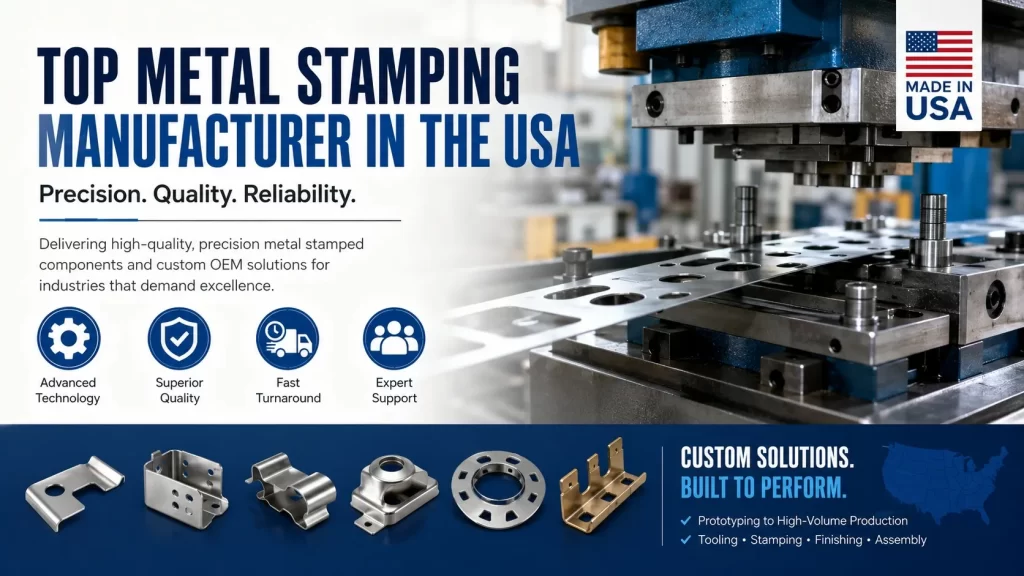
The trusted American metal stamping supplier is more than just a production partner, they become a long-term manufacturing partner that can aid during engineering, prototyping, tooling, quality control and high volume manufacturing.
This guide will outline the properties of metal stamping; why U.S. manufacturers have led the industry; and what criteria you should use when selecting the right supplier.
What Is Metal Stamping?
Metal stamping is a high efficiency manufacturing process in which flat metal plates are stamped into precision parts by applying precision dies and stamping presses. This process allows for manufacturing of complex components with high precision and repeatability while reducing material waste and manufacturing expenses.
Common metal stamping operations are as follows:
- Progressive die stamping
- Deep draw stamping
- Fine blanking
- Four-slide stamping
- Transfer die stamping
- Precision sheet metal stamping
- Micro stamping
These methods enable one to make millions of parts with very low tolerances.
Why Choose a U.S. Metal Stamping Manufacturer?
While global sourcing is the norm, numerous OEMs are still relying on American manufacturers due to their engineering prowess, quality, and reliability.
1. Superior Manufacturing Quality
Advanced production machinery, automated inspection systems, and highly-trained engineers are all investments that top U.S. manufacturers make. This results in:
- Tight tolerances
- Excellent repeatability
- Stable production quality
- Reduced defect rates
Precision is a crucial requirement in industries like aerospace, defense, medical devices, and automotive applications, making quality assurance particularly significant.
2. Faster Lead Times
Working with a domestic supplier helps reduce:
- International shipping delays
- Customs clearance issues
- Communication barriers
- Supply chain disruptions
A shorter period of product launch can also be achieved with faster development of prototypes.
3. Better Engineering Support
The skilled metal stamping companies are not just making components, they're working with their customer during the development of your product.
Engineering teams may often help with:
- Design for Manufacturability (DFM)
- Material selection
- Tool design
- Cost optimization
- Prototype improvements
Involving engineers early in the process often saves money and enhances the performance of the product.
Key Capabilities to Look For
Not all the stamping companies are equal in their experience. Check the following capabilities prior to picking a supplier.
Custom Tooling
High-quality tooling determines:
- Part accuracy
- Production efficiency
- Tool life
- Manufacturing consistency
Generally, manufacturers that have an internal tool and die department offer superior process control and turnaround time for changes.
Material Expertise
There should be a variety of materials for the professional stamping companies to work on:
- Stainless steel
- Carbon steel
- Aluminum
- Brass
- Copper
- Phosphor bronze
- Beryllium copper
- Nickel alloys
The type of material you need will depend on the strength, conductivity, corrosion resistance, and environmental conditions of your application.
Advanced Equipment
Modern facilities often utilize:
- CNC machining
- Progressive die presses
- Wire EDM
- Automated inspection systems
- Vision measurement technology
- CAD/CAM software
These technologies improve accuracy while increasing production efficiency.
Industries That Depend on Precision Metal Stamping
Metal stamping supports nearly every manufacturing industry.
Automotive
Applications include:
- Brackets
- Battery contacts
- Clips
- Electrical terminals
- Seat components
- Structural reinforcements
The growth of electric vehicles will drive up the demand for precision electrical contacts and lightweight stamped components.
Aerospace
Aerospace vehicles need lightweight and strong metal parts that are extremely precise.
Common Aerospace Components include:
- Mounting brackets
- Clips
- Connectors
- Shielding components
- Structural hardware
Medical Devices
Medical manufacturers rely on precision stamping for:
- Surgical instruments
- Implant components
- Medical clips
- Electrical contacts
- Diagnostic equipment
Strict quality requirements make experienced manufacturers essential.
Electronics
Consumer electronics and industrial electronics frequently use stamped components such as:
- Battery contacts
- EMI shields
- Connectors
- Spring contacts
- Terminal clips
Small tolerances are critical for electronic reliability.
Industrial Equipment
Heavy machinery and industrial automation systems utilize stamped components for:
- Fastening systems
- Springs
- Retainers
- Structural brackets
- Mechanical assemblies
Why Custom Metal Stamping Matters
Off-the-shelf components cannot always satisfy specialized engineering requirements.
Custom metal stamping provides:
- Exact dimensions
- Improved product performance
- Better assembly compatibility
- Reduced secondary operations
- Lower long-term production costs
Experienced manufacturers work closely with customers throughout product development to ensure every component meets functional and manufacturing requirements.
Quality Control Makes the Difference
Reliable manufacturers build quality into every production stage rather than inspecting only finished products.
Look for suppliers that provide:
- ISO-certified quality systems
- First article inspection
- Statistical Process Control (SPC)
- Automated vision inspection
- Material traceability
- Continuous process monitoring
Consistent quality reduces scrap, warranty claims, and costly production delays.
Questions to Ask Before Choosing a Metal Stamping Partner
Before requesting a quote, consider asking:
- How many years of stamping experience do you have?
- Do you offer design assistance?
- Is tooling produced in-house?
- What materials can you process?
- Can you support prototyping and high-volume production?
- What quality certifications do you maintain?
- Which industries do you currently serve?
- What are your standard lead times?
The responses will do a lot to gauge whether the supplier can accommodate the production requirements of your company in the present and the future.
The Value of Full-Service Manufacturing
In many instances, a full service metal stamping company is chosen over having to deal with various suppliers.
A full-service manufacturer can offer:
- Product design consultation
- Prototype development
- Tool and die manufacturing
- Precision stamping
- Secondary machining
- Surface finishing
- Assembly
- Packaging
- Inventory management
- Logistics support
This comprehensive solution streamlines the communication process, reduces production time, and enhances overall project efficiency.
Future Trends in Metal Stamping
The metal stamping industry keeps on advancing with automation and digital manufacturing technologies.
Current trends include:
- Smart factory automation
- AI-assisted quality inspection
- Real-time production monitoring
- Sustainable manufacturing practices
- Lightweight material processing
- Electric vehicle component production
- High-speed precision stamping
Companies that have embraced advanced technology are more likely to keep up with the needs of today's industries.
Final Thoughts
When looking for the top metal stamping manufacturer in the USA, it's not only price that matters. The ultimate manufacturing partner is one that possesses engineering skills, high-tech equipment, quality control and customer responsiveness to ensure a long-term, reliable manufacturing performance.
From prototype development to custom tooling to precision sheet metal stamping to high volume production, working with an experienced U.S. manufacturer can help ensure a high-quality product, mitigate supply chain risk, and streamline time to market.
Through conducting technical evaluations, industry experience assessments, material knowledge and quality system reviews, OEMs can establish sustainable partnership relationships that foster innovation and sustainable growth.
Talk to the Manufacturer, Not a Middleman
Resources & Insights
-
 Hide blog post
CNC Machining Robotic Parts: How GD&T Controls Robot Assembly Accuracy
2026-09-24By KT Engineering -
 Hide blog post
Hardware Stamping Springback Control for High-Strength Steel Parts
2026-09-24By KT Engineering -
 Hide blog post
Spring Stamping Fatigue Life: How Geometry, Material and Edge Quality Affect Cycle Life
2026-09-24By KT Engineering -
 Hide blog post
Mechanical Automation Parts for Robot End Effectors and Positioning Accuracy
2026-09-23By KT Engineering