Contact Us
  Home /
 Custom Metal Stamping Services


Table of Contents
- What Is Metal Stamping?
- How the Metal Stamping Process Works
- Common Types of Metal Stamping
- Popular Materials for Metal Stamping
- Advantages of Metal Stamping
- Limitations of Metal Stamping
- Industries That Use Metal Stamping
- Design Tips for Better Metal Stamped Parts
- Choosing the Right Metal Stamping Manufacturer
- Conclusion

One of the most efficient manufacturing methods for mass production of high precision metal components is metal stamping. Whether it's automotive brackets, electronic connectors, medical device housings, or industrial hardware, custom metal stamping offers unparalleled repeatability, high production speed, and low per-part costs.
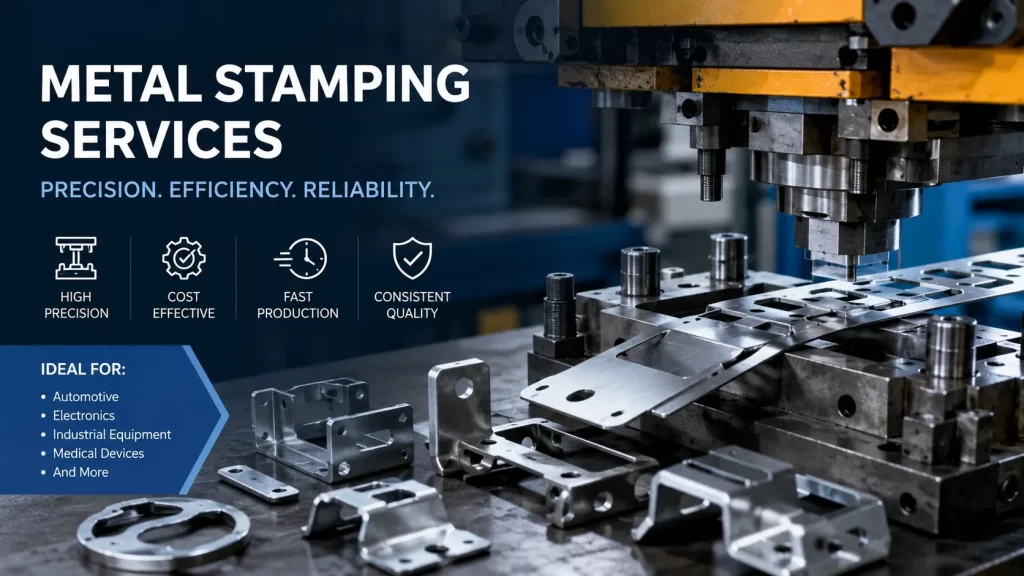
If you're a new product developer or a production scale-up, knowing the metal stamping process can ensure you select the most appropriate manufacturing solution. This guide will outline the metal stamping process, some of the most common techniques used for metal stamping, the various materials available, the benefits of metal stamping, design considerations for metal stamping and how to choose a reliable metal stamping manufacturing partner.
What Is Metal Stamping?
Metal stamping is a cold forming process that utilizes specialized dies, high tonnage stamping presses and flat metal sheets or coils to produce finished components. Instead of cutting or stamping out content such as CNC machining, stamping is a method that forms metal parts by means of controlled force, which is suitable for mass production of duplicate parts.
Several operations can be used in a complete stamping process, such as:
- Blanking
- Punching
- Piercing
- Bending
- Embossing
- Coining
- Forming
- Drawing
Depending on the complexity of the component the operations can be made in one action or in several progressive actions.
How the Metal Stamping Process Works
The production workflow generally follows these steps:
1. Design and Engineering
Engineers develop CAD models and analyze manufacturability and determine the right materials, tolerances and tooling options.
2. Tool and Die Manufacturing
Precision dies are made to fit the geometry desired. Quality tooling is important as it directly influences dimensional accuracy, consistency and production efficiency.
3. Material Preparation
Metal sheets and coils are chosen based on thickness, mechanical properties, corrosion resistance, and formability.
4. Stamping Operation
The material is then passed through a stamping press where the punch presses the material into or through the die. There can be several stages of forming in an operation, depending on the project.
5. Secondary Processing
Finished parts may require:
- Deburring
- Heat treatment
- Surface polishing
- Powder coating
- Electroplating
- Anodizing
- Passivation
- Welding
- Assembly
6. Quality Inspection
Precision measuring tools are used to check critical dimensions, flatness, hole location and surface finishes to ensure that all parts are correct.
Common Types of Metal Stamping
Progressive Die Stamping
Progressive die stamping is where a continuous metal strip is fed through different stations. At each station, one operation is executed, before the final separation of the finished component.
Advantages include:
- Extremely high production efficiency
- Excellent repeatability
- Lower cost per part
- Ideal for large production volumes
Typical applications include electrical terminals, automotive clips, connectors, and brackets.
Transfer Die Stamping
Transfer stamping moves individual workpieces between separate dies rather than keeping them attached to a strip.
This process works well for:
- Larger parts
- Deep geometries
- Complex multi-stage forming
Deep Draw Stamping
Deep drawing forms deep cavities and cup-shaped components while maintaining structural integrity.
Common products include:
- Metal containers
- Battery housings
- Medical equipment
- Automotive fuel components
Four-Slide Stamping
Four-slide stamping uses four independent sliding tools to form complex components from multiple directions.
It is widely used for:
- Springs
- Clips
- Fasteners
- Electronic contacts
Popular Materials for Metal Stamping
Material selection depends on strength requirements, corrosion resistance, conductivity, and cost.
Carbon Steel
Carbon steel offers excellent strength, affordability, and formability, making it one of the most common stamping materials.
Applications include:
- Structural brackets
- Mounting plates
- Industrial hardware
Stainless Steel
Stainless steel provides outstanding corrosion resistance and durability.
Popular grades include:
- 301 Stainless Steel
- 304 Stainless Steel
- 316 Stainless Steel
These alloys are widely used in food processing, medical equipment, aerospace, and marine industries.
Aluminum
Aluminum combines lightweight properties with excellent corrosion resistance and good formability.
Typical applications include:
- Automotive components
- Consumer electronics
- Aerospace assemblies
Copper
Copper offers superior electrical and thermal conductivity.
Common stamped products include:
- Bus bars
- Electrical connectors
- Switch contacts
Brass
Brass provides attractive appearance, corrosion resistance, and excellent machinability.
It is frequently used for:
- Decorative hardware
- Plumbing fittings
- Electrical terminals
Advantages of Metal Stamping
Metal stamping remains one of the most cost-effective production methods for sheet metal parts.
High Production Speed
Modern stamping presses can manufacture hundreds or even thousands of parts per hour, making the process ideal for mass production.
Excellent Repeatability
Precision tooling ensures every component maintains consistent dimensions across large production runs.
Lower Manufacturing Cost
Although tooling requires an upfront investment, the cost per part decreases dramatically as production volume increases.
Tight Tolerances
Well-designed stamping systems achieve precise dimensional accuracy suitable for demanding industries such as aerospace, electronics, and medical manufacturing.
Material Efficiency
Optimized nesting layouts reduce material waste, improving overall production efficiency and lowering manufacturing costs.
Scalable Production
Metal stamping supports:
- Prototype runs
- Low-volume production
- Medium-volume manufacturing
- High-volume production exceeding millions of parts annually
Limitations of Metal Stamping
Despite its advantages, metal stamping is not suitable for every project.
Potential limitations include:
- High initial tooling investment
- Longer lead times for die manufacturing
- Design modifications may require new tooling
- Less economical for extremely small production quantities
For prototypes or limited production runs, CNC machining or laser cutting may offer greater flexibility.
Industries That Use Metal Stamping
Metal stamping supports nearly every manufacturing sector.
Automotive
Manufacturers produce:
- Chassis components
- Seat brackets
- Engine brackets
- Heat shields
- Structural reinforcements
Electronics
Precision stamping creates:
- Connectors
- Shielding components
- Battery contacts
- Terminal pins
Aerospace
Lightweight stamped components help reduce aircraft weight while maintaining structural strength.
Medical
Medical manufacturers rely on stamped parts for:
- Surgical instruments
- Implant components
- Diagnostic equipment
- Medical device housings
Industrial Equipment
Stamped components are commonly found in:
- Control cabinets
- HVAC systems
- Agricultural machinery
- Robotics
- Automation equipment
Design Tips for Better Metal Stamped Parts
To improve manufacturability and reduce production costs:
- Maintain consistent material thickness.
- Avoid extremely sharp inside corners.
- Design holes with appropriate spacing.
- Minimize unnecessary bends.
- Use standard material sizes whenever possible.
- Consult manufacturers during the early design stage.
Design optimization often reduces tooling complexity while improving product quality.
Choosing the Right Metal Stamping Manufacturer
Look for a manufacturing partner that has more than just stamping equipment.
Look for suppliers that offer:
- Engineering support
- Design for Manufacturability (DFM) analysis
- Custom tooling development
- Prototype production
- ISO-certified quality management
- In-process inspection
- Flexible production capacity
- Surface finishing services
- Assembly capabilities
- Global logistics support
A seasoned manufacturer can assist to get products to market quickly and provide uniform product quality from prototype to mass production.
Conclusion
Metal stamping is still one of the most effective manufacturing methods to create competitive, durable and high precision metal components at low costs. It offers excellent repeatability, high production speed, and scalable manufacturing, making it suitable for various industries, including automotive, aerospace, electronics, and medical devices.
It is necessary to determine the right stamping method, material and manufacturing partners to enable optimal product quality and overall production costs. Through intelligent design, coupled with proven engineering expertise and accurate tooling, companies can realize reliable, high-volume production, with adherence to rigid quality standards and a faster time to market.
Talk to the Manufacturer, Not a Middleman
Resources & Insights
-
 Hide blog post
CNC Machining Robotic Parts: How GD&T Controls Robot Assembly Accuracy
2026-09-24By KT Engineering -
 Hide blog post
Hardware Stamping Springback Control for High-Strength Steel Parts
2026-09-24By KT Engineering -
 Hide blog post
Spring Stamping Fatigue Life: How Geometry, Material and Edge Quality Affect Cycle Life
2026-09-24By KT Engineering -
 Hide blog post
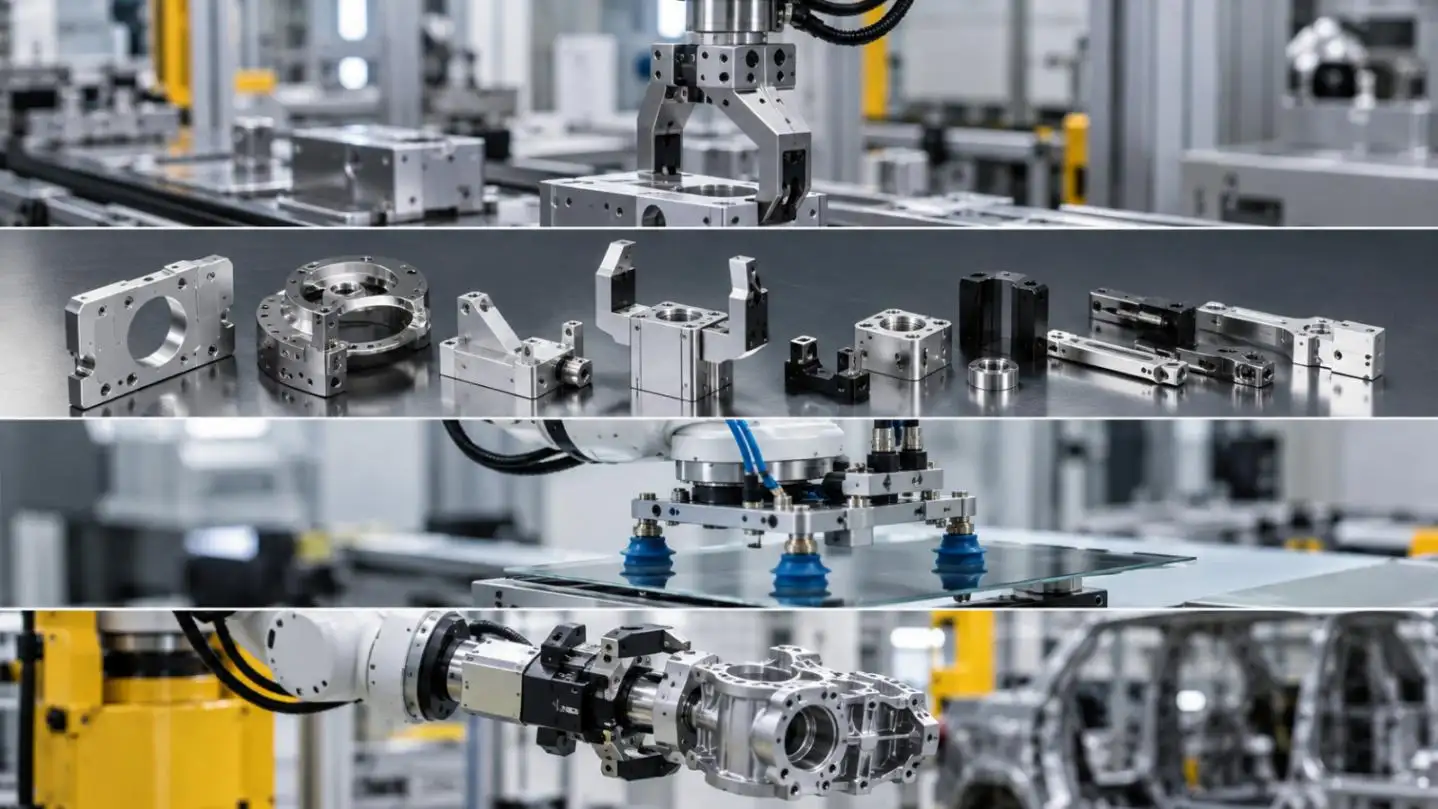
Mechanical Automation Parts for Robot End Effectors and Positioning Accuracy
2026-09-23By KT Engineering