Contact Us
  Home /
 Lightweight Aluminum Die Casting For New Energy Vehicle Parts


Table of Contents
- Why New Energy Vehicle Parts Use Aluminum Die Casting
- KT's Comprehensive Manufacturing Strategy for New Energy Vehicle Parts
- Precision CNC Machining of Aluminum Die-Cast Parts
- Dimensional Inspection and Quality Control
- Selection of Aluminum Alloys for Components in New Energy Vehicles
- Surface Finishing of Aluminum Die-Cast Components
- Applications Of Aluminum Die Casting For New Energy Vehicle Components
- Why Select KT For New Energy Vehicle Parts Manufacturing

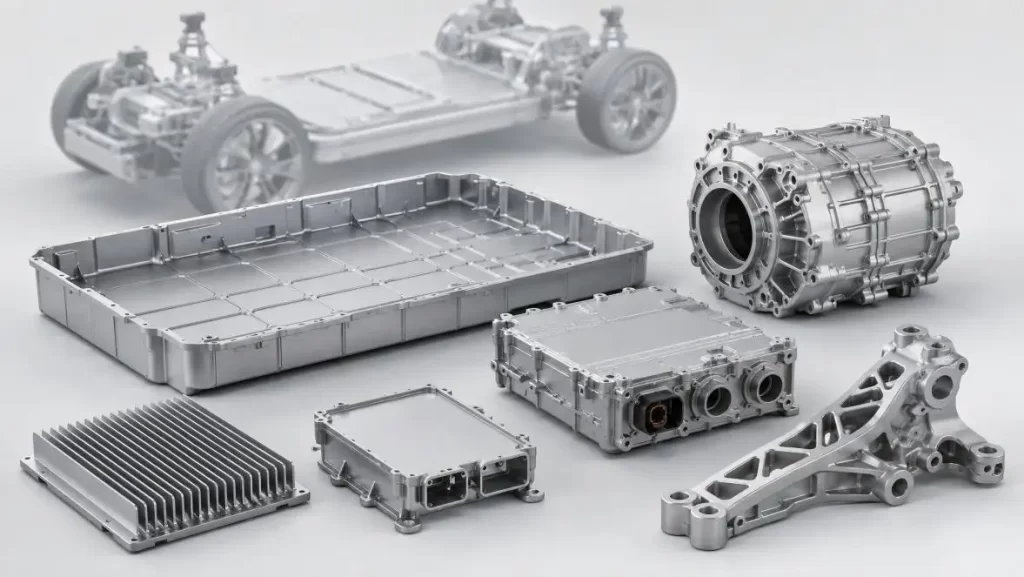
The growing market for electric vehicles (EVs) necessitates the development of sophisticated, lightweight, integrated, high-performance manufacturing technologies. Aluminum die casting is one such manufacturing technology whose characteristics (i.e. high adaptability for complex structures, lightweight, high production volume) are beneficial for manufacturing parts for new energy vehicles (NEVs). KT offers integrated manufacturing solutions from prototype to mass production including aluminum die casting, precision CNC machining, tooling, and surface finish to support the dynamic needs of the automotive industry.
Why New Energy Vehicle Parts Use Aluminum Die Casting
Parts of new energy vehicles (NEVs) must be lightweight, strong, and allow for heat dissipation, as well as be durable. For manufacturing of these parts, aluminum die casting is the suitable technology.
1. High Strength-to-Weight Performance
Parts manufactured through aluminum die casting allow for significant weight savings over traditional steel parts, while still allowing for component design.
In electric vehicles, every incremental mass reduction is beneficial as it may provide an improvement in energy efficiency and an increase in the driving range.
2. Complex Structural Integration
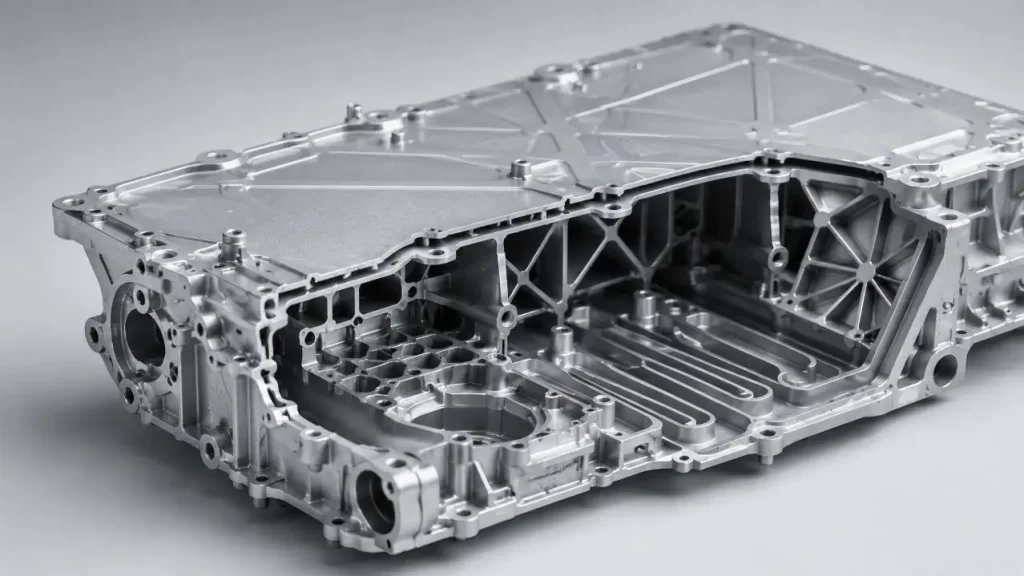
The high-pressure die casting process allows the manufacture of complex parts that can include multiple features such as:
• Internal ribs to strengthen the part
• Bosses for assembling parts
• Cooling channels for heat removal
• Reinforced sections to support loads
This design capability reduces part count and simplifies assemblies.
3. Thin-Wall Manufacturing Capability
With respect to modern aluminum die casting, the lower limit for wall thickness for castings is roughly 1.5 mm, although in some instances walls can be even thinner. The upper limit for wall thickness for thin wall die casting is about 5 mm. The precise limits for wall thickness for a given application can depend on a number of factors, including selection of the aluminum alloy, the design of the casting, as well as the overall dimensions of the part.
The ability to cast thin wall sections can help in the development of lightweight automotive designs that still meet performance requirements.
4. Constant High-Volume Production
After the necessary tooling for aluminum die casting has been completed, the production of automotive components through this manufacturing process can be done consistently in high volumes.
Aluminum die casting is capable of producing significant quantities of components with consistently high quality, thanks to the controlled parameters of the process.
KT's Comprehensive Manufacturing Strategy for New Energy Vehicle Parts
KT combines its die casting with its engineering, tooling, machining, and finishing capabilities to provide customers with a complete manufacturing solution.
The integrated approach shortens the customer's manufacturing value chain and ensures part consistency throughout its lifecycle.
1. From Tooling Development to Mass Production
Die Casting Tool Design And Optimization
Aluminum die casting tools must be designed for each specific application, taking into account the geometry of the part, the material, and the production requirements.
In the die tool design, the following factors must be analyzed:
• Flow of the molten metal into the cavity
• Cooling channel design
• Location of the parting line
• Ejection system
• Desired durability of the tool
Involvement of engineers in the early stages of tool design helps reduce risks associated with the manufacturing and enhances the stability of the casting process.
2. Design for Manufacturability (DFM) Support
Prior to beginning production, KT provides DFM guidance to optimize the die casting design of New Energy Vehicle parts.
The following design aspects will generally be modified for optimization:
• Consistent wall thickness
• Correct draft angle
• Low height ribs and bosses
• Excess stock for machining
• Production tolerances
Effective design improves the die-casting process and reduces the necessity for machining, thus creating a more efficient and less variable process.
3. Prototype and Low-Volume Production
KT performs prototype validation as a part of a new product's development cycle, providing:
• CNC machined aluminum prototypes.
• Rapid tooling.
• Low-volume production of castings.
This enables customers to review the structural performance, the compatibility of the components, and the thermal considerations before committing to the production of the full volume.
Precision CNC Machining of Aluminum Die-Cast Parts
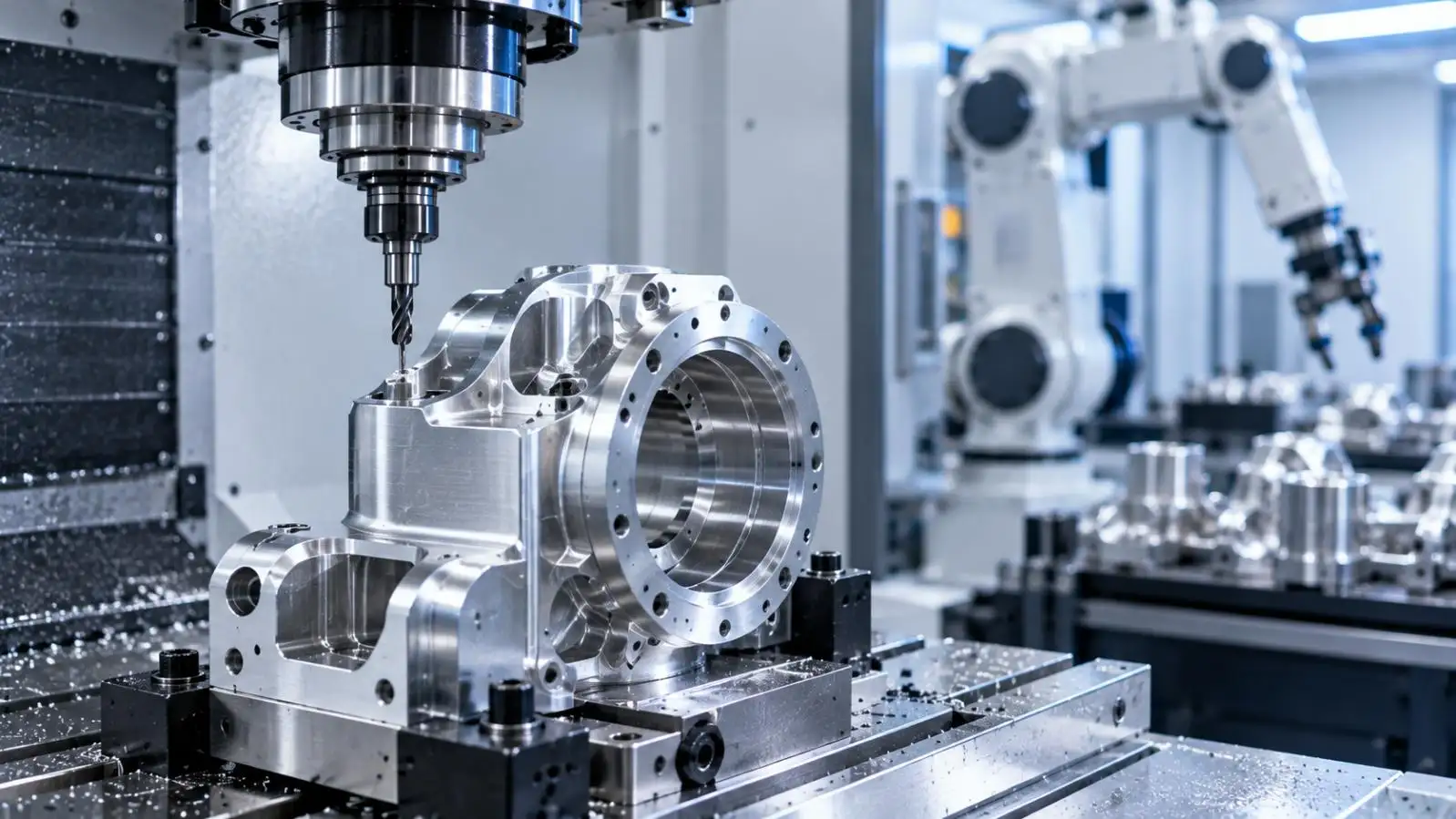
Most aluminum die-cast components for new energy vehicles require additional machining to create precision interfaces that are functionally satisfactory.
Commonly machined features are:
• Sealing surfaces
• Bearing bores
• Mounting holes
• Alignment references
• Precision assembly interfaces
KT has the capability of multi-axis machining, such as:
• 3-axis machining
• 4-axis machining
• 5-axis machining
For features that are critical machined, precision can be reached within the range of ±0.01 mm to ±0.05 mm based on component design, material condition, and the requirements of inspection.
Dimensional Inspection and Quality Control
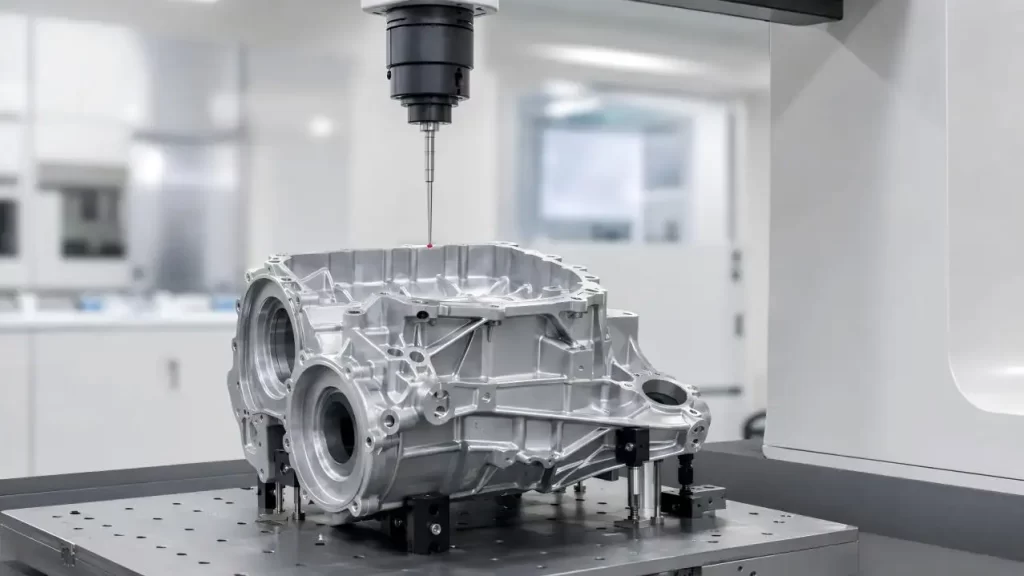
Automotive components demand and require consistency. KT implements thorough and systematic quality control for both the casting and machining processes.
The following outlines the stages of inspection and the associated methods:
| Inspection Stage | Method | Purpose |
| Examination of Raw Material | Alloy Identification and Input Inspection | Checks consistency of materials |
| Die Casting Procedure Control | Parameter Inspection and Sight Control | Establishes control for the stability of die cast |
| Inspection of CNC Machining | Measurement During Machining | Defines control for critical dimensions |
| CMM Inspection | Verification of coordinate measuring machine | Ensures geometric precision |
| Final Inspection | Checks for all dimensions and visual appearance | Checks compliance for shipment |
The following outlines requirements for accuracy and tolerance:
| Manufacturing Stage | Tolerance Level | Use |
| General As-Cast Features | ± 0.2 mm to ± 0.5 mm | Standard dimensions for cast |
| Precision As-Cast Features | ± 0.1 mm to ± 0.3 mm | Controlled Tooling |
| CNC Machined Features | ± 0.01 mm to ± 0.05 mm | Interfaces for assembly and sealing |
| Large Structural Components | ± 0.5 mm to ± 1.5 mm | Components forlarge battery housings |
The tolerance limit is influenced by the part dimensions, choice of alloy, tooling design, and manufacturing process.
Selection of Aluminum Alloys for Components in New Energy Vehicles
The choice of materials will impact how strong the components can be, how they will withstand corrosion, if they will conduct heat well, and how easily the components can be manufactured.
| Aluminum Alloy | Characteristics | Typical Applications |
| A380 / ADC12 | Good balance of mechanical properties, good machinability, excellent castability | Motor housings, inverter cases, electronic enclosures |
| A356 / AlSi10Mg | Ductility, good corrosion resistance, can be treated thermally | Structural components, battery tray supports |
| AlSi10MnMg | Good strength and crash performance | Lightweight structural automotive parts |
| Aluminum Thermal Alloys | Good potential for heat transfer | Heat sinks, thermal management components |
KT collaborates with clients to understand the demands of the particular application and the context of use in order to choose the most suitable alloys.
Surface Finishing of Aluminum Die-Cast Components
Finishing primarily enhances corrosion resistance, aesthetics, and durability of the cast components.
Some of the more common finishing options include:
• Anodizing
Oxide layer as finishing and protection improvement
• Powder Coating
High performance, durable protective finishing for structural components in and related to batteries as well as exterior components.
• Sandblasting And Polishing
Provides controlled surface texture to fulfill functional and aesthetic requirements.
• Conversion Coating
Improves protection against corrosion and paint compatibility. Dimensional stability is retained.
The choice of finishing method is driven by the environmental conditions that the component will be subject to and client preferences.
Applications Of Aluminum Die Casting For New Energy Vehicle Components
Aluminum die casting is extensively applied in the complete range of electric vehicle systems, including:
• Battery Systems
Lightweight, strong, and thermally manage structures are required for battery trays, covers, and battery systems housings.
• Motor And Inverter Housing
These systems require stability of the structure and good performance of heat transfer as well as high precision of the interfaces to be machined.
• Enclosures for On-Board Chargers and DC-DC Converters
Aluminum housings are used for mechanical protection, electromagnetic shielding, and thermal management.
• Structural Brackets and Mounts
Die-cast aluminum brackets help reduce vehicle weight and provide dependable positioning of components.
• Heat Dissipation Components
Aluminum heat sinks and other cooling components utilize aluminum's thermal conductivity for control of electronic component temperatures.
Why Select KT For New Energy Vehicle Parts Manufacturing
KT (KING TOOL) provides an all-in-one service package for the automotive industry that includes:
• Die casting for aluminum parts
• Development for die casting tools
• CNC machining with precision
• Finishing for surfaces
• Inspection of quality
• Validation of prototypes
• Support for mass production
Answers for our customers' challenges with the design of new energy vehicle parts are provided by our extensive experience with manufacturing and our DFM engineering support.
Final Observations
Lightweight aluminum die casting provides an efficient solution for manufacturing modern electric vehicle components. Combined with precision CNC machining and strict quality control, it enables new energy vehicle parts to achieve the required performance, durability, and accuracy.
KT provides complete manufacturing services to automotive clients. These services include pulling the entire process together facilitated by our tooling and manufacturing capabilities. Our customers can build dependable automotive parts and adjust to the evolving requirements of the EV sector.
FAQs
Q1. What die casting alloys does KT use for EV parts?
KT leverages A380, ADC12, A356, and AlSi10MnMg aluminum alloys for die casting.
Q2. What are the advantages of aluminum die casting for new energy vehicle parts?
Aluminum die casting is lightweight and allows for complex parts with fast production for high volumes.
Q3. What are die-cast aluminum parts tolerances?
As-cast tolerances are generally ±0.1 mm to 0.5 mm. However, NC machining can achieve tolerances of ±0.01 mm to 0.05 mm.
Q4. Can KT perform die casting and machining?
Yes, all aluminum die casting, machining, tooling, and finishing processes are available at KT.
Q5. What EV parts can aluminum die casting manufacture?
Aluminum die casting can make battery housings, motor cases, inverters, and brackets.
Talk to the Manufacturer, Not a Middleman
Resources & Insights
-
 Industry Insights
CNC Machining Robotic Parts: How GD&T Controls Robot Assembly Accuracy
2026-09-24By KT Engineering -
 Industry Insights
Hardware Stamping Springback Control for High-Strength Steel Parts
2026-09-24By KT Engineering -
 Industry Insights
Spring Stamping Fatigue Life: How Geometry, Material and Edge Quality Affect Cycle Life
2026-09-24By KT Engineering -
 Industry Insights
Mechanical Automation Parts for Robot End Effectors and Positioning Accuracy
2026-09-23By KT Engineering