Contact Us
  Home /
 Nylon Prototype Machining Services | CNC Nylon Prototyping Supplier


Table of Contents
-
Nylon Prototyping: CNC Solutions to the New Engineering
- What is Nylon Prototype Machining and Why is it Important
- CNC Nylon Prototype Machining Process
- Constructed to Be Used in Heavy-Duty Applications
- CNC Machining Nylon Technical Benefits
- Compared to Other Materials, Nylon CNC Machining is Better
- Advantages of Engineering Uses and Product Development
- CNC Nylon Machining Process in Industry Performance
- Combination with Advanced CNC Machining Projects
- Conclusion:

Nylon Prototyping: CNC Solutions to the New Engineering
- One of the key processes in the contemporary world of manufacturing that is fast-paced has become nylon prototype machining. It is used by engineers, designers, and product developers to transform ideas into real working parts. It is powerful, pliable, and possesses good wear resistance, and the cost of production is maintained.
- Our KTC CNC Machining business is committed to offering precision nylon prototype machining services to the automotive and robotics industries. Nylon lets you experiment, debug, and scale your product safely with or without a single prototype or low-volume manufacturing.
What is Nylon Prototype Machining and Why is it Important
Nylon prototype machining is the process of shaping nylon plastic into prototype components, which are functional, on the CNC machines. It is common in the field of engineering since nylon is powerful and at the same time, lightweight, and hence it can be tested in reality.
Compared to other plastics, nylon offers:
• High tensile strength
• Low friction performance
• Excellent impact resistance
• Good chemical stability
• Stressful service life.
Coupled with CNC machining of nylon prototypes, manufacturers are able to achieve extremely accurate shapes and tight tolerances that are vital in functional prototypes.
CNC Nylon Prototype Machining Process
The CNC nylon plastic machining service operation is a complex computer-controlled machine that cuts nylon to the desired shape. This guarantees that all the parts are highly matched with the CAD design.
Typical CNC techniques:
- Simple geometries (3-axis) CNC prototype machining.
- CNC machining of prototypes of nylon with complex and curved shapes.
- Quick prototyping, CNC machining, and nylon to quickly validate a product.
- Multi-axis CNC machining of great detail industrial components made of nylon.
Key machining steps:
1. CAD design preparation
2. Toolpath programming
3. Choice of material (PA6, PA66, glass-filled nylon)
4. CNC turning or milling.
5. Finishing and inspection of surfaces.
The existing CNC systems allow tight tolerance nylon machining services, which in most cases are as accurate as ±0.01 mm, depending on the complexity of the design.
Nylon Materials Used in Prototype Machining
Different grades of nylon are used based on the strength, temperature resistance, and use. Common materials include:
- Nylon 6
- Good impact resistance and toughness, usually in general prototypes.
- Nylon 66 (PA66 nylon CNC machining)
- More thermally resistant and stronger than PA6.
- Machining of glass-reinforced nylon.
- Increased stiffness and dimensional stability.
- Engineering plastic nylon machining
Constructed to Be Used in Heavy-Duty Applications
All the materials are chosen according to the mechanical needs of the end prototype.
Nylon prototype parts are often machined in industries where durability and precision are a concern.
Automotive Industry
• Engine covers
• Gear components
• Bushings and spacers
• Fluid system parts
Aerospace Sector
• Lightweight structural components
• Cabin interior fittings
• Airflow testing prototypes
Medical Devices
• Surgical tool housings
• Diagnostic equipment parts
• Sterilization-resistant components
Robotics Industry
• Robot arm joints
• Motion system parts
• Protective housings
Industrial Equipment
• Machine guards
• Wear-resistant components
• OEM system parts
We are also an OEM prototype machining services provider, helping manufacturers to easily switch between prototype and production.
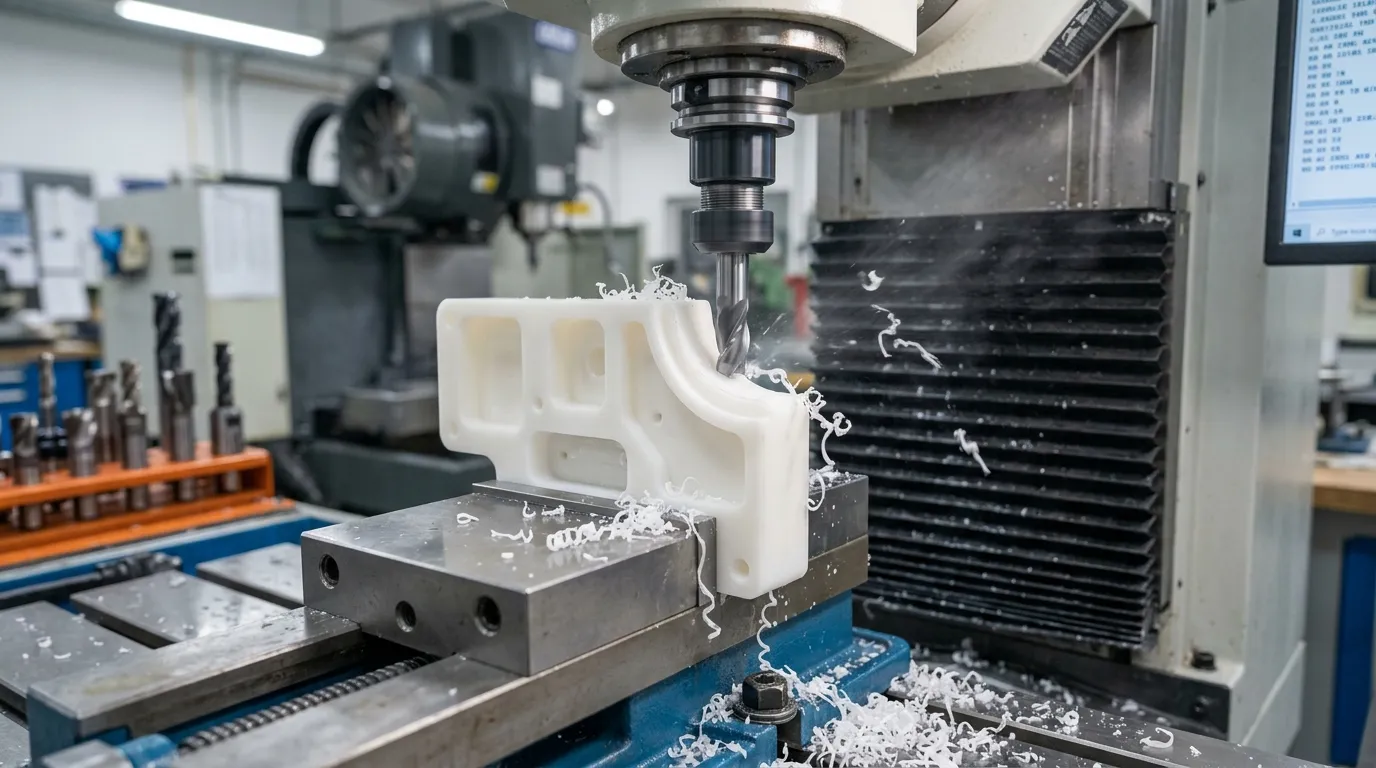
CNC Machining Nylon Technical Benefits
The choice of high-precision CNC machining of nylon parts has a number of engineering advantages.
Key benefits:
• Very good dimensional stability under load.
• Low friction, appropriate in component motion.
• High fatigue resistance
• Lightweight as opposed to metals.
• Low cost at low levels of production.
Typical machining tolerances:
• Standard CNC: ±0.05 mm
• Precision CNC: ±0.01 mm
• Surface finish: Ra 1.6 to Ra 3.2 μm
Cutting performance insights:
• Tool speed: medium to high RPM
• Feed rate: optimum heat control.
• Cooling: there is a desire for minimal lubrication or air.
This makes the industrial nylon prototype machining solutions ideal both in functional testing and in the end-use parts.
Compared to Other Materials, Nylon CNC Machining is Better
Nylon is superior to metals and other plastics in terms of prototype development.
Nylon vs Aluminum
- Nylon is lighter
- Aluminum is more rigid.
- Nylon: Nylon minimizes noise and vibration.
Nylon vs ABS
- Nylon is more wear-resistant and stronger.
- ABS is less strong and can be molded more easily.
Nylon vs PEEK
- Nylon is more cost-effective
- PEEK: PEEK is more resistant to thermal conditions but is more costly.
Industries that tend to have a need to balance cost and performance tend to be best served by custom nylon CNC prototyping.
Advantages of Engineering Uses and Product Development
Speed and accuracy are important in product development. This is the reason why precision nylon machining is used in prototypes by companies.
Benefits for engineers:
• Faster design validation
• Reduced development costs
• Real-world performance testing
• Easy design modification
This makes it easy to machine solutions for prototype development, especially for those companies that are involved in high-mix low-volume production. We also enable on-demand production of nylon prototypes, which helps companies to scale without delay.
CNC Nylon Machining Process in Industry Performance
The nylon plastic CNC machining process is well optimized to provide uniform quality.
Steps followed:
- Materials conditioning of stability.
- High-speed CNC milling.
- Controlled heat in the cutting.
- Post machining inspection and testing.
Our machining systems are very precise in making nylon prototypes, and all the parts are tested in real operating conditions.
Combination with Advanced CNC Machining Projects
At KTC CNC Machining, we don’t only work with nylon. We also produce complex metal parts, such as aluminum systems. Using the aluminum alloy impeller machining project as an example, we can see that we are capable of handling high-precision flow and rotational components.
This expertise is useful in industries that require plastic and metal prototype integration in the same project.
Why Choose KTC CNC Machining
The choice of the right prototype machining supplier of industrial nylon is important as far as the quality of the product is concerned.
Why engineers confide in us:
• State-of-the-art 3-axis and 5-axis CNC.
• Knowledge of nylon 6, nylon 66, and reinforced plastics.
• Tough quality control measure.
• Quick prototype response.
• Low volume, high mix production capability.
We specialize in:
• Nylon components CNC machining.
• Prototyping nylon CNC.
• Engineering nylon plastic machining
• Low-volume nylon CNC production
• Durable prototype parts made of nylon, CNC-machined.
We are very easy to hit, and to deliver parts that will work in the field.
Conclusion:
Nylon prototype machining is not just a process of manufacturing. It is the intermediary between design and reality. Nylon remains one of the most preferred materials in all industries due to its strength, flexibility, and machining accuracy.
CNC prototype machining services are applied in automotive systems, robotics, and medical devices, among others, to convert the original ideas into working and testable parts. Nylon performs when it comes to precision, speed, and reliability.
At KT CNC Machining, all prototypes are considered to be the basis of something bigger, a product that is about to work in the real world.
Talk to the Manufacturer, Not a Middleman
Resources & Insights
-
 Blog
BlogCNC Machining Robotic Parts: How GD&T Controls Robot Assembly Accuracy
2026-09-24By KT Engineering -
 Blog
BlogHardware Stamping Springback Control for High-Strength Steel Parts
2026-09-24By KT Engineering -
 Blog
BlogSpring Stamping Fatigue Life: How Geometry, Material and Edge Quality Affect Cycle Life
2026-09-24By KT Engineering -
 Blog
BlogMechanical Automation Parts for Robot End Effectors and Positioning Accuracy
2026-09-23By KT Engineering