Contact Us
  Home /
 rapid prototyping 3d printing


Table of Contents
- What Is Rapid Prototyping?
- How Does 3D Printing Enable Rapid Prototyping?
- Why Rapid Prototyping Matters
- Advantages of 3D Printing for Rapid Prototyping
- Common 3D Printing Technologies Used for Prototyping
- Applications Across Industries
- Rapid Prototyping vs Traditional Manufacturing
- Best Practices for Successful Rapid Prototyping
- The Future of Rapid Prototyping
- Conclusion

The times are time and time again, that in today's competitive manufacturing environment, you have to be faster than the competition, or you will fall behind. There is a constant need for companies to reduce product development time and quality. Here is where 3D printing has made an impact as a rapid prototyping technology.
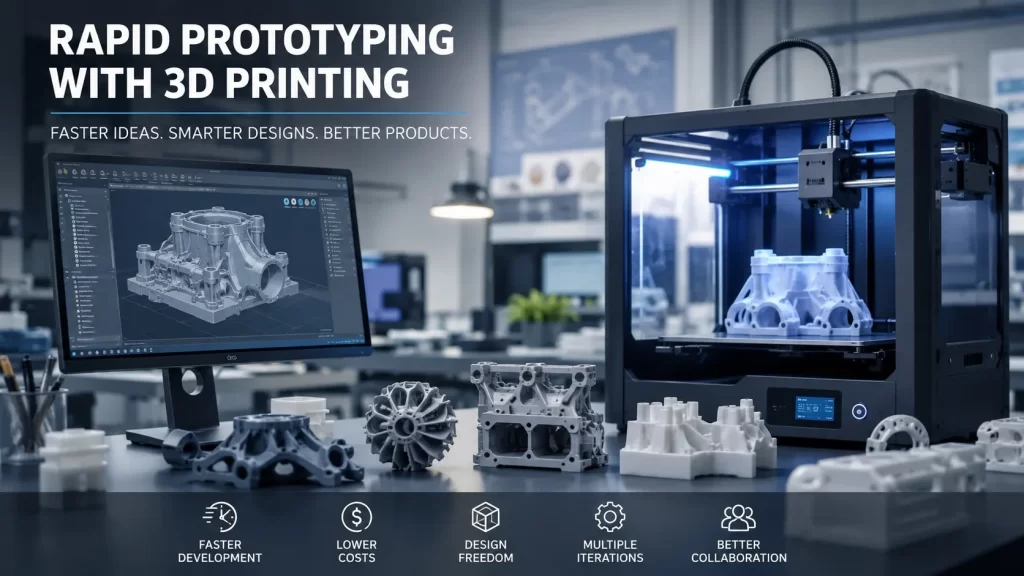
3D printing allows engineers, designers, and manufacturers to model their ideas in digital format and then quickly convert them into physical parts—faster than they could ever be using expensive, time-heavy production tooling. Additive manufacturing technologies are still evolving and the fast prototyping method has become indispensable to automotive, aerospace, medical, electronics, consumer product and industrial manufacturing.
What Is Rapid Prototyping?
Rapid prototyping is the process of producing a physical model or a functional prototype, directly from digital CAD designs in a short period of time. It is mainly used to test the design, function, fit and performance of a product before going onto mass production.
The key advantage of rapid prototyping over conventional prototype production is that the setup time is significantly reduced, and multiple design changes can be made in a fraction of the time required by traditional methods. Unlike conventional prototype production, which normally involves the set up of tools, such as molds or cutting tools, or the process of machining the prototype, rapid prototyping uses a minimum of tools and allows multiple design changes in a fraction of the time.
Today, the modern method of rapid prototyping is through the process of 3D printing, which involves the manufacture of components in layers by using digital manufacturing methods.
How Does 3D Printing Enable Rapid Prototyping?
The workflow is straightforward but highly efficient:
1. Design Creation
The engineers design a 3D model of the object in computer-aided design (CAD) software like SolidWorks, Fusion 360, CATIA or Creo.
2. File Preparation
The CAD model is exported as an STL or 3MF file and then imported into a slicer software, where printing parameters such as layer height, infill, sup-port and orientation are set.
3. Additive Manufacturing
The 3D printer fabricates the part, one layer at a time, with the chosen material, without the need for molds or machining.
4. Post-Processing
The prototypes may need removal of supports, curing, sanding, machining and/or surface finishing, depending on the printing technology used.
5. Testing and Improvement
The prototype is evaluated for:
- Form
- Fit
- Function
- Mechanical performance
- User experience
Feedback is fed into the CAD model and an improved version can be printed the same day. This quick product iteration cycle significantly speeds up product development.
Why Rapid Prototyping Matters
The traditional prototype manufacturing process can take weeks to produce, given that tooling, suppliers and machining operations are required.
Rapid prototyping reduces many of these delays by enabling the manufacturers to internally produce prototypes.
Key benefits include:
- Faster product validation
- Reduced engineering risk
- Lower prototype costs
- Earlier detection of design flaws
- Improved collaboration between design teams
- Shorter time-to-market
Engineers are able to test several iterations of designs in days or even hours, rather than weeks.
Advantages of 3D Printing for Rapid Prototyping
1. Significantly Faster Development
The best thing is probably its speed.
Engineering teams can speed up innovation as complex parts, which used to take several weeks, can now be produced overnight.
This allows the business to be more responsive to customers' needs and market shifts.
2. Lower Development Costs
Traditional prototype production often involves:
- CNC machining
- Injection mold tooling
- Custom fixtures
- Outsourced manufacturing
For small-scale prototypes, these techniques are cost prohibitive.
The elimination of tooling costs makes 3D printing feasible for the production of one part or more design variations—due to the fact that it is economical.The elimination of tooling costs make it economical to produce one part or multiple design variations – it is feasible due to the fact that it is economical.
3. Unlimited Design Freedom
Additive manufacturing enables geometries impossible for conventional manufacturing, including:
- Internal channels
- Lightweight lattice structures
- Organic shapes
- Topology-optimized components
- Complex assemblies
Designers gain far greater creative freedom without worrying about machining constraints.
4. More Design Iterations
Good products don't typically come from one design.
Rapid prototyping promotes ongoing enhancements through rapid testing, modification, and reprinting of parts.
As the iterations increase, the products become more successful.
5. Improved Team Collaboration
Ideas are more effectively communicated with physical prototypes than with computer models.
Engineers, customers, investors and production crews can test real parts to minimize misunderstandings in development.
Common 3D Printing Technologies Used for Prototyping
Several additive manufacturing processes support rapid prototyping.
FDM (Fused Deposition Modeling)
Ideal for:
- Functional prototypes
- Concept models
- Low-cost testing
Advantages:
- Affordable
- Fast
- Wide material selection
SLA (Stereolithography)
Best for:
- High-detail prototypes
- Smooth surface finishes
- Visual models
Advantages:
- Excellent accuracy
- Fine details
- Professional appearance
SLS (Selective Laser Sintering)
Suitable for:
- Functional engineering parts
- Complex geometries
- Durable nylon components
Advantages:
- No support structures
- Strong mechanical properties
Metal 3D Printing
Used for:
- Aerospace
- Medical implants
- Automotive engineering
- Production tooling
Materials include:
- Stainless steel
- Titanium
- Aluminum
- Tool steel
Industrial metal additive manufacturing allows manufacturers to prototype production-grade components before full-scale manufacturing.
Applications Across Industries
Automotive
Automotive manufacturers use rapid prototyping to develop:
- Engine components
- Dashboard designs
- Mounting brackets
- Air ducts
- Interior panels
Fast validation shortens vehicle development cycles.
Aerospace
Aircraft manufacturers produce lightweight prototype components for:
- Cabin interiors
- Structural brackets
- Cooling systems
- Airflow testing
Medical
Healthcare companies create:
- Surgical guides
- Anatomical models
- Medical device prototypes
- Orthopedic implants
Rapid prototyping improves surgical planning and product validation.
Consumer Products
Companies developing electronics, appliances, toys, and wearable devices rely on rapid prototyping for:
- Ergonomic testing
- Appearance validation
- Assembly verification
- User feedback
Industrial Manufacturing
Factories use rapid prototyping to develop:
- Production fixtures
- Assembly jigs
- Inspection gauges
- Custom tools
Many organizations now continue using additive manufacturing beyond prototyping for production tooling and end-use parts.
Rapid Prototyping vs Traditional Manufacturing
| Feature | Rapid Prototyping | Traditional Manufacturing |
|---|---|---|
| Lead Time | Hours to days | Weeks to months |
| Tooling Required | No | Yes |
| Initial Cost | Low | High |
| Design Changes | Simple | Expensive |
| Best for | Low-volume prototypes | Mass production |
| Complexity | Very high | Limited by machining |
While conventional manufacturing remains the preferred choice for large production runs, rapid prototyping offers unmatched flexibility during product development.
Best Practices for Successful Rapid Prototyping
To maximize the benefits of rapid prototyping:
- Clearly define prototype objectives.
- Choose the appropriate printing technology.
- Select materials based on testing requirements.
- Optimize print orientation for strength and accuracy.
- Evaluate form, fit, and function separately.
- Document every design iteration.
- Incorporate user and engineering feedback early.
With a structured validation process, the final products are better, and with fewer expensive engineering changes.
The Future of Rapid Prototyping
With the increased capabilities of industrial additive manufacturing, rapid prototyping is continuing to grow in significance.
Emerging developments include:
- High-speed industrial 3D printers
- AI-assisted design optimization
- Multi-material printing
- Carbon fiber reinforced composites
- Metal additive manufacturing
- Digital manufacturing workflows
- Cloud-based production management
The boundaries between rapid prototyping and full-scale production are becoming increasingly indistinct, and as the technologies continue to develop, companies are able to seamlessly transition from rapid prototyping to mass production, retaining the same digital workflow.
Conclusion
3D printing is revolutionizing product development by enabling innovation to be faster, more cost-effective and more flexible. Engineering teams can validate ideas, refine designs and minimize development risk in days, rather than weeks, with the time-neutral solution.
From automotive components to medical devices, aerospace parts to consumer products, rapid prototyping can save you money, enhance the quality of your product, and save time as you get your product to market. Additive manufacturing is evolving, rapid prototyping will continue to play a key role in fast, agile and competitive manufacturing.
Talk to the Manufacturer, Not a Middleman
Resources & Insights
-
 Hide blog post
CNC Aluminum Components: How Surface Finish Affects Anodizing Quality
2026-08-18By KT Engineering -
 Hide blog post
Stamping Supplier in China: Dongguan Precision Tooling and Metal Stamping Guide
2026-08-18By KT Engineering -
 Hide blog post
Cabinet Cover Components: Lightweight, Modular and Smart Enclosure Design Guide
2026-08-17By KT Engineering -
 Hide blog post
Connector Mold Components for Automotive High-Voltage Connectors
2026-08-16By KT Engineering