Contact Us
  Home /
 Rapid Prototyping Methods


Table of Contents
- What Is Rapid Prototyping?
- Why Rapid Prototyping Matters
- The Most Common Rapid Prototyping Methods
- Rapid Prototyping Method Comparison
- How to Choose the Right Rapid Prototyping Method
- Industries That Benefit from Rapid Prototyping
- Future Trends in Rapid Prototyping
- Conclusion

Rapid prototyping has revolutionized modern product development and made it possible for businesses to convert digital ideas into physical parts in a couple of hrs or days. From the design of consumer electronics to automotive parts, medical devices, and industrial equipment, choosing the appropriate rapid prototyping technique can greatly shorten development time, contain costs, and increase the quality of the product.
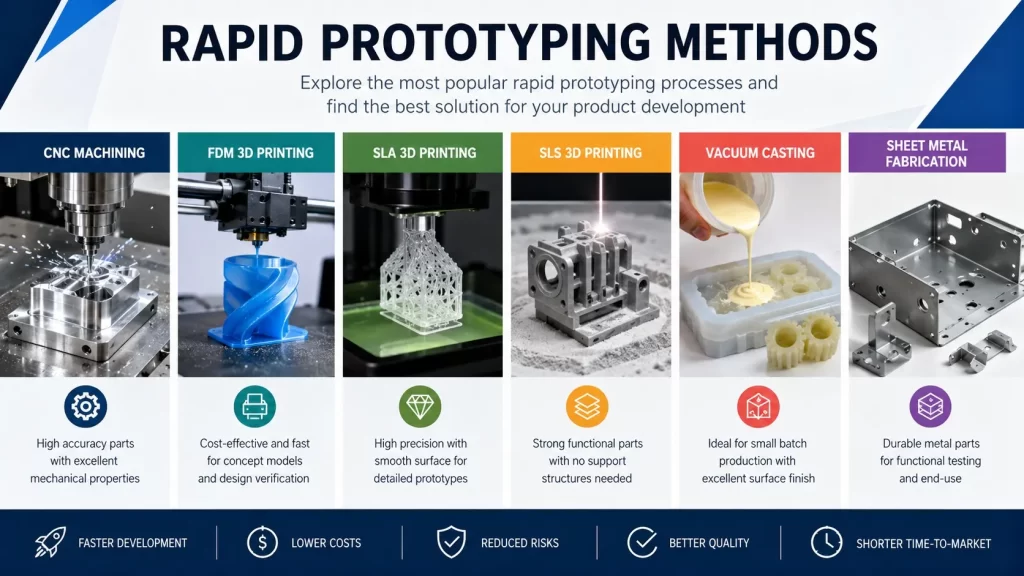
This guide introduces the most common rapid prototyping techniques and their benefits and drawbacks, materials used, applications and how to select the right rapid prototyping process for your project.
What Is Rapid Prototyping?
Rapid Prototyping: The process of generating a real physical model, working prototype or marketable product quickly from a 3D CAD design. Engineers can quickly validate their designs in days, rather than weeks, with the expensive tooling; find problems early; and iteratively test and refine designs efficiently in preparation for mass production.
Rapid prototyping is now in use throughout the industries such as:
- Automotive
- Aerospace
- Medical equipment
- Robotics
- Consumer electronics
- Industrial machinery
- Manufacturing equipment
The first and foremost objective is to test ideas quickly and to minimise development risk and cost.
Why Rapid Prototyping Matters
In traditional product development, expensive molds or tooling is often needed prior to testing. However, if there are any flaws in the design, the manufacturer would have to spend more time and money to rectify the design.
Rapid Prototyping benefits businesses by:
- Accelerate product development
- Reduce engineering costs
- Improve product performance
- Validate assembly and functionality
- Obtain customer feedback earlier
- Shorten time-to-market
A lot of companies have embraced the concept of rapid prototyping and put it in place in every phase of product development including concept validation and low volume manufacture.
The Most Common Rapid Prototyping Methods
1. CNC Machining
CNC machining takes material from a solid block of material with a computer controlled cutting tool.
Best for
- Functional prototypes
- Tight tolerances
- Metal parts
- Engineering plastics
- Production-like components
Advantages
- Excellent dimensional accuracy
- Superior surface finish
- Wide material selection
- High mechanical strength
- Suitable for end-use testing
Limitations
- Material waste
- Less economical for highly complex internal geometries
- Longer machining time for intricate designs
Common materials include:
- Aluminum
- Stainless steel
- Brass
- Titanium
- ABS
- POM
- Nylon
- Acrylic
- Polycarbonate
2. FDM 3D Printing (Fused Deposition Modeling)
FDM builds parts layer by layer using melted thermoplastic filament.
Best for
- Concept models
- Design verification
- Low-cost prototypes
- Educational applications
Advantages
- Lowest manufacturing cost
- Fast turnaround
- Simple operation
- Multiple thermoplastic options
Limitations
- Visible layer lines
- Lower dimensional accuracy
- Reduced mechanical strength
- Limited surface quality
Typical materials:
- PLA
- ABS
- PETG
- TPU
- Nylon
3. SLA 3D Printing (Stereolithography)
SLA uses UV lasers to cure liquid resin into highly detailed parts.
Best for
- Appearance models
- Transparent parts
- Medical prototypes
- Fine-detail components
Advantages
- Excellent surface finish
- High precision
- Smooth appearance
- Complex geometries
Limitations
- Brittle materials
- Resin handling requirements
- Post-curing needed
- Higher material cost
4. SLS 3D Printing (Selective Laser Sintering)
SLS fuses powdered nylon using a laser without support structures.
Best for
- Functional plastic prototypes
- Complex geometries
- Small batch production
- Moving assemblies
Advantages
- Strong functional parts
- No support structures
- Excellent design freedom
- Good chemical resistance
Limitations
- Rougher surface finish
- Higher equipment cost
- Powder removal required
5. Vacuum Casting
Vacuum casting produces polyurethane parts using silicone molds.
Best for
- Small production runs
- Appearance testing
- Bridge manufacturing
- Marketing samples
Advantages
- Excellent surface quality
- Multiple color options
- Low tooling cost
- Fast batch production
Limitations
- Limited mold life
- Lower mechanical properties than injection molding
- Best suited for low-volume production
6. Sheet Metal Fabrication
Sheet metal prototypes are manufactured through laser cutting, bending, welding, and finishing.
Best for
- Electronic enclosures
- Cabinets
- Brackets
- Industrial housings
Advantages
- Production-grade materials
- Excellent structural strength
- Fast fabrication
- Cost-effective for large parts
Limitations
- Geometry restrictions
- Tooling required for complex bends
- Additional finishing may be necessary
Rapid Prototyping Method Comparison
| Method | Speed | Accuracy | Strength | Cost | Best Use |
|---|---|---|---|---|---|
| CNC Machining | Fast | Excellent | Excellent | Medium | Functional testing |
| FDM Printing | Very Fast | Moderate | Moderate | Low | Concept models |
| SLA Printing | Fast | Excellent | Moderate | Medium | Visual prototypes |
| SLS Printing | Fast | High | High | Medium-High | Functional plastic parts |
| Vacuum Casting | Medium | High | High | Medium | Small batch production |
| Sheet Metal | Fast | High | Excellent | Medium | Metal enclosures |
How to Choose the Right Rapid Prototyping Method
Selecting the best process depends on several important factors.
Project Objective
Ask yourself:
- Is appearance the priority?
- Do you need functional testing?
- Is the prototype for investors?
- Will it undergo mechanical testing?
Different objectives require different manufacturing technologies.
Material Requirements
Material properties often determine the manufacturing method.
If you need:
- High strength → CNC machining
- Transparent parts → SLA
- Flexible materials → FDM
- Production-like plastics → Vacuum casting
- Metal structures → Sheet metal fabrication
Required Accuracy
Some applications demand extremely tight tolerances.
Typical accuracy ranking:
- CNC Machining
- SLA
- SLS
- Sheet Metal
- Vacuum Casting
- FDM
Production Quantity
Prototype quantity also influences the decision.
- 1–5 parts → 3D Printing
- 5–50 parts → CNC or Vacuum Casting
- 50–500 parts → Rapid Tooling or Injection Molding
Budget
Lower-cost options:
- FDM
- Basic CNC
- Laser-cut sheet metal
Higher-end solutions:
- SLA
- SLS
- Multi-axis CNC
- Vacuum casting
Balancing cost against performance is critical.
Industries That Benefit from Rapid Prototyping
Nearly every manufacturing sector uses rapid prototyping today.
Automotive
- Interior components
- Fixtures
- Functional testing
- Lightweight design validation
Medical
- Surgical guides
- Prosthetics
- Device housings
- Patient-specific models
Aerospace
- Lightweight brackets
- Airflow testing
- Structural verification
Consumer Electronics
- Product enclosures
- Wearables
- Connectors
- Smart devices
Industrial Equipment
- Machine components
- Automation fixtures
- Assembly verification
Future Trends in Rapid Prototyping
Rapid prototyping continues to evolve through advances in digital manufacturing.
Emerging trends include:
- AI-assisted product optimization
- Metal additive manufacturing
- Hybrid CNC and 3D printing workflows
- Faster industrial printers
- Sustainable materials
- Digital manufacturing integration
As these technologies evolve, they will offer manufacturers reduced lead time, increased design freedom, and reduced product development costs.
Conclusion
Rapid prototyping is not only a design tool, it is a competitive advantage. Choosing the right manufacturing process can shorten product development time, enhance product performance and speed up product innovation.
Depending on the product you're developing, the precision of CNC machining, the flexibility of 3D printing, the efficiency of vacuum casting, or the durability of sheet metal fabrication might be your preferred method, and knowing the pros and cons of each can help you create successful products.
The key to selecting the most appropriate rapid prototyping method depends on the goals of your project, the material needs, budget and quantity of production. Bring ideas to market faster with less risk and greater design confidence with a suitable manufacturing partner and process.
Talk to the Manufacturer, Not a Middleman
Resources & Insights
-
 Hide blog post
CNC Aluminum Components: How Surface Finish Affects Anodizing Quality
2026-08-18By KT Engineering -
 Hide blog post
Stamping Supplier in China: Dongguan Precision Tooling and Metal Stamping Guide
2026-08-18By KT Engineering -
 Hide blog post
Cabinet Cover Components: Lightweight, Modular and Smart Enclosure Design Guide
2026-08-17By KT Engineering -
 Hide blog post
Connector Mold Components for Automotive High-Voltage Connectors
2026-08-16By KT Engineering