Contact Us
  Home /
 Sheet Metal Stamping Process Guide


Table of Contents
- What Is Sheet Metal Stamping?
- How the Sheet Metal Stamping Process Works
- Common Sheet Metal Stamping Operations
- Types of Stamping Dies
- Types of Stamping Presses
- Advantages of Sheet Metal Stamping
- Industries That Use Sheet Metal Stamping
- Choosing the Right Sheet Metal Stamping Manufacturer
- Final Thoughts

Sheet metal stamping is among the most effective and economical manufacturing processes for generating high volume metal parts that are extremely precise. Stamped metal parts are used in almost every modern industry from automotive body parts to electronic enclosures, medical devices and aerospace parts.
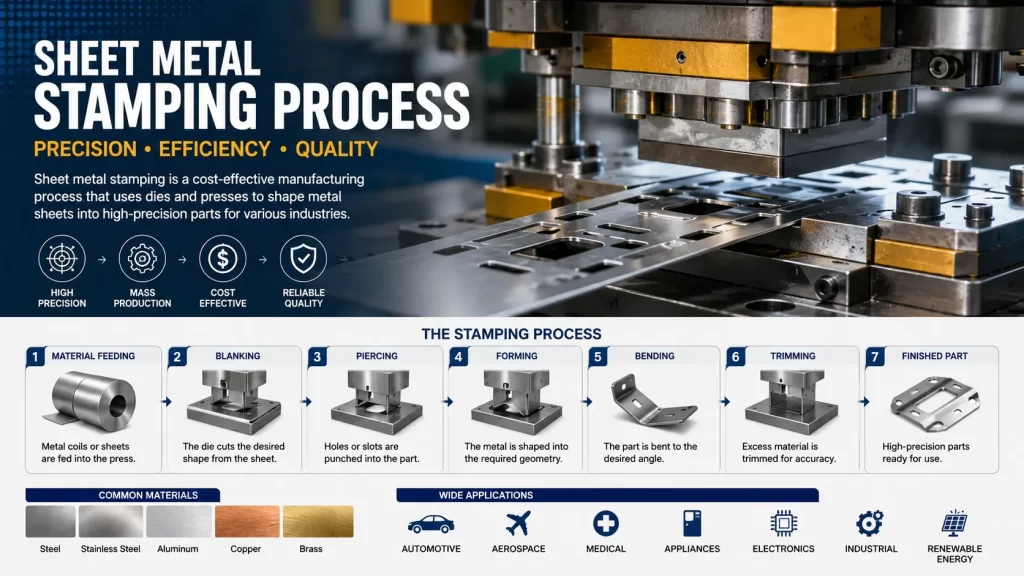
Sheet metal stamping still is an attractive manufacturing option as manufacturers strive for greater tolerances, faster lead times and reduced manufacturing costs. The guide illustrates the stamping process of sheet metal, the various types of stamping operations, the most common materials used in the stamping process, the various types of tooling, and how to select the right manufacturing partner for your project.
What Is Sheet Metal Stamping?
Sheet metal stamping is a cold-forming manufacturing method that is used to form metal sheets or metal coils into qualified products through stamping presses and specially designed stamping dies.
Stamping is not a material removal process like machining, but is principally a process that deforms, cuts, or punches the metal in a controlled manner. This means that manufacturers can manufacture parts that are identical to one another, with remarkable consistency, thousands, if not millions, of times.
This process is suitable for:
- Automotive components
- Electrical contacts
- Appliance parts
- Aerospace brackets
- Medical device components
- Consumer electronics
- Industrial hardware
- Construction fittings
Stamping can integrate several production processes into one process, so the productivity is excellent, and it can also reduce the labor waste and material waste.
How the Sheet Metal Stamping Process Works
While each project is different, the basic process of sheet metal stamping is similar for most stamping jobs.
1. Material Selection
The initial step in production is to choose the right sheet metal, which relies on:
- Strength requirements
- Corrosion resistance
- Formability
- Surface finish
- Cost
Common materials include:
- Carbon steel
- Stainless steel
- Aluminum
- Copper
- Brass
- Titanium
- Nickel alloys
Material thickness typically ranges from thin foils to several millimeters depending on the application.
2. Tool and Die Design
The heart of all stamping operations is the die.
CAD software and simulation tools are used by engineers to create tooling that can manufacture parts with close tolerances and with reduced part defects to minimize wrinkling, cracking or springback.
A high quality tooling directly affects:
- Part accuracy
- Production speed
- Tool life
- Manufacturing cost
If the dies are well designed, they can easily last for hundreds of thousands of, or even millions of, production cycles.
3. Feeding the Material
Metal is introduced into the press in one of two ways:
- Individual sheet blanks
- Continuous metal coil
Automated coil feeding systems are typically employed for high volume production, as they are more efficient and less labour intensive.
4. Stamping Operation
After the punch is cemented into the die, very strong forces are applied to it, forcing it into the die.
The press can:
- Cut
- Bend
- Stretch
- Punch
- Coin
- Emboss
- Form
Many modern progressive dies perform multiple operations simultaneously during one production cycle.
5. Secondary Finishing
After stamping, parts may undergo additional processes such as:
- Deburring
- Tapping
- Welding
- Heat treatment
- Surface polishing
- Powder coating
- Electroplating
- Anodizing
- Quality inspection
These finishing operations prepare components for assembly or shipment.
Common Sheet Metal Stamping Operations
Different products require different stamping techniques.
Blanking
Blanking cuts the desired part shape directly from the metal sheet.
The removed section becomes the finished workpiece while the surrounding material becomes scrap.
Blanking provides excellent dimensional accuracy and is often the first production step.
Piercing
Piercing creates holes, slots, or cutouts in the workpiece.
Unlike blanking, the removed slug becomes scrap while the surrounding sheet remains the product.
This operation is widely used for mounting holes and ventilation openings.
Bending
Bending permanently changes the angle of the metal without removing material.
Examples include:
- Brackets
- Electrical enclosures
- Cabinets
- Structural supports
Proper bend radius selection helps prevent cracking while maintaining dimensional precision.
Forming
Forming reshapes flat sheet metal into more complex three-dimensional geometries.
This broad category includes flanging, curling, hemming, and various custom forming techniques.
Deep Drawing
Deep drawing creates parts with significant depth compared to their diameter.
Typical examples include:
- Automotive oil pans
- Kitchen sinks
- Beverage cans
- Metal containers
This process carefully stretches material while minimizing tearing and thinning.
Coining and Embossing
Coining uses extremely high pressure to create fine details and improve dimensional precision.
Embossing adds raised or recessed features for branding, decorative patterns, or functional identification marks.
Types of Stamping Dies
Choosing the correct die significantly affects production speed and manufacturing cost.
Progressive Die
Progressive dies move metal strip through multiple stations.
Each station performs one operation until the completed part exits the final station.
Advantages include:
- High production speed
- Excellent consistency
- Low labor costs
- Ideal for mass production
Compound Die
Compound dies perform multiple cutting operations during one press stroke.
They are commonly used when flat precision components require several cutting features.
Combination Die
Combination dies perform both cutting and forming in a single stroke.
These dies reduce handling while improving manufacturing efficiency.
Transfer Die
Transfer die systems move individual blanks between stations.
They are often selected for larger, more complex parts that cannot remain attached to a continuous strip.
Types of Stamping Presses
Different applications require different press technologies.
Mechanical Press
Mechanical presses deliver:
- Extremely high production speed
- Excellent repeatability
- Lower operating costs
Best suited for high-volume manufacturing.
Hydraulic Press
Hydraulic presses provide:
- Adjustable stroke length
- Consistent forming force
- Greater flexibility
Ideal for deep drawing and large formed parts.
Servo Press
Servo presses combine the speed of mechanical presses with programmable motion control.
Benefits include:
- Higher precision
- Improved energy efficiency
- Better forming quality
- Reduced tooling wear
Servo technology is increasingly popular in advanced manufacturing environments.
Advantages of Sheet Metal Stamping
Manufacturers continue choosing sheet metal stamping because it offers numerous advantages.
High Production Efficiency
Once tooling is completed, stamping can produce thousands of parts every hour.
Exceptional Repeatability
Every production cycle creates nearly identical components with tight dimensional consistency.
Lower Cost for Large Volumes
Although tooling requires an upfront investment, the cost per part decreases dramatically during high-volume production.
Excellent Material Utilization
Modern nesting and progressive tooling minimize scrap while maximizing raw material efficiency.
Tight Tolerances
Precision dies allow manufacturers to achieve highly accurate dimensions suitable for demanding industries.
Automation Compatibility
Today's stamping lines integrate:
- Robotic handling
- Automatic feeding
- Vision inspection
- Real-time quality monitoring
This reduces labor costs while improving consistency.
Industries That Use Sheet Metal Stamping
Sheet metal stamping supports virtually every manufacturing sector.
Major industries include:
- Automotive
- Aerospace
- Medical equipment
- Consumer electronics
- Telecommunications
- Renewable energy
- Home appliances
- Industrial machinery
- Defense
- Construction
Applications range from tiny electronic connectors to large structural components.
Choosing the Right Sheet Metal Stamping Manufacturer
A good stamp supplier will help to increase product quality and lower production risk if the supplier is an experienced one.
Look for manufacturers that provide:
- Engineering and DFM support
- In-house die design
- Precision tooling capabilities
- ISO-certified quality systems
- Advanced inspection equipment
- Prototype development
- High-volume production capacity
- Multiple finishing services
- Reliable global logistics
An experienced supplier can also recommend design improvements that will minimize tooling costs and make the design more manufacture friendly before going into production.
Final Thoughts
Sheet metal stamping is still one of the most effective mass production methods for manufacturing parts of metal at high precision to a high quality. Precise tooling, the latest in press technology, and automated production systems can all contribute to a manufacturer attaining unrivalled consistency, reduced lead times, and reduced per unit costs.
The sheet metal stamping process is the manufacturing method that can be applied to every type of bracket, precision electronic parts or even complex automotive parts, so understanding the sheet metal stamping process will help you choose the right manufacturing method and the right manufacturer. With advancing manufacturing technologies, such as servo presses, digital simulation, and smart automation, sheet metal stamping is expected to be a key player in the efficient and high-volume metal product manufacturing process for years to come.
Talk to the Manufacturer, Not a Middleman
Resources & Insights
-
 Hide blog post
CNC Machining Robotic Parts: How GD&T Controls Robot Assembly Accuracy
2026-09-24By KT Engineering -
 Hide blog post
Hardware Stamping Springback Control for High-Strength Steel Parts
2026-09-24By KT Engineering -
 Hide blog post
Spring Stamping Fatigue Life: How Geometry, Material and Edge Quality Affect Cycle Life
2026-09-24By KT Engineering -
 Hide blog post
Mechanical Automation Parts for Robot End Effectors and Positioning Accuracy
2026-09-23By KT Engineering