Contact Us
  Home /
 When is metal stamping better than sheet metal fabrication?


Table of Contents
- What Is Metal Stamping?
- What Is Sheet Metal Fabrication?
- Metal Stamping vs. Sheet Metal Fabrication
- When Is Metal Stamping the Better Choice?
- When Sheet Metal Fabrication Is the Better Option
- Industries That Benefit Most from Metal Stamping
- Factors to Consider Before Choosing
- Can Both Processes Be Combined?
- Conclusion

Selecting the suitable manufacturing process is one of the most critical decisions for developing a metal product. Metal stamping and sheet metal fabrication are two of the most common techniques that are used. Both methods are used to convert sheet metal into finished products, but each with different production needs, budget and design requirements.
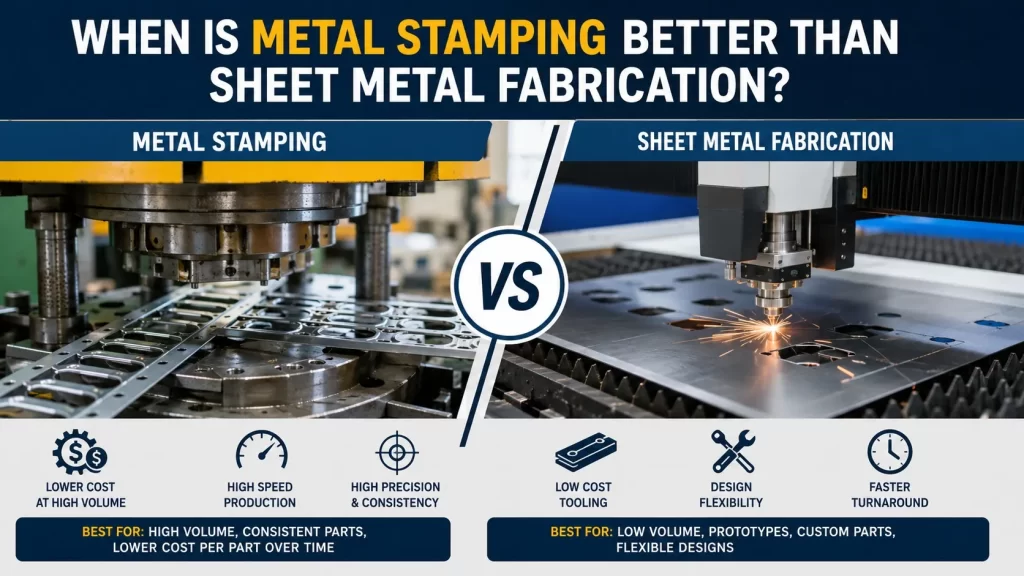
So, when is metal stamping better than sheet metal fabrication? It all depends on part complexity, production volume, precision required, lead time and investment in the tooling.
Let's take a look at metal stamping vs. sheet metal fabrication in detail to help engineers, product designers, and purchasing managers decide which manufacturing process is best for the job.
What Is Metal Stamping?
Metal stamping is a high-speed manufacturing process which utilizes a specially designed die and press to cut, bend, emboss, punch or form the sheet metal into a finished part.
A stamping press is a tool that presses metal plates between the precision tooling to create products. After tooling is made, identical parts can be manufactured very rapidly with very good part to part repeatability.
Examples of common stamping processes are:
- Blanking
- Piercing
- Bending
- Coining
- Embossing
- Deep drawing
- Progressive die stamping
- Transfer die stamping
Metal stamping is commonly used for:
- Automotive components
- Electronics
- Home appliances
- Medical devices
- Consumer products
- Industrial equipment
What Is Sheet Metal Fabrication?
Sheet metal fabrication is a versatile manufacturing application that can produce finished sheet metal items with a variety of methods.
Common manufacturing techniques are:
- Laser cutting
- CNC punching
- Waterjet cutting
- Press brake bending
- Welding
- Riveting
- Grinding
- Assembly
Fabrication is generally not as costly as stamping because expensive custom dies are not required, which is an ideal option for prototypes and low volume manufacturing.
Metal Stamping vs. Sheet Metal Fabrication
| Feature | Metal Stamping | Sheet Metal Fabrication |
|---|---|---|
| Tooling Cost | High | Low |
| Production Speed | Extremely Fast | Moderate |
| Unit Cost | Very Low at High Volumes | Higher |
| Best Production Volume | Medium to High | Low to Medium |
| Design Flexibility | Limited After Tooling | Very Flexible |
| Lead Time | Longer Initial Setup | Faster Startup |
| Repeatability | Excellent | Excellent |
| Material Waste | Low | Moderate |
| Automation | Very High | Moderate |
When Is Metal Stamping the Better Choice?
1. High-Volume Production
The first benefit of metal stamping is that they can make millions of identical parts in a short time.
When tooling cost is high, but the investment is distributed across thousands or even millions of parts.
Examples include:
- Automotive brackets
- Electrical terminals
- Battery contacts
- Appliance components
- Consumer electronics
Stamping may often be the most economical method for production volumes of more than several thousand units.
2. Consistent Part Quality
It's important to note that the tolerances applied when the stamping dies are created are very tight.
After proper adjustment, all the production cycles yield similar parts having:
- Uniform dimensions
- Stable hole locations
- Accurate bends
- Repeatable surface quality
This uniformity is crucial in industries that demand high levels of quality control, like automotive and healthcare manufacturing.
3. Faster Mass Production
The modern stamping press are capable of making hundreds of pieces per minute.
Progressive die stamping enables more than one operation such as cutting, bending, punching and forming to be performed in one press stroke.
This is much more productive than fabrication.
4. Lower Cost Per Part
The start-up cost of a new tool can vary from a few thousand dollars to tens of thousands of dollars; but as production increases, the per unit cost decreases rapidly.
For manufacturers producing:
- 20,000 parts
- 50,000 parts
- 100,000+ parts
Metal stamping becomes significantly more economical than sheet metal fabrication.
5. Excellent Material Utilization
The stamping dies should be well designed to make them use materials as efficiently as possible.
Progressive Die layouts make use of part nesting to reduce scrap.
Benefits include:
- Lower raw material costs
- Reduced waste
- Better sustainability
- Improved manufacturing efficiency
6. Complex Features in One Operation
Advanced progressive dies can perform multiple manufacturing steps simultaneously, including:
- Punching holes
- Creating slots
- Forming ribs
- Embossing logos
- Coining surfaces
- Bending flanges
Instead of several fabrication processes, one stamping cycle completes the part.
7. Highly Automated Manufacturing
Stamping integrates easily with automated production lines.
Automation can include:
- Coil feeding
- Robotic unloading
- Vision inspection
- Automatic packaging
- In-line quality monitoring
Automation improves productivity while reducing labor costs.
When Sheet Metal Fabrication Is the Better Option
Metal stamping isn't always the right choice.
Sheet metal fabrication is often preferable when:
Low Production Volumes
If only a few hundred or a few thousand parts are needed, expensive stamping dies are difficult to justify.
Fabrication requires minimal tooling investment.
Rapid Prototyping
Product designs frequently change during development.
Laser cutting and CNC bending allow quick revisions without modifying costly tooling.
Large Components
Very large panels or structural parts may exceed the size limitations of stamping presses.
Fabrication equipment can often handle larger workpieces.
Frequent Design Changes
Every stamping die is designed for one specific geometry.
If the design changes, tooling modifications can become expensive.
Fabrication offers much greater flexibility.
Custom Products
Industries requiring customized equipment often benefit from fabrication.
Examples include:
- Industrial enclosures
- Control cabinets
- Machine guards
- Custom brackets
- Architectural metalwork
Industries That Benefit Most from Metal Stamping
Many industries rely on stamping because of its speed and consistency.
These include:
Automotive
- Seat brackets
- Body panels
- Reinforcement plates
- Battery housings
- Heat shields
Electronics
- Shielding covers
- Connectors
- Battery terminals
- Precision contacts
Medical Equipment
- Surgical instrument parts
- Device housings
- Stainless steel clips
Consumer Products
- Kitchen appliances
- Power tools
- Furniture hardware
Industrial Equipment
- Mounting brackets
- Fastening plates
- Mechanical supports
Factors to Consider Before Choosing
Before selecting either process, evaluate the following:
Annual Production Volume
High volume favors stamping.
Low volume favors fabrication.
Budget
Stamping requires significant upfront tooling investment.
Fabrication requires much lower startup costs.
Lead Time
Fabrication starts production quickly.
Stamping requires tooling design, manufacturing, and testing before production begins.
Design Complexity
Complex formed features may be ideal for stamping.
Large assemblies requiring welding often favor fabrication.
Product Lifecycle
Products expected to remain unchanged for years are ideal candidates for stamping.
Products undergoing continuous improvement are usually better suited for fabrication.
Can Both Processes Be Combined?
Absolutely.
Many manufacturers combine both technologies to optimize cost and efficiency.
For example:
- Stamp small precision components
- Fabricate larger structural assemblies
- Weld stamped components into fabricated frames
- Use laser cutting for prototypes before investing in stamping dies
This combination gives flexibility in the product development process and cost savings in full-scale production.
Conclusion
Metal stamping and sheet metal fabrication have their own unique benefits, but they are intended for different manufacturing situations.
Metal Stamping is often the better option if your project is a high-volume production, requires high consistency, short cycle times, and low per-unit costs. Tooling costs more up front, but it quickly comes to fruition for long production runs.
But when your project requires small lots, lots that change often, quick prototyping, or custom-made parts, sheet metal fabrication will allow you more flexibility and lower initial investment.
The key to the best manufacturing approach is to have a clear understanding of your production volume, budget, timeline and product requirements. Choosing the appropriate process (or using both) can enhance product quality and lower manufacturing expenses, while also speeding time to market.
Whether you're looking for metal stamping or sheet metal fabrication, working with a seasoned manufacturer that provides both services can help you deliver the best performance, cost and scalability in your automotive, electronics, medical or industrial applications.
Talk to the Manufacturer, Not a Middleman
Resources & Insights
-
 Hide blog post
CNC Machining Robotic Parts: How GD&T Controls Robot Assembly Accuracy
2026-09-24By KT Engineering -
 Hide blog post
Hardware Stamping Springback Control for High-Strength Steel Parts
2026-09-24By KT Engineering -
 Hide blog post
Spring Stamping Fatigue Life: How Geometry, Material and Edge Quality Affect Cycle Life
2026-09-24By KT Engineering -
 Hide blog post
Mechanical Automation Parts for Robot End Effectors and Positioning Accuracy
2026-09-23By KT Engineering