Contact Us
  Home /
 who invented the 3d printer


Table of Contents
- What Is 3D Printing?
- The Early Origins of 3D Printing
- Chuck Hull: The Father of Commercial 3D Printing
- Other Pioneers Who Shaped 3D Printing
- A Timeline of 3D Printing History
- How 3D Printing Has Evolved
- Industries Benefiting from 3D Printing
- Why 3D Printing Matters Today
- The Future of Additive Manufacturing
- Final Thoughts

3D printing is revolutionizing the way products are designed, prototyped and produced. The possibilities of 3-D printing have moved beyond the engineering lab and are now in use for various customized medical implants, aerospace parts and more. However, who invented 3D printing? It's not that easy to just name one inventor.
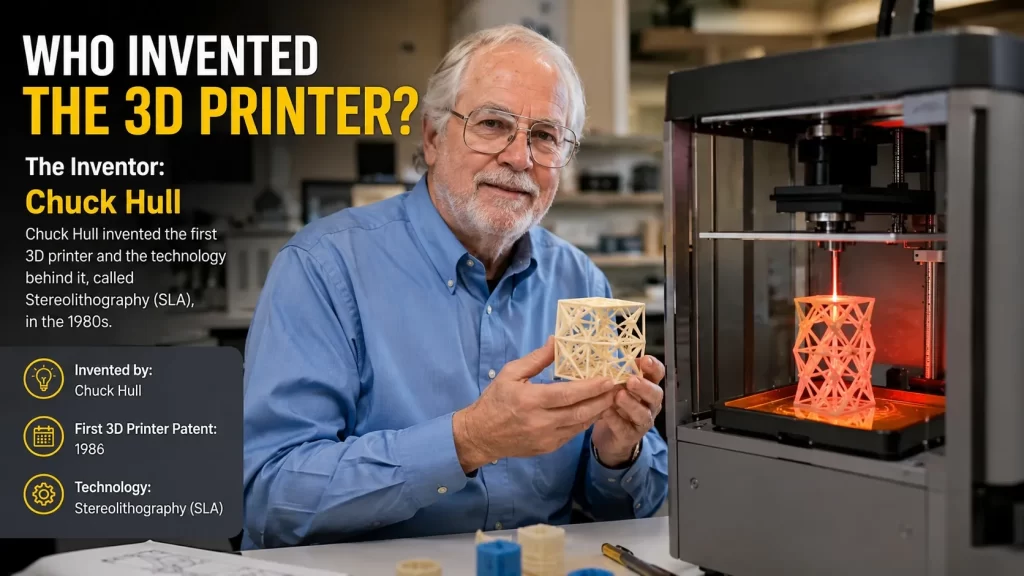
Over the decades it has been developed, many different innovators have made impressive developments that have formed the basis of the modern 3D printing industry. In this guide, you'll learn the history of 3D printing, who invented it, and how it has evolved into one of the greatest manufacturing innovations of the 21st century.
What Is 3D Printing?
Additive manufacturing (AM), also referred to as 3D printing, is a manufacturing method which builds an object by adding material in layers based on a digital 3D model.
3D Printing, in contrast to subtractive manufacturing (which involves cutting, drilling or milling parts), only consumes the material needed to create the part. This minimizes waste, decreases production time and provides for very complex shapes.
The wide use of 3D printing today is in the following industries:
- Aerospace
- Automotive
- Healthcare
- Consumer electronics
- Architecture
- Education
- Industrial manufacturing
- Jewelry and fashion
The Early Origins of 3D Printing
While 3D printing was introduced in the commercial market during the 2000s, it has been around since the early 1980s.
Hideo Kodama: The First Published Concept
Dr. Hideo Kodama of the Nagoya Municipal Industrial Research Institute, Japan, published one of the first descriptions of additive manufacturing in 1981.
His research gave birth to a process which was able to build solid objects layer by layer using a UV-curable photopolymer resin.
Kodama was able to successfully demonstrate the scientific principles behind stereolithography (SLA), one of the most accurate resin printing technologies of today. But he did not finish the patenting process before the deadline and his invention was therefore not commercialized.
Chuck Hull: The Father of Commercial 3D Printing
There are a number of researchers who have been researching ideas for additive manufacturing but Chuck Hull is best known as the inventor of the first commercially viable 3D printer.
In 1984, Hull developed a process called Stereolithography (SLA).
In his system, his work was done by:
- Filling a tank with liquid photopolymer resin.
- Using an ultraviolet laser to cure one thin layer.
- Lowering the build platform.
- Repeating the process until the complete object was formed.
This layer on layer manufacturing process was the basis of the current resin based 3D printing.
Hull filed his patent in 1984, patents were issued to him in 1986 and he established one of the first commercial 3D printing companies, 3D Systems. He's also responsible for the STL file format, which is the most common file format for most 3D printers currently available.
Other Pioneers Who Shaped 3D Printing
There were several inventors who developed new printing technologies and brought about the evolution of Additive Manufacturing.
Carl Deckard and Selective Laser Sintering (SLS)
A new technology called Selective Laser Sintering (SLS) was developed in the late 1980s by Carl Deckard from the University of Texas.
In the case of SLS, powdered materials are used and are fused together using a powerful laser.
Advantages include:
- No support structures required
- Strong mechanical properties
- Complex industrial parts
- Metal and polymer compatibility
Today, SLS is widely used for functional engineering prototypes and production components.
Scott Crump and Fused Deposition Modeling (FDM)
The most widely known 3D printing technology of today is probably Fused Deposition Modeling (FDM).
FDM was developed in 1988 by S. Scott Crump and is based on the idea of extruding thermoplastic filament through a heated nozzle.
The material cools down after deposition, thereby forming one layer at a time.
Later, Crump co-founded another major 3D printer manufacturer, Stratasys.
As key FDM patents expired in the mid 2000s, affordable desktop printers became available to consumers and hobbyists, schools and small businesses exploded.
A Timeline of 3D Printing History
1981
Hideo Kodama publishes one of the earliest additive manufacturing concepts using UV-curable resin.
1984
Chuck Hull builds the first working stereolithography machine.
1986
Hull receives the stereolithography patent and establishes 3D Systems.
1988
Carl Deckard develops Selective Laser Sintering (SLS).
1989
Scott Crump patents Fused Deposition Modeling (FDM).
1990s
Industrial manufacturers begin using rapid prototyping for product development.
Early 2000s
Metal additive manufacturing gains wider commercial adoption.
Around 2009
Major FDM patents expire, making low-cost desktop 3D printers widely available.
Today
3D printing is used for production-grade parts, medical implants, aerospace components, construction, and even food printing.
How 3D Printing Has Evolved
Modern additive manufacturing extends far beyond plastic prototypes.
Today's technologies include:
- FDM (Filament Printing)
- SLA (Resin Printing)
- SLS (Powder Bed Fusion)
- DMLS (Direct Metal Laser Sintering)
- SLM (Selective Laser Melting)
- Binder Jetting
- Multi Jet Fusion (MJF)
- Electron Beam Melting (EBM)
These processes can print with:
- PLA
- ABS
- PETG
- Nylon
- TPU
- Stainless steel
- Titanium
- Aluminum
- Carbon fiber composites
- Ceramic materials
- High-performance engineering polymers
Industries Benefiting from 3D Printing
The impact of additive manufacturing continues to grow across nearly every sector.
Aerospace
Aircraft manufacturers produce lightweight structural components that reduce fuel consumption while maintaining strength.
Automotive
Manufacturers rapidly prototype new designs, produce custom tools, and manufacture low-volume production parts.
Medical
Doctors use 3D printing for:
- Dental aligners
- Prosthetics
- Surgical guides
- Hearing aids
- Patient-specific implants
Education
Schools and universities use desktop printers to teach engineering, robotics, architecture, and product design.
Consumer Products
Businesses create customized products with minimal tooling costs, enabling faster innovation and personalized manufacturing.
Why 3D Printing Matters Today
The original goal of 3D printing was rapid prototyping. Today, it has become a practical production technology.
Key advantages include:
- Faster product development
- Lower tooling costs
- Reduced material waste
- Complex geometries impossible with traditional manufacturing
- On-demand production
- Mass customization
- Localized manufacturing
- Shorter supply chains
These benefits continue to drive adoption across industries worldwide.
The Future of Additive Manufacturing
New technologies are further enhancing the possibilities of 3D printing.
Future developments include:
- Multi-material printing
- AI-assisted print optimization
- Large-scale construction printing
- Bioprinting human tissue
- Sustainable recycled materials
- Faster industrial production systems
- Hybrid manufacturing combining CNC machining and additive manufacturing
Advancements in hardware, software, and materials will make AM an even more prominent element of global manufacturing in the future.
Final Thoughts
So, who invented 3D printing?
Hideo Kodama first developed the idea for layer-by-layer photopolymer fabrication, while Chuck Hull is credited with the development of the first commercially viable 3D printing system using stereolithography. Later, innovators like Carl Deckard and Scott Crump developed SLS and FDM that helped create the wide variety of additive manufacturing that exists today.
3D Printing has been a revolutionary manufacturing technique since its inception in the early 1980s, and has become an increasingly sophisticated technology for industrial manufacturing today. With innovations in materials, automation, and artificial intelligence ongoing, additive manufacturing will become a more significant tool in the future development and global production of products.
Talk to the Manufacturer, Not a Middleman
Resources & Insights
-
 Hide blog post
CNC Machining Robotic Parts: How GD&T Controls Robot Assembly Accuracy
2026-09-24By KT Engineering -
 Hide blog post
Hardware Stamping Springback Control for High-Strength Steel Parts
2026-09-24By KT Engineering -
 Hide blog post
Spring Stamping Fatigue Life: How Geometry, Material and Edge Quality Affect Cycle Life
2026-09-24By KT Engineering -
 Hide blog post
Mechanical Automation Parts for Robot End Effectors and Positioning Accuracy
2026-09-23By KT Engineering