Contact Us
  Home /
 3 Axis CNC Machining


Table of Contents
- What Is 3-Axis CNC Machining?
- How Does 3-Axis CNC Machining Work?
- Advantages of 3-Axis CNC Machining
- Limitations of 3-Axis CNC Machining
- Common 3-Axis CNC Machining Operations
- Materials Suitable for 3-Axis CNC Machining
- Applications of 3-Axis CNC Machining
- Design Tips for Better Machinability
- 3-Axis vs 4-Axis vs 5-Axis CNC Machining
- How to Choose Between 3-Axis and 5-Axis Machining
- Tips for Reducing CNC Machining Costs
- Future Trends in 3-Axis CNC Machining
- Conclusion

The Computer Numerical Control (CNC) machining revolution has revolutionized today's manufacturing industry, providing unparalleled accuracy, repeatability, and efficiency. Today, there are various types of CNC machining configurations, but 3-axis CNC machining is still the most commonly used option for manufacturing precision components in various industries.
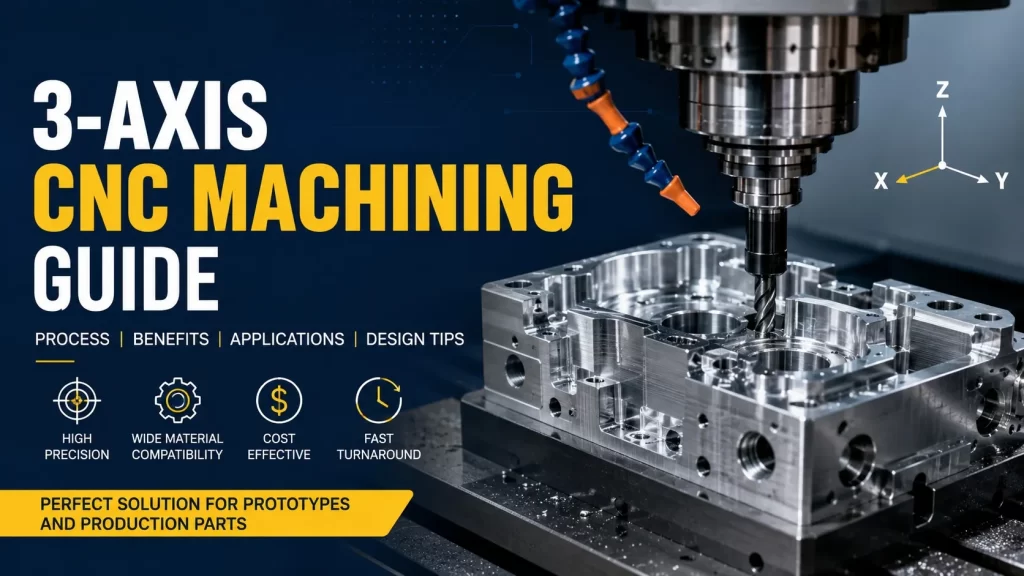
Whether it is rapid prototyping or mass production, 3-axis CNC machines provide a great cost, accuracy, and productivity. When creating custom aluminum parts, plastic enclosures or industrial tooling, it's important to understand how 3-axis machining works to help you determine which manufacturing process to use.
This guide covers the working principle, pros and cons, application, materials and design tips of 3 axis CNC machining.
What Is 3-Axis CNC Machining?
3-axis CNC machining is a type of subtractive manufacturing that involves three linear movements of the cutting tools.
- X-axis: Left and right movement
- Y-axis: Front and back movement
- Z-axis: Up and down movement
Workpiece is held stationary and the cutting tool is programmed to move through a series of toolpaths to remove material layer by layer to obtain the required geometry.
A 3-axis machine does not continuously rotate the part during machining as can be done with a 4-axis or 5-axis machine. Complex features that are located on multiple sides will often need to be shifted over or multiple setups will be needed. However, given the limitation, 3 axis machining is still the preferred method of manufacturing flat, prismatic and moderately complex parts because of its versatility and cost-efficiency.
How Does 3-Axis CNC Machining Work?
The machining process generally follows these steps:
1. CAD Design
Engineers create a detailed 3D model using CAD software such as:
- SolidWorks
- Fusion 360
- Creo
- CATIA
2. CAM Programming
The CAD model is imported into CAM software to generate:
- Toolpaths
- Cutting strategies
- Feed rates
- Spindle speeds
- G-code
3. Machine Setup
Operators install:
- Raw material
- Fixtures
- Cutting tools
- Work offsets
Proper fixturing is essential to maintain dimensional accuracy.
4. Machining
The CNC controller executes the programmed instructions while the spindle performs operations such as:
- Face milling
- Pocket milling
- Contouring
- Slotting
- Drilling
- Tapping
- Engraving
5. Inspection
Finished parts undergo quality inspection using:
- Coordinate Measuring Machines (CMM)
- Calipers
- Micrometers
- Surface roughness testers
Advantages of 3-Axis CNC Machining
Cost-Effective Manufacturing
Compared with multi-axis machining centers, 3-axis CNC machines have:
- Lower equipment costs
- Lower maintenance expenses
- Reduced programming complexity
This makes them ideal for prototypes and medium-volume production.
Excellent Precision
Modern CNC machining centers can routinely achieve tight dimensional tolerances when properly configured. High-quality equipment can deliver precision suitable for aerospace, automotive, and medical components.
Faster Programming
Programming a 3-axis machine is significantly easier than creating toolpaths for simultaneous 5-axis machining, reducing engineering time.
Wide Material Compatibility
3-axis machining supports hundreds of engineering materials including:
Metals
- Aluminum
- Stainless steel
- Carbon steel
- Brass
- Copper
- Titanium
Plastics
- ABS
- Nylon
- POM (Delrin)
- Acrylic
- Polycarbonate
- PEEK
- PTFE
High Repeatability
Once optimized, CNC programs can manufacture thousands of identical parts with consistent quality.
Limitations of 3-Axis CNC Machining
Although highly versatile, 3-axis machining has certain constraints.
Multiple Setups
Features located on different sides often require manual repositioning.
Limited Access
Deep cavities, undercuts, and intricate geometries may be impossible to machine directly.
Longer Production Time
Compared with 5-axis machining, additional setups increase overall cycle time.
Reduced Efficiency for Complex Parts
Highly sculptured surfaces or aerospace components may benefit from simultaneous multi-axis machining.
Common 3-Axis CNC Machining Operations
Manufacturers perform numerous machining operations using 3-axis equipment.
Face Milling
Creates flat, smooth surfaces.
Pocket Milling
Produces internal cavities.
Slot Milling
Machines channels and grooves.
Profile Milling
Cuts external contours.
Drilling
Creates accurate holes.
Tapping
Produces internal threads.
Chamfering
Removes sharp edges and improves assembly.
Materials Suitable for 3-Axis CNC Machining
Aluminum
- Lightweight
- Excellent machinability
- Corrosion resistant
- Ideal for aerospace and electronics
Stainless Steel
- High strength
- Excellent corrosion resistance
- Medical and food-grade applications
Brass
- Attractive surface finish
- Good electrical conductivity
- Easy machining
Titanium
- High strength-to-weight ratio
- Aerospace applications
- Medical implants
Engineering Plastics
Popular materials include:
- PEEK
- Nylon
- ABS
- Delrin
- Acrylic
- Polycarbonate
These materials offer lightweight performance and electrical insulation.
Applications of 3-Axis CNC Machining
3-axis machining serves virtually every manufacturing sector.
Automotive
- Engine brackets
- Transmission housings
- Fixtures
- Prototype components
Aerospace
- Structural brackets
- Mounting plates
- Aircraft fixtures
Medical
- Surgical instruments
- Medical device housings
- Laboratory equipment
Electronics
- Heat sinks
- Enclosures
- Connector housings
Industrial Equipment
- Machine components
- Custom tooling
- Assembly fixtures
- Mechanical parts
Design Tips for Better Machinability
Optimized designs reduce manufacturing costs while improving quality.
Maintain Uniform Wall Thickness
Avoid excessively thin walls that may deform during machining.
Use Standard Hole Sizes
Standard drills reduce machining time and tooling costs.
Avoid Sharp Internal Corners
Use generous internal radii because cutting tools are round.
Minimize Deep Pockets
Very deep cavities require long tools that increase vibration.
Simplify Geometry
Reducing unnecessary complexity lowers machining time and improves reliability.
3-Axis vs 4-Axis vs 5-Axis CNC Machining
| Feature | 3-Axis | 4-Axis | 5-Axis |
|---|---|---|---|
| Linear Movement | X, Y, Z | X, Y, Z + Rotation | X, Y, Z + Dual Rotation |
| Part Complexity | Moderate | High | Very High |
| Number of Setups | More | Fewer | Minimal |
| Programming Difficulty | Easy | Medium | Advanced |
| Production Cost | Lowest | Medium | Highest |
| Ideal Applications | Flat parts, brackets, plates | Multi-side components | Aerospace, molds, complex surfaces |
How to Choose Between 3-Axis and 5-Axis Machining
Choose 3-axis machining if your project requires:
- Flat or prismatic components
- Moderate complexity
- Cost-effective production
- Rapid prototyping
- Medium production volumes
Consider 5-axis machining when parts include:
- Deep cavities
- Undercuts
- Organic surfaces
- Complex aerospace geometries
- Single-setup machining requirements
Tips for Reducing CNC Machining Costs
Manufacturers can lower production costs by:
- Designing machinable geometries
- Selecting standard material sizes
- Avoiding unnecessary tight tolerances
- Reducing the number of setups
- Using standard tooling whenever possible
- Ordering higher production quantities when practical
These strategies improve both production efficiency and overall project economics.
Future Trends in 3-Axis CNC Machining
While multi-axis machining keeps gaining momentum, 3-axis CNC technology continues to be very relevant. Emerging developments include:
- AI-assisted toolpath optimization
- Smart machine monitoring
- Automated tool management
- Digital twin simulation
- Predictive maintenance
- Industry 4.0 integration
The innovations increase productivity without changing the low price point associated with 3-axis machining, which is appealing to many manufacturers.
Conclusion
3-axis CNC machining is still one of the most dependable and cost effective ways of precision production. It is essential for many industries, including automotive, aerospace, electronics, medical, and industrial, because it can create accurate and repeatable parts from a variety of materials, such as metals and plastics.
It may not be quite as versatile as 5-axis machines for the most intricate shapes, but it's an excellent solution for the vast majority of normal machining applications. Through proper design, appropriate material, and collaboration with an experienced CNC production company, businesses can ensure high quality, timely delivery and competitive manufacturing prices.
Talk to the Manufacturer, Not a Middleman
Resources & Insights
-
 Hide blog post
CNC Machining Robotic Parts: How GD&T Controls Robot Assembly Accuracy
2026-09-24By KT Engineering -
 Hide blog post
Hardware Stamping Springback Control for High-Strength Steel Parts
2026-09-24By KT Engineering -
 Hide blog post
Spring Stamping Fatigue Life: How Geometry, Material and Edge Quality Affect Cycle Life
2026-09-24By KT Engineering -
 Hide blog post
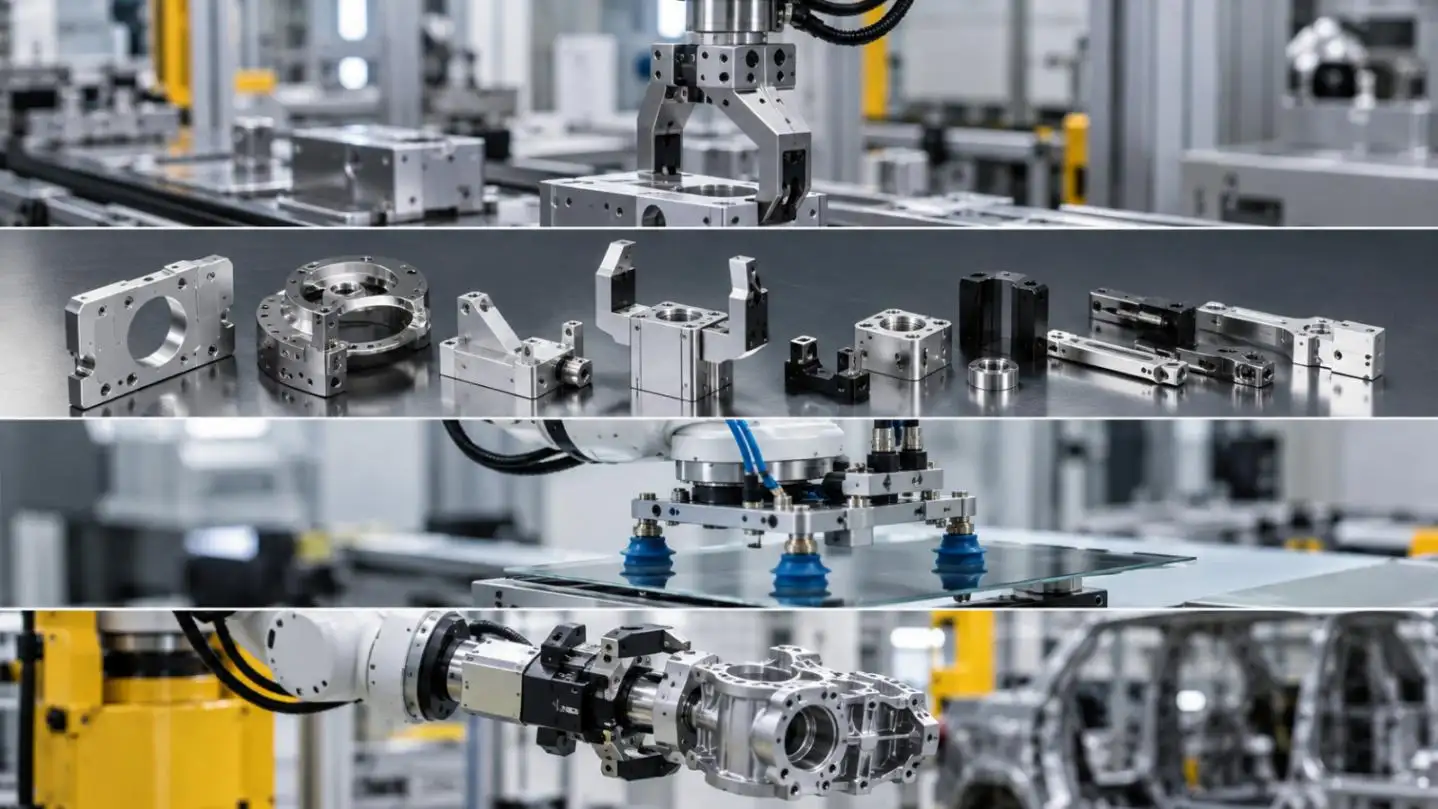
Mechanical Automation Parts for Robot End Effectors and Positioning Accuracy
2026-09-23By KT Engineering