Contact Us
  Home /
 Best Small CNC Machines in 2026


Table of Contents

It can be difficult to select the ideal small CNC machine. The strength of compact machines has increased even further since then and hobbyists, startups, educational institutions and professional machine manufacturers can all make quality parts without having to buy expensive industrial equipment.
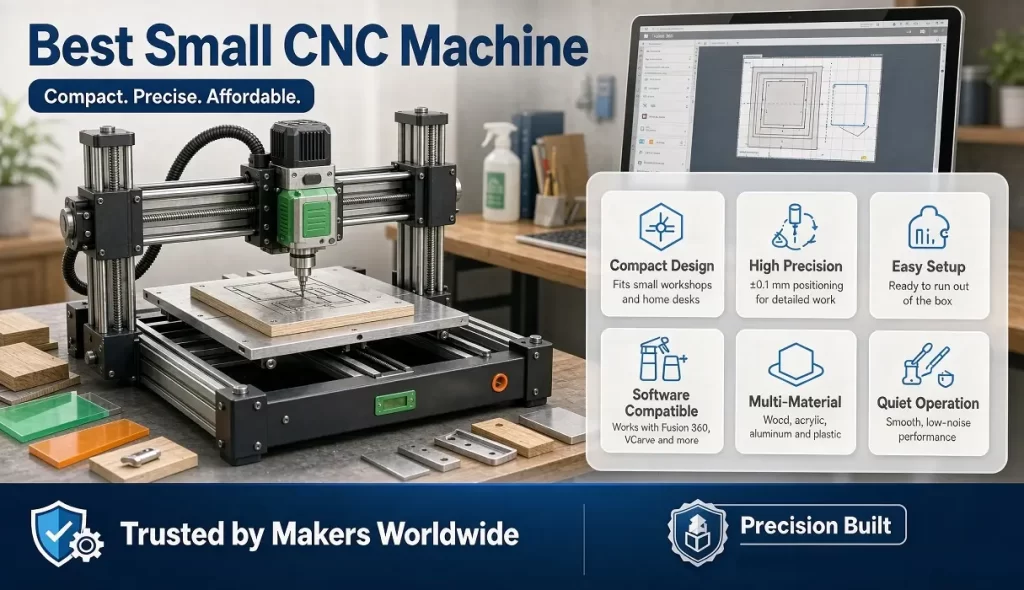
From aluminum machining to wood engraving, prototype manufacturing to starting a small manufacturing business, the type of CNC machine you choose plays a significant role in your productivity, precision, and profitability.
In this guide, you'll get the scoop on the best small CNC machines available today and learn more about the features you should be looking for and what you should look out for when choosing the right CNC machine for your application.
The content of this article is based on current market trends and popular compact CNC models in use in workshops and manufacturing environments.
What Is a Small CNC Machine?
A small CNC (Computer Numerical Control) machine is a small automated machining system that can be used for producing parts from computer generated toolpath.
Small CNC machines have the following advantages over large industrial machining centers:
- Compact footprints
- Lower investment costs
- Easier installation
- Reduced power consumption
- High machining precision
- Excellent flexibility for custom production
Modern compact CNC equipment can process:
- Aluminum
- Brass
- Copper
- Engineering plastics
- Acrylic
- MDF
- Hardwood
- Foam
- Carbon fiber
- Composite materials
Small CNC machines are employed in many businesses for rapid protype, custom making, sign making, making models and educative training.
Why Choose a Small CNC Machine?
Small CNC machines provide numerous advantages over traditional manual machining.
Space Saving
A desktop or compact CNC occupies only a fraction of the space required by industrial machining centers, making it ideal for:
- Small workshops
- Home businesses
- Schools
- Laboratories
- Startup manufacturers
Lower Initial Investment
Compact CNC systems typically cost significantly less than industrial machines while still delivering excellent precision.
This allows businesses to:
- Start manufacturing with lower capital investment
- Test new product ideas
- Expand production gradually
High Precision
Modern CNC machines commonly achieve positioning accuracy suitable for:
- Mechanical components
- Consumer products
- Electronic housings
- Medical prototypes
- Custom tooling
With proper calibration, repeatability remains excellent across multiple production runs.
Easy Learning Curve
Many manufacturers now provide intuitive software, touchscreen controllers, and beginner-friendly interfaces, allowing new operators to become productive quickly.
Key Features to Consider
Before purchasing a CNC machine, evaluate these essential specifications.
Working Area
Choose a machine with sufficient travel for your largest workpieces.
Common desktop sizes include:
- 300 × 180 mm
- 600 × 400 mm
- 1200 × 1200 mm
Larger working areas improve versatility but require additional workshop space.
Spindle Power
The spindle determines cutting capability.
Typical ranges include:
- 300W–800W for engraving
- 1.5–2.2kW for light machining
- 3–6kW for professional production
Higher spindle power enables faster cutting and supports tougher materials.
Frame Construction
A rigid frame minimizes vibration and improves machining accuracy.
Popular frame materials include:
- Cast iron
- Steel
- Aluminum alloy
Heavy-duty frames generally deliver better long-term stability.
Motion System
High-quality linear guides and ball screws improve positioning accuracy, reduce backlash, and extend machine life.
Premium machines often include:
- Precision linear rails
- Ball screw drives
- Helical rack-and-pinion systems
Control System
Reliable CNC controllers simplify programming and operation.
Popular control systems include:
- GRBL
- Mach3
- LinuxCNC
- Syntec
- PathPilot
- Proprietary manufacturer software
Choose software compatible with your preferred CAD/CAM workflow.
Best Small CNC Machines
1. Tormach 1100M
The Tormach 1100M is a popular professional CNC mill designed for prototyping and light production.
Advantages
- Excellent machining accuracy
- Powerful spindle
- User-friendly PathPilot controller
- Strong community support
Best For
- Machine shops
- Product development
- Small-batch production
- Precision metalworking
2. Haas Mini Mill
The Haas Mini Mill combines industrial performance with a compact footprint.
It offers:
- High rigidity
- Reliable automation
- Fast spindle options
- Professional CNC controls
This machine is suitable for manufacturers requiring dependable daily production.
3. Blue Elephant ELECNC-1212ATC
For businesses requiring CNC routing rather than milling, the ELECNC-1212ATC offers industrial-level performance in a compact format.
Key highlights include:
- Automatic tool changer
- 24,000 RPM spindle
- Syntec control system
- Heavy-duty frame
- Continuous production capability
It performs particularly well when machining:
- Wood
- MDF
- Acrylic
- PVC
- Plastics
- Composite panels
- Soft metals
Automatic tool changing greatly reduces setup time while increasing production efficiency.
4. Sherline 5400
The Sherline 5400 remains one of the most respected desktop CNC mills.
Benefits include:
- Affordable price
- Excellent precision
- Small footprint
- Educational applications
- Easy maintenance
It is ideal for prototyping, research, and precision miniature components.
5. Pocket NC V2-10
If five-axis machining is required, the Pocket NC V2-10 provides advanced capabilities in a desktop-sized machine.
Ideal applications include:
- Aerospace prototypes
- Medical devices
- Jewelry
- Research laboratories
- Multi-axis precision machining
6. Bantam Tools Desktop CNC
Designed for engineers and product developers, the Bantam Desktop CNC emphasizes speed and accuracy.
Advantages include:
- High spindle speed
- Easy setup
- Aluminum machining capability
- Excellent software integration
It is particularly useful for rapid prototyping.
7. SainSmart Genmitsu 3018 PROVer
The Genmitsu 3018 PROVer is one of the best entry-level CNC machines available.
Features include:
- Budget-friendly pricing
- Pre-assembled design
- Open-source GRBL controller
- Aluminum frame
Perfect for:
- Beginners
- Education
- PCB engraving
- Hobby machining
8. Shapeoko 4 XXL
The Shapeoko 4 XXL bridges the gap between hobby machines and professional CNC routers.
Its larger cutting area supports:
- Cabinet production
- Furniture
- Sign making
- Plastic fabrication
- Aluminum machining
The rigid construction also makes it suitable for small-scale manufacturing.
How to Choose the Right Small CNC Machine
Selecting the right machine depends on your production requirements.
For Beginners
Choose machines with:
- Easy software
- Affordable pricing
- Strong online support
Recommended:
- Genmitsu 3018 PROVer
- Sherline 5400
For Professional Workshops
Prioritize:
- Higher spindle power
- Better rigidity
- Larger work area
- Reliable controller
Recommended:
- Haas Mini Mill
- Tormach 1100M
For Woodworking Businesses
A CNC router is usually more suitable than a CNC mill.
Look for:
- Large working area
- Automatic tool changer
- Dust collection compatibility
Recommended:
- Blue Elephant ELECNC-1212ATC
- Shapeoko 4 XXL
For Precision Metal Parts
Focus on:
- Ball screw drives
- High rigidity
- Stable spindle
- Accurate motion system
Recommended:
- Pocket NC
- Haas Mini Mill
- Tormach 1100M
Maintenance Tips
Maintaining a machine properly is to guarantee the consistency of machining quality and prolong the life of the machine.
Follow these best practices:
- Clean chips after every job
- Lubricate linear guides regularly
- Inspect spindle bearings
- Verify machine calibration
- Tighten fasteners
- Update controller software
- Replace worn cutting tools promptly
Proper preventive maintenance can save a lot of time and money in repairs.
Final Thoughts
Today, small CNC machines have become very capable manufacturing machines for business of all sizes. From startups to growing workshops and prototyping needs, today's small CNC machines offer impressive accuracy, efficiency, and versatility.
The ideal machine is based on your materials to produce, space available, and budget. For entry level, lower cost desktop machines may be desirable and for more advanced professional machines, industrial compact mills or routers with automatic tool changing and advanced control systems may be better choices for the professional manufacturers.
When deciding on a CNC machine, it's essential to consider factors such as spindle power, work area, frame rigidity, controller compatibility, and future production requirements, all of which can contribute to a machine that will grow with your business and yield high-quality results.
- PREV: how much does a cnc machine cost
- NEXT: 3 Axis CNC Machining
Talk to the Manufacturer, Not a Middleman
Resources & Insights
-
 Hide blog post
CNC Aluminum Components: How Surface Finish Affects Anodizing Quality
2026-08-18By KT Engineering -
 Hide blog post
Stamping Supplier in China: Dongguan Precision Tooling and Metal Stamping Guide
2026-08-18By KT Engineering -
 Hide blog post
Cabinet Cover Components: Lightweight, Modular and Smart Enclosure Design Guide
2026-08-17By KT Engineering -
 Hide blog post
Connector Mold Components for Automotive High-Voltage Connectors
2026-08-16By KT Engineering