Contact Us
 Home /
304 vs 316 Stainless Steel for CNC Machining: Which Is Better for Your Parts?


Table of Contents

Choosing between 304 and 316 stainless steel is an important decision when designing precision CNC machined components. Both materials offer good corrosion resistance, mechanical performance, and versatility. However, their differences in chemical composition, manufacturing cost, and environmental resistance can affect the long-term performance of industrial parts.
For OEM manufacturers, automation equipment builders, and mechanical engineers, the best material depends on operating conditions, machining requirements, and production budgets.
This guide compares 304 vs 316 stainless steel for CNC machining, helping you select the right material for custom precision parts.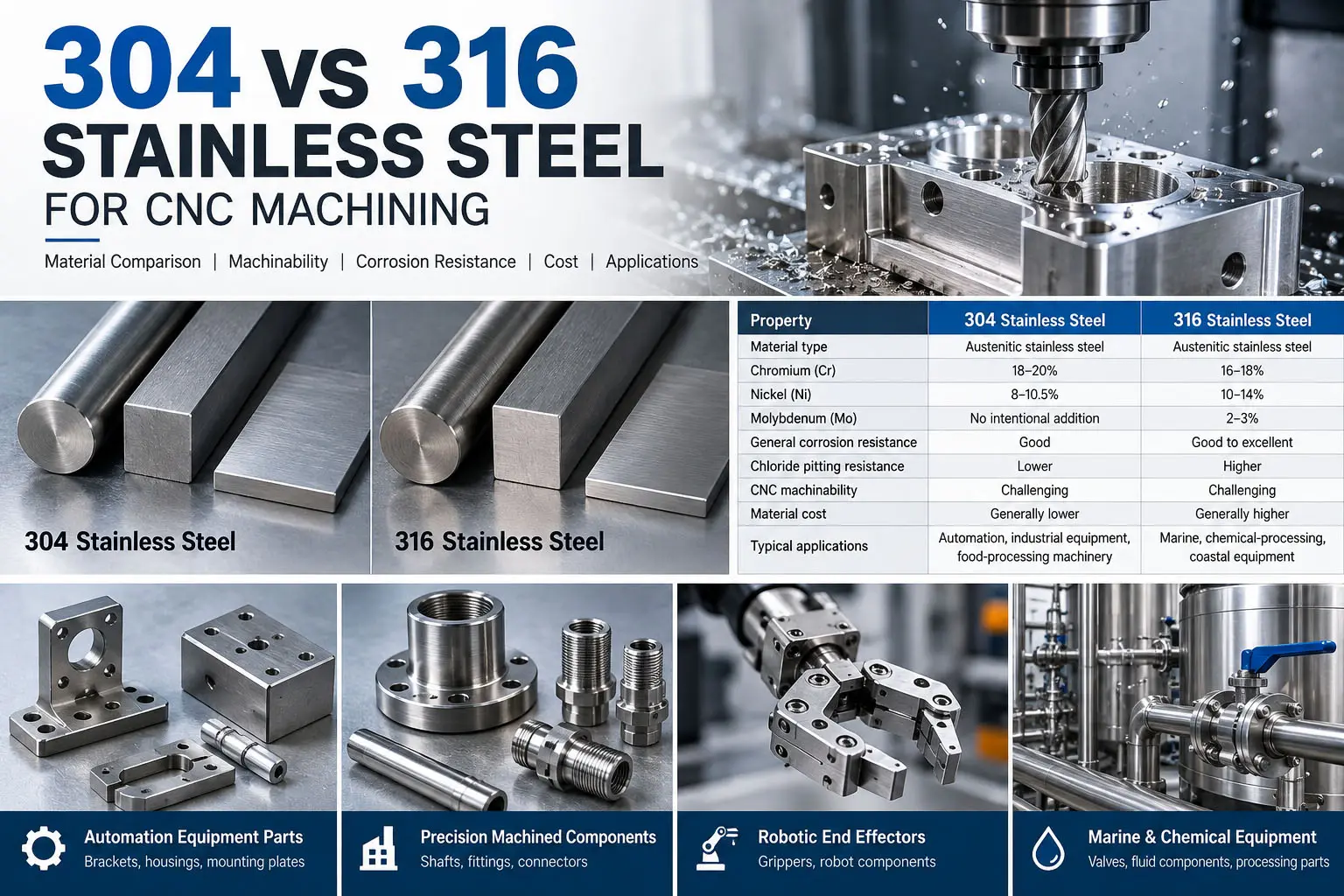
1. What Is the Difference Between 304 and 316 Stainless Steel?
304 and 316 are austenitic stainless steels widely used in precision manufacturing.
The primary difference is their chemical composition.
304 stainless steel contains chromium and nickel, offering good corrosion resistance for many general industrial environments.
316 stainless steel also contains molybdenum, typically around 2–3%, which improves resistance to chloride-related pitting and crevice corrosion.
304 vs 316 Stainless Steel Comparison Table
| Property | 304 Stainless Steel | 316 Stainless Steel |
|---|---|---|
| Material type | Austenitic stainless steel | Austenitic stainless steel |
| Chromium content | 18–20% | 16–18% |
| Nickel content | 8–10.5% | 10–14% |
| Molybdenum content | No intentional addition | 2–3% |
| General corrosion resistance | Good | Good to excellent |
| Chloride pitting resistance | Lower | Higher |
| CNC machinability | Challenging | Challenging |
| Work hardening | Significant | Significant |
| Material cost | Generally lower | Generally higher |
| Typical applications | Automation, industrial equipment, food-processing machinery | Marine, chemical-processing, coastal equipment |
| Welding option | 304L for demanding welded applications | 316L for demanding welded applications |
Both grades can be used to manufacture precision CNC milled and turned components. Material selection should focus on the environmental exposure and functional requirements of the finished part rather than choosing the most expensive alloy automatically.
2. CNC Machinability: Is 304 Easier to Machine Than 316?
Machinability is a major consideration when comparing 304 and 316 stainless steel.
Both materials present similar manufacturing challenges because of their ductility, work-hardening behavior, and tendency to form continuous chips.
Machining 304 Stainless Steel
304 stainless steel is commonly used for CNC milled brackets, machine components, fasteners, housings, and industrial fittings.
Its machining challenges include:
-
Rapid surface work hardening when tools rub instead of cutting
-
Increased cutting forces compared with many aluminum alloys
-
Continuous chip formation that requires effective chip evacuation
-
Tool wear resulting from excessive heat or unsuitable machining parameters
-
Potential distortion in thin-walled or highly stressed components
Rigid machine setups, suitable carbide tooling, consistent feed rates, and effective cooling help maintain dimensional accuracy.
Machining 316 Stainless Steel
316 stainless steel requires similarly controlled machining conditions.
Its cutting performance may be less favorable than 304 in certain operations, although actual tool life and cycle time depend on the stock condition, geometry, tooling, and cutting strategy.
Important considerations include:
-
Maintaining continuous cutting engagement
-
Using sharp tools with suitable cutting-edge geometry
-
Managing cutting temperatures and coolant delivery
-
Preventing tool rubbing and excessive work hardening
-
Controlling burr formation and inspecting critical machined features
Which Material Is Easier to CNC Machine?
304 is often a practical choice for general-purpose CNC components because of its material cost and broad availability.
316 may require additional process optimization in some applications, particularly when manufacturing components with deep holes, small internal features, complex profiles, or demanding surface requirements.
Neither material should be considered an easy-machining stainless steel grade. Both require an appropriate machining strategy.
3. Corrosion Resistance: When Is 316 Better Than 304?
Corrosion resistance is often the deciding factor between these two alloys.
304 stainless steel performs well in many indoor industrial environments, especially where exposure to aggressive chemicals and chlorides is limited.
316 stainless steel provides better resistance to localized corrosion in many chloride-containing environments because of its molybdenum content.
When to Choose 304 Stainless Steel
304 is often suitable for:
-
Indoor automation equipment components
-
Industrial machinery brackets and housings
-
General-purpose precision fixtures
-
Equipment used in mild operating environments
-
Machinery components requiring routine cleaning
-
Noncritical components without significant chloride exposure
When to Choose 316 Stainless Steel
316 may be preferable for:
-
Marine equipment components
-
Coastal industrial machinery
-
Chemical-processing equipment
-
Parts exposed to chloride-containing cleaning agents
-
Food-processing machinery subject to demanding washdown conditions
-
Fluid-handling components requiring increased corrosion resistance
Important: Although 316 offers improved chloride resistance, it is not immune to corrosion. Concentrated chloride solutions, high temperatures, stagnant conditions, and crevices can still cause corrosion.
The actual service environment should always be evaluated before selecting a material.
4. 304 vs 316 Stainless Steel CNC Machining Cost
Manufacturing cost is another important factor for OEM buyers.
In most markets, 316 stainless steel has a higher raw material price because of its alloy composition.
However, the final price of a CNC machined component depends on more than the cost of raw material.
Factors Affecting CNC Machining Costs
Material Price
316 generally costs more than 304. The price difference changes with material form, alloy markets, supplier availability, and order quantity.
Part Geometry
Complex contours, thin walls, deep cavities, and multiple machining setups can increase costs for both materials.
Machining Time
Toolpath efficiency, chip control, cutting parameters, and tool changes affect cycle time.
Tolerance Requirements
Tighter tolerances can require additional finishing operations, measurement, and inspection.
Surface Finishing
Passivation, electropolishing, specified roughness, and other finishing requirements may contribute to the overall manufacturing cost.
Production Volume
Prototype quantities and repeat production orders often have different unit-cost structures due to programming, setup, and inspection expenses.
Example: Choosing a Material for 500 CNC Machined Parts
Consider an OEM manufacturer ordering 500 stainless steel automation brackets.
If the brackets will operate inside a controlled factory environment, 304 may satisfy the corrosion and mechanical requirements at a lower material cost.
If identical brackets must operate near seawater or undergo repeated chloride-containing washdown, 316 may offer better long-term value despite higher initial material costs.
A reliable supplier quotation should compare equivalent part drawings, tolerances, surface finishes, inspection requirements, and batch quantities.
The lowest initial unit price does not always result in the lowest total ownership cost.
5. Which Stainless Steel Is Better for Automation Equipment Parts?
Material selection in automation manufacturing depends on functionality and service conditions.
CNC Machined Brackets and Mounting Plates
304 stainless steel is often appropriate for general-purpose machine brackets, mounting plates, and support components used indoors.
316 may be selected when the machinery operates in corrosive or demanding cleaning environments.
Robotic End Effectors and
Talk to the Manufacturer, Not a Middleman
Resources & Insights
-
 Blog
Sheet Metal Fabrication Manufacturer: Prototype-to-Production Experience
2026-10-23By KT Engineering -
 Blog
Precision 5 Axis Machining for Medical Components and Surface Finish
2026-10-23By KT Engineering -
 Blog
CNC Machining Service and Digital Twins: Reducing Collision and Setup Risk
2026-10-23By KT Engineering -
 Blog
Custom Aluminum Automation Parts Machining for Robotic Joint Housings
2026-10-21By KT Engineering