Contact Us
  Home /
 Best Online 3D Printing Services in 2026


Table of Contents
- What Is an Online 3D Printing Service?
- Why Businesses Use Online 3D Printing Services
- How Online 3D Printing Works
- Best Online 3D Printing Services
- Choosing the Right 3D Printing Technology
- Factors to Consider Before Ordering
- Industries That Benefit from Online 3D Printing
- Future Trends in Online 3D Printing
- Conclusion

Online 3D printing services have revolutionized the manufacturing of prototypes, custom parts and small-scale production parts for businesses and individuals alike. Rather than buying expensive equipment and tweaking print settings, users can upload a CAD file, choose from a list of materials, get an instant quote, and have the professionally manufactured parts delivered in days.
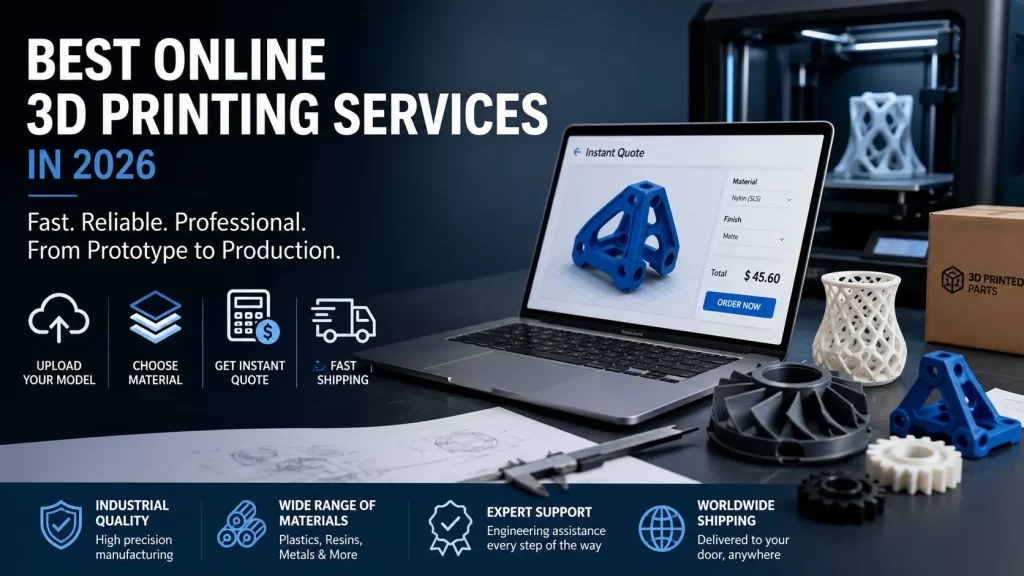
From a product designer to a startup founder, an engineer, an architect, or a hobbyist, there are plenty of factors that could impact the development cost of a product, and deciding on the right online 3D printing service can help to achieve them.
Here, we will explain what online 3D printing is, what it's like, what you should look for in a 3D printer, and some of the best online 3D printing services available today.
What Is an Online 3D Printing Service?
Online 3D printing services are cloud-based manufacturing services that enable users to:
- Upload 3D CAD files (STL, STEP, OBJ, 3MF, etc.)
- Automatically analyze printability
- Choose materials and finishes
- Receive instant pricing
- Place production orders online
- Receive finished parts shipped worldwide
Professional print shop-style manufacturing, without having to invest thousands in an industrial printer.
Why Businesses Use Online 3D Printing Services
Additive manufacturing is becoming more and more popular for modern manufacturers, as it provides several benefits.
Faster Product Development
Rapid prototyping cuts down on product development time. In a matter of days, engineers can test multiple design iterations, whereas it typically takes weeks to wait for traditional machining to finish.
Lower Equipment Costs
The 3D printers (Industrial SLA, SLS, MJF, and metal) require significant capital investments. Online Services remove the need for equipment investment, maintenance, calibration and operator training.
Access to Professional Materials
Most online providers offer engineering-grade materials including:
- PLA
- ABS
- PETG
- Nylon (PA12)
- TPU
- Resin
- Aluminum
- Stainless Steel
- Titanium
- Carbon Fiber Reinforced Polymers
This gives designers far more flexibility than a typical desktop printer.
Scalable Manufacturing
Many services support:
- Single prototypes
- Functional testing
- Bridge manufacturing
- Low-volume production
- End-use components
As demand grows, production can easily scale without investing in new equipment.
How Online 3D Printing Works
The ordering process is straightforward.
Step 1: Design Your Model
Create a 3D model using CAD software such as Fusion 360, SolidWorks, Blender, or other professional design tools.
Ensure the design:
- Is watertight
- Has proper wall thickness
- Avoids unsupported geometry
- Meets printer tolerances
Step 2: Upload Your File
Most platforms support:
- STL
- STEP
- OBJ
- 3MF
- IGES
Automatic software checks often identify mesh errors before production.
Step 3: Select Materials
Choose materials based on application requirements.
Examples include:
- PLA for concept models
- ABS for durable prototypes
- Nylon for mechanical parts
- Resin for high-detail models
- Aluminum for lightweight metal components
Step 4: Choose Surface Finish
Available finishing options may include:
- Sanding
- Polishing
- Vapor smoothing
- Dyeing
- Painting
- Anodizing
- Bead blasting
Step 5: Production and Shipping
Once approved, production begins immediately. Many providers deliver within 2–7 business days depending on material and complexity.
Best Online 3D Printing Services
1. Xometry
Best for industrial manufacturing.
Strengths include:
- Instant quoting
- Hundreds of manufacturing partners
- Metal and plastic printing
- CNC machining integration
- Injection molding services
Ideal for engineers and OEM manufacturers.
2. Protolabs
Best for rapid product development.
Advantages include:
- Fast turnaround
- Excellent engineering support
- High manufacturing precision
- Multiple additive manufacturing technologies
Popular among aerospace, automotive, and medical industries.
3. Shapeways
Best for designers and creators.
Features include:
- Large material selection
- Jewelry production
- Consumer products
- Marketplace integration
- Worldwide shipping
Excellent for artists and small businesses.
4. Sculpteo
Best for international businesses.
Key benefits:
- Cloud manufacturing platform
- Batch production
- Design verification
- Industrial-quality materials
- Automated quoting
Suitable for startups and production teams.
5. PCBWay 3D Printing
Best for affordable prototypes.
Offers:
- Competitive pricing
- Plastic and metal printing
- CNC machining
- PCB manufacturing
- Surface finishing
A popular option for hardware startups.
6. Craftcloud by All3DP
Best for comparing prices.
Instead of manufacturing directly, Craftcloud compares quotes from numerous production partners worldwide, helping customers find the most cost-effective solution.
Choosing the Right 3D Printing Technology
Different projects require different manufacturing methods.
FDM (Fused Deposition Modeling)
Best for:
- Concept models
- Functional prototypes
- Low-cost parts
Pros:
- Affordable
- Fast
- Wide material selection
SLA (Stereolithography)
Best for:
- High-detail models
- Dental applications
- Jewelry
- Miniatures
Pros:
- Smooth surfaces
- Excellent accuracy
- Fine detail
SLS (Selective Laser Sintering)
Best for:
- Functional engineering parts
- Complex assemblies
- Production-grade components
Pros:
- No support structures
- Strong nylon parts
- Excellent mechanical properties
MJF (Multi Jet Fusion)
Best for:
- Production quantities
- Durable components
- Consistent quality
Pros:
- Faster production
- Stronger parts
- Better surface finish
Metal 3D Printing
Suitable for:
- Aerospace
- Automotive
- Medical devices
- Industrial tooling
Common materials include aluminum, stainless steel, titanium, and Inconel.
Factors to Consider Before Ordering
When comparing providers, evaluate the following:
Material Availability
Not every company offers engineering plastics, composites, or metals.
Print Accuracy
Industrial projects often require tolerances within ±0.1 mm or better.
Lead Time
Rapid delivery is essential during product development.
Pricing
Compare:
- Material costs
- Setup fees
- Shipping charges
- Quantity discounts
Engineering Support
Experienced engineers can identify manufacturability issues before production begins, saving both time and money.
Certifications
Businesses in regulated industries should verify certifications such as:
- ISO 9001
- ISO 13485
- AS9100
Industries That Benefit from Online 3D Printing
Online additive manufacturing is widely used across many sectors.
- Automotive prototyping
- Aerospace components
- Medical devices
- Consumer electronics
- Robotics
- Architecture
- Industrial equipment
- Education
- Product design
- Manufacturing tooling
Digital manufacturing gives businesses the agility to experiment and innovate faster at lower development costs.
Future Trends in Online 3D Printing
The manufacturing business is still in a dynamic phase in the online world. Emerging trends include:
- AI-assisted design optimization
- Automated manufacturability analysis
- Larger selections of sustainable materials
- Faster global production networks
- Hybrid manufacturing combining CNC machining and additive manufacturing
- Expanded use of cloud-based manufacturing platforms
These innovations are enabling businesses of all sizes to become professional manufacturers.
Conclusion
Online 3D printing services are now a crucial tool in the modern manufacturing of products. They make it possible to access the high level of industrial manufacturing that is in their business without the cost of purchasing the equipment.
The choice between a single prototype, engineering parts capable of functioning as a product, or low volume production depends upon the materials you need, the accuracy you expect, the production time and your budget.
Through collaborating with a trusted 3D printing provider, businesses can speed up innovation, minimize manufacturing expenses, and make products available quicker than ever before.
Talk to the Manufacturer, Not a Middleman
Resources & Insights
-
 Hide blog post
CNC Machining Robotic Parts: How GD&T Controls Robot Assembly Accuracy
2026-09-24By KT Engineering -
 Hide blog post
Hardware Stamping Springback Control for High-Strength Steel Parts
2026-09-24By KT Engineering -
 Hide blog post
Spring Stamping Fatigue Life: How Geometry, Material and Edge Quality Affect Cycle Life
2026-09-24By KT Engineering -
 Hide blog post
Mechanical Automation Parts for Robot End Effectors and Positioning Accuracy
2026-09-23By KT Engineering