Contact Us
  Home /
 how much is a 3d printer


Table of Contents
- 3D Printer Price Ranges
- Entry-Level 3D Printers ($150–$400)
- Mid-Range Desktop Printers ($400–$1,000)
- Prosumer 3D Printers ($1,000–$5,000)
- Professional 3D Printers ($5,000–$15,000)
- Industrial 3D Printers ($15,000–$100,000+)
- Additional Costs Beyond the Printer
- Factors That Affect 3D Printer Pricing
- Is a Cheap 3D Printer Worth Buying?
- Should You Buy or Use an Online 3D Printing Service?
- Final Thoughts

The cost and availability of 3D printing have never been better. From a 3D printer for a hobbyist to make DIY projects to an engineer or manufacturerwho needs to build a prototype, there's a 3D printer on the market for almost any budget.
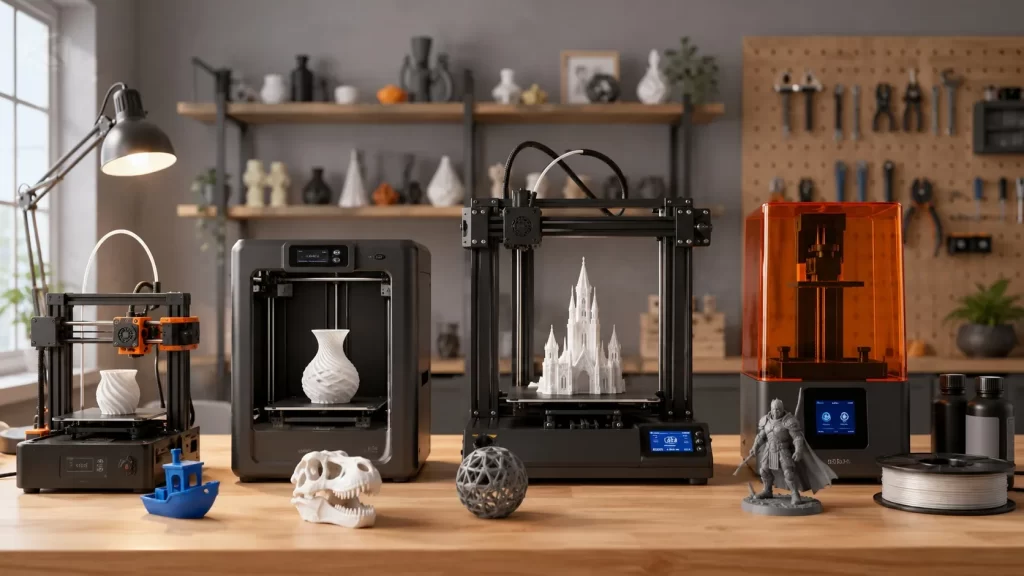
However, one of the most frequently asked questions is:
How much does a 3D printer cost?
While it depends on several factors, such as printing technology, build size, compatibility, precision, and application, the most common answer is probably the 3D printer. Consumer desktop printers can be under $200 while industrial metal 3D printing systems can be over $100,000.
This guide will give you the full cost of ownership of a 3D printer and help you decide what 3D printer you should buy, without spending too much money.
3D Printer Price Ranges
The 3D printing market generally falls into five categories.
| Printer Category | Typical Price | Best For |
|---|---|---|
| Entry-Level | $150–$400 | Beginners, students, hobbyists |
| Mid-Range Desktop | $400–$1,000 | Makers, designers, small businesses |
| Prosumer | $1,000–$5,000 | Engineers, product development |
| Professional | $5,000–$15,000 | Manufacturing, rapid prototyping |
| Industrial | $15,000–$100,000+ | Production, aerospace, medical |
Price may be used to indicate performance, but don't always have to break the bank. The best value is suitable for the print purpose.
Entry-Level 3D Printers ($150–$400)
FDM printers for beginners have come a long way in these last several years. A lot of contemporary machines nowadays have features which were once only available in high end machines.
Typical features include:
- Automatic bed leveling
- Touchscreen controls
- High-speed printing
- Wi-Fi connectivity
- Easy assembly
- Open-source software compatibility
These printers are perfect for:
- Home projects
- STEM education
- Beginners
- Small decorative models
- Basic functional parts
Popular materials include:
- PLA
- PETG
- TPU (on compatible models)
An entry-level printer is good for most users the first time they buy one without making any big investment.
Mid-Range Desktop Printers ($400–$1,000)
Mid-range printers offer a noticeable improvement in print quality, reliability, and speed.
Advantages include:
- Larger build volume
- Better frame stability
- Faster print speeds
- Improved cooling systems
- Higher-quality extruders
- Better software integration
These machines are commonly used by:
- Product designers
- Architecture firms
- Small workshops
- Entrepreneurs
- Educational institutions
Many users begin selling printed products using printers in this price range.
Prosumer 3D Printers ($1,000–$5,000)
Prosumer printers bridge the gap between consumer and industrial equipment.
Typical upgrades include:
- Multi-material printing
- Enclosed printing chambers
- Carbon fiber compatibility
- Engineering plastics
- High-temperature hotends
- Greater dimensional accuracy
These systems are designed for:
- Functional prototypes
- Engineering validation
- Small-batch manufacturing
- Continuous production
Businesses frequently choose prosumer printers because they balance affordability with professional-grade performance.
Professional 3D Printers ($5,000–$15,000)
Professional systems are built for reliability and repeatability.
Key capabilities often include:
- Dual extrusion
- Advanced calibration
- Superior print consistency
- Large-format printing
- Continuous operation
- Enterprise software support
Industries using professional printers include:
- Automotive
- Consumer products
- Medical devices
- Industrial equipment
- Electronics
These machines can operate for extended periods with minimal downtime, making them ideal for commercial prototyping.
Industrial 3D Printers ($15,000–$100,000+)
Industrial additive manufacturing systems represent the highest level of performance.
They support technologies such as:
- Metal printing
- Selective Laser Sintering (SLS)
- Direct Metal Laser Sintering (DMLS)
- Multi Jet Fusion (MJF)
- Large-format polymer printing
Applications include:
- Aerospace components
- Medical implants
- Automotive production
- Tooling
- End-use manufacturing
While the initial investment is substantial, these systems can dramatically reduce production lead times and tooling costs for high-value applications.
Additional Costs Beyond the Printer
The purchase price is only part of the total investment.
You should also budget for ongoing operating costs.
Filament and Resin
Materials are recurring expenses.
Typical prices include:
- PLA: $18–$30/kg
- PETG: $20–$35/kg
- ABS: $25–$45/kg
- Nylon: $40–$100/kg
- Carbon Fiber Composites: $60–$150/kg
- Standard Resin: $25–$60/L
Specialty engineering materials cost considerably more.
Maintenance
Routine maintenance helps ensure consistent print quality.
Common replacement parts include:
- Nozzles
- Build plates
- Belts
- Cooling fans
- PTFE tubes
- Bearings
Most hobby users spend between $30 and $150 annually on maintenance.
Electricity
One advantage of desktop FDM printers is their low power consumption.
A typical printer uses approximately 100–300 watts while operating.
For most users, electricity costs only a few dollars per month, depending on print volume.
Software
Many excellent slicers are completely free.
Popular options include:
- Cura
- OrcaSlicer
- PrusaSlicer
- Bambu Studio
Professional CAD software, however, may require paid licenses depending on your workflow.
Factors That Affect 3D Printer Pricing
Several variables determine how much a printer costs.
Printing Technology
Different technologies have different price points.
Examples include:
- FDM (most affordable)
- Resin (higher precision)
- SLA
- SLS
- Metal printing
Industrial technologies require significantly more expensive hardware.
Build Volume
Larger printers require:
- Stronger frames
- Larger heated beds
- More powerful electronics
This naturally increases cost.
Print Speed
High-speed printers include:
- Better motion systems
- Advanced firmware
- Stronger motors
- Improved vibration compensation
These features reduce print times while maintaining quality.
Material Compatibility
Printing engineering plastics requires:
- Heated chambers
- High-temperature nozzles
- Better cooling
- Durable components
The ability to print advanced materials generally increases machine price.
Automation Features
Premium printers often include:
- Auto calibration
- AI print monitoring
- Remote control
- Automatic filament loading
- Multi-color printing
- Failure detection
These convenience features reduce user intervention while improving reliability.
Is a Cheap 3D Printer Worth Buying?
Yes to many users.
They are capable of producing more than impressive prints with a modern entry-level printer, as opposed to a printer from just a few years ago.
They are ideal for:
- Learning 3D printing
- Personal projects
- Educational use
- Light prototyping
But in the case of enterprises that manufacture customer-ready products or engineering prototypes, they can start to reap the rewards of an upgrade to more dependable systems swiftly.
Should You Buy or Use an Online 3D Printing Service?
But, if just a few parts are needed per year, the cost of buying a printer might not be the most cost-effective answer.
The advantages of online 3D printing services include:
- No hardware investment
- Professional materials
- Industrial-grade equipment
- High dimensional accuracy
- Fast turnaround
Buying your own printer becomes cost-effective when:
- You print regularly
- You need rapid iteration
- You require design privacy
- You want complete production control
Final Thoughts
The prices for 3D printers range from very low to very high, and at this point in time there is a 3D printer available for just about any price.
- $150–$400 printers are ideal for beginners and hobbyists.
- $400–$1,000 machines provide outstanding value for creators and small businesses.
- $1,000–$5,000 systems deliver professional-grade performance for engineering and product development.
- Industrial printers costing tens of thousands of dollars support advanced manufacturing and production.
When you check your budget you need to take in account not only the cost of the printer but also the materials, maintenance, software and the cost of operating the printer in the long run. If you select the right machine for your specific requirements, you will get the best return on investment & a better experience starting 3D printing.
Talk to the Manufacturer, Not a Middleman
Resources & Insights
-
 Hide blog post
CNC Machining Robotic Parts: How GD&T Controls Robot Assembly Accuracy
2026-09-24By KT Engineering -
 Hide blog post
Hardware Stamping Springback Control for High-Strength Steel Parts
2026-09-24By KT Engineering -
 Hide blog post
Spring Stamping Fatigue Life: How Geometry, Material and Edge Quality Affect Cycle Life
2026-09-24By KT Engineering -
 Hide blog post
Mechanical Automation Parts for Robot End Effectors and Positioning Accuracy
2026-09-23By KT Engineering