Contact Us
  Home /
 How Much Does a Metal 3D Printer Cost?


Table of Contents
- Average Metal 3D Printer Price
- What Determines Metal 3D Printer Cost?
- Build Volume Matters
- Material Compatibility
- Software and Automation
- Hidden Costs Beyond the Printer
- Cost Per Printed Part
- Is Buying a Metal 3D Printer Worth It?
- When Outsourcing Is a Better Choice
- Tips for Choosing the Right Metal 3D Printer
- Future Trends in Metal 3D Printing Costs
- Final Thoughts

Metal 3-D printing is one of the most groundbreaking and revolutionary manufacturing processes today. Companies are increasingly looking to additively manufactured products for a variety of reasons, ranging from a reduction in production lead times to the ability to develop complex geometries, to enhancing product performance, the potential for AM is seemingly limitless.
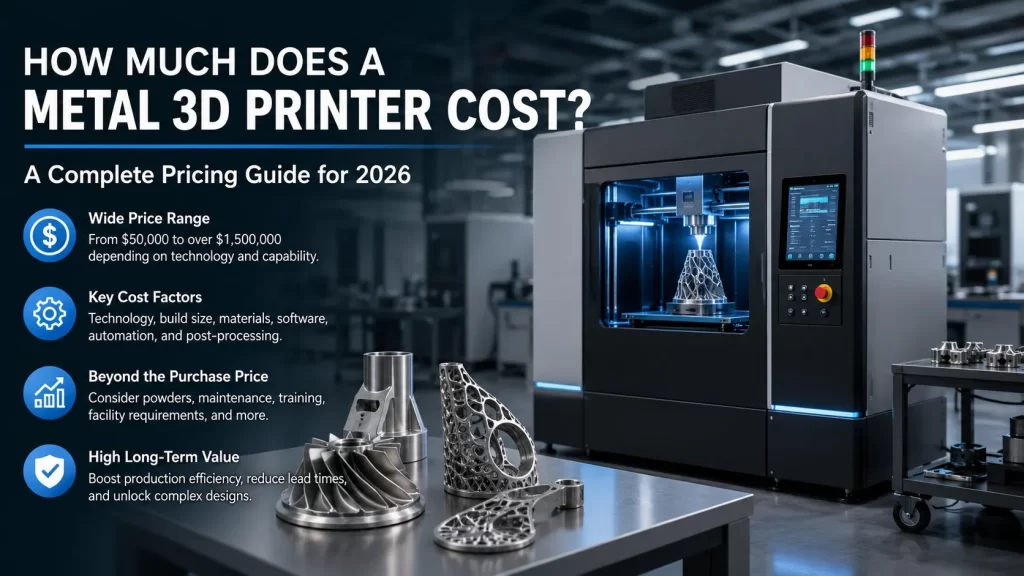
But one of the initial queries people have is, how much does a metal 3D printer cost?
There is no single answer; it is not as simple as stating a number. The price of metal 3D printers ranges significantly from one machine to another, depending on the 3D printing technology, build volume, materials that can be used, production capacity, and operating expenses.
The pricing guide for metal 3D printing aims to give manufacturers, engineers and business owners the information they need to make an informed decision about investing in 3D printing with metals.
Average Metal 3D Printer Price
The price of a typical industrial metal 3D printer is in the range of $50,000 to over $1,500,000. Entry level systems are much cheaper than high production industrial machine systems in aerospace or medical production.
Typical price ranges include:
| Printer Type | Typical Price |
|---|---|
| Entry-Level Bound Metal Systems | $50,000–$150,000 |
| Metal Extrusion Systems | $80,000–$200,000 |
| Industrial LPBF/DMLS Systems | $250,000–$1,000,000+ |
| Multi-Laser Production Systems | $1M–$2M+ |
The price of the purchase is significant, but it's not the entire investment.
What Determines Metal 3D Printer Cost?
Several factors influence the final price of a metal additive manufacturing system.
1. Printing Technology
The printing process is the biggest pricing factor.
Laser Powder Bed Fusion (LPBF)
LPBF is widely used for producing dense, high-performance metal components with exceptional precision.
Advantages include:
- Excellent dimensional accuracy
- High mechanical strength
- Wide material selection
- Suitable for aerospace and medical parts
Because these systems require sophisticated lasers, inert gas chambers, and advanced controls, they are usually the most expensive option.
Direct Metal Laser Sintering (DMLS)
DMLS is similar to LPBF and remains one of the most common technologies in industrial manufacturing.
It produces:
- Complex internal channels
- Lightweight lattice structures
- Functional end-use parts
- High-quality prototypes
These systems often cost several hundred thousand dollars due to their precision and production capabilities.
Bound Metal Deposition
Bound metal printers use metal powder mixed with a polymer binder before a debinding and sintering process.
Benefits include:
- Lower machine cost
- Improved workplace safety
- Easier operation
- Reduced powder handling
They are ideal for companies entering metal additive manufacturing without investing in high-end laser systems.
Binder Jetting
Binder jetting deposits liquid binder onto layers of metal powder before sintering.
Advantages include:
- Fast production speeds
- High-volume manufacturing
- Lower per-part costs
- Excellent scalability
Although the equipment is expensive, the production efficiency often reduces long-term manufacturing costs.
Build Volume Matters
Larger printers cost more because they require:
- Bigger build chambers
- More powerful lasers
- Enhanced thermal management
- Larger inert gas systems
For manufacturers producing oversized components or multiple parts simultaneously, the increased productivity may justify the additional investment.
Material Compatibility
Different printers support different metal materials.
Common printable metals include:
- Stainless steel
- Aluminum
- Titanium
- Tool steel
- Inconel
- Cobalt chrome
- Copper alloys
Machines capable of processing multiple advanced alloys typically command higher prices because of their specialized hardware and calibration requirements.
Software and Automation
Modern industrial systems include advanced software features such as:
- Build preparation
- Automatic support generation
- Simulation tools
- Print monitoring
- Remote operation
- Quality inspection
Automation improves productivity but also increases equipment cost.
Hidden Costs Beyond the Printer
Many first-time buyers underestimate the total cost of ownership.
Metal Powders
Industrial metal powders are considerably more expensive than plastic filaments.
Costs vary depending on:
- Material type
- Purity
- Particle size
- Supplier
Titanium and nickel alloys are generally among the most expensive options.
Post-Processing Equipment
Most metal parts require additional finishing before use.
Typical equipment includes:
- Heat treatment furnaces
- Debinding systems
- Sintering furnaces
- CNC machining
- Surface polishing
- Sandblasting equipment
These systems can add tens or even hundreds of thousands of dollars to the investment.
Installation and Facility Requirements
Industrial metal printers often require:
- Stable power supply
- Controlled environment
- Ventilation systems
- Fire safety equipment
- Inert gas storage
- Powder handling areas
Facility upgrades should be included in budgeting.
Maintenance
Annual maintenance costs may include:
- Laser calibration
- Filter replacement
- Gas system servicing
- Wear components
- Software updates
- Preventive maintenance
Service contracts can represent a significant annual expense.
Operator Training
Metal additive manufacturing requires specialized knowledge.
Training often covers:
- Machine operation
- Powder handling
- Design for additive manufacturing (DfAM)
- Quality inspection
- Safety procedures
Well-trained operators reduce production errors and maximize machine utilization.
Cost Per Printed Part
The machine price alone doesn't determine manufacturing economics.
The cost of each printed part depends on:
- Material usage
- Build time
- Machine depreciation
- Energy consumption
- Support structures
- Labor
- Post-processing
- Inspection requirements
Optimizing part orientation and nesting multiple components in a single build can significantly reduce unit costs.
Is Buying a Metal 3D Printer Worth It?
Purchasing a metal printer makes sense for organizations that:
- Produce complex geometries
- Need rapid prototyping
- Manufacture customized products
- Require short production cycles
- Want to reduce tooling costs
- Produce low-to-medium production volumes
Companies that regularly outsource metal additive manufacturing may eventually achieve a positive return on investment by bringing production in-house.
When Outsourcing Is a Better Choice
Not every business needs to purchase a machine.
Outsourcing remains an excellent option for companies that:
- Have occasional printing requirements
- Produce limited quantities
- Want to avoid capital investment
- Need access to multiple printing technologies
- Lack trained operators
Service providers already have experienced engineers, certified equipment, and post-processing capabilities.
Tips for Choosing the Right Metal 3D Printer
Before purchasing, evaluate the following:
- Required production volume
- Part size
- Material compatibility
- Surface finish requirements
- Mechanical performance
- Available budget
- Facility readiness
- Operator expertise
- Maintenance support
- Software ecosystem
Looking beyond the purchase price helps ensure the best long-term return on investment.
Future Trends in Metal 3D Printing Costs
As additive manufacturing continues to mature, buyers can expect:
- Lower equipment prices
- Faster printing speeds
- Larger build volumes
- Improved automation
- Better software integration
- Reduced material costs
- Higher production efficiency
Competition between manufacturers is also putting industrial metal printing within reach of SMBs.
Final Thoughts
Metal 3D printers are a major investment, and vary from about $50,000 for a basic metal 3D printer to over $1 million for an advanced industrial metal 3D printer. Once the initial cost of the purchase has been made, the buyer needs to think about the costs of the materials used, post processing equipment, maintenance, facility upgrades, and training their staff.
A metal 3D printer can offer a significant long-term return on investment (ROI) for manufacturers that make complex, lightweight, or highly customized metal parts, as it helps to accelerate product development, cut down on material waste, and offer design freedom. It is important to understand what type of system you need and how much it will cost you and your production needs to decide on the best system and to get the best return on your investment.
Talk to the Manufacturer, Not a Middleman
Resources & Insights
-
 Hide blog post
CNC Machining Robotic Parts: How GD&T Controls Robot Assembly Accuracy
2026-09-24By KT Engineering -
 Hide blog post
Hardware Stamping Springback Control for High-Strength Steel Parts
2026-09-24By KT Engineering -
 Hide blog post
Spring Stamping Fatigue Life: How Geometry, Material and Edge Quality Affect Cycle Life
2026-09-24By KT Engineering -
 Hide blog post
Mechanical Automation Parts for Robot End Effectors and Positioning Accuracy
2026-09-23By KT Engineering