Contact Us
  Home /
 Ultra-Tight Tolerances: Engineering ±0.005mm Precision in Medical Machining


Table of Contents
- Why ±0.005mm Tolerance is Critical for Medical Applications
- Core Engineering Systems Behind Tight-Tolerance Machining
- Material Behavior in Medical Precision Machining
- Production Environment and Quality Assurance
- From Prototype Development to Volume Production
- Representative Medical Component Machining Applications

Precision of ±0.005mm (±5 microns / ±0.0002 inches) in medical device manufacturing requires an integrated manufacturing system and advanced engineering. It involves systemically tuned machines, controlled behavior of the material, and managed thermal and rigid metrological systems.
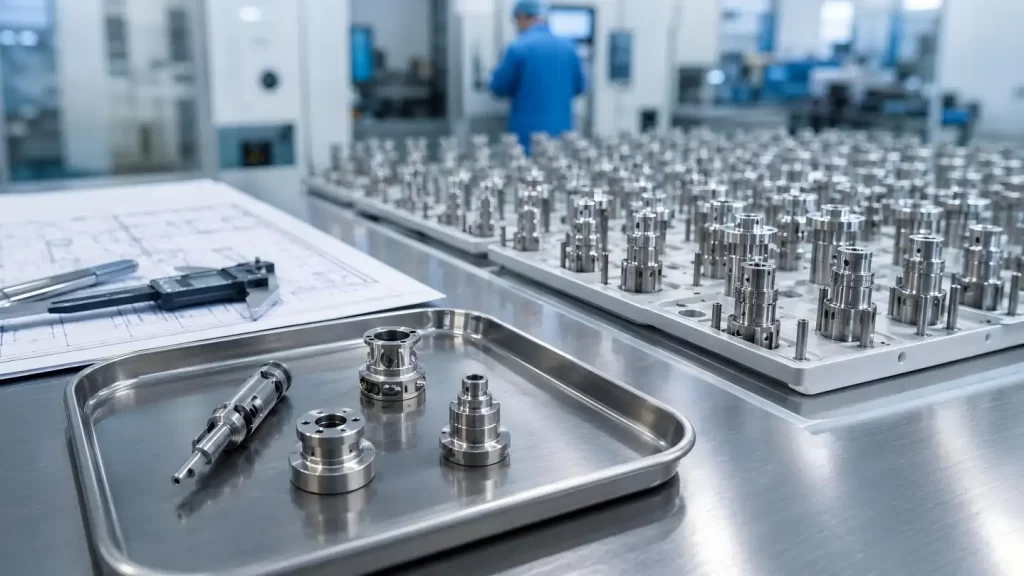
In surgical robotics and a range of other implantable or fluid control devices, even microns can change the performance of the device. At KT, we have designed our medical precision machining systems to promote discipline in control of the processes to allow repeatable accuracy from the first prototype to the final production run.
Why ±0.005mm Tolerance is Critical for Medical Applications
At the level of precision where dimensions are in microns, the integrity of the device's functionality is at stake. In medical devices, even the smallest deviation can adversely impact fluid flow, mechanical engagement, or distribution of forces.
The major uses consist of:
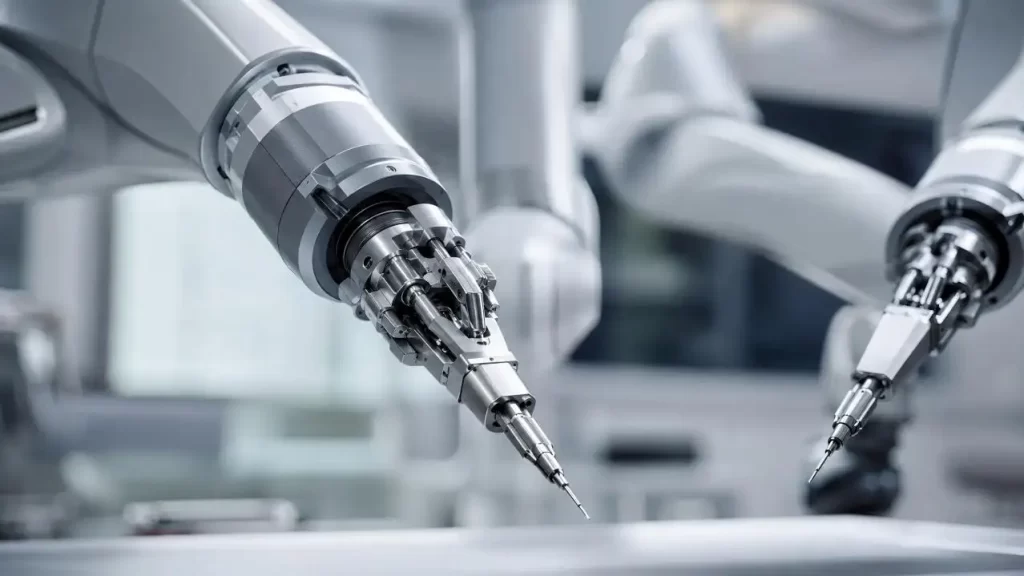
•Robotic systems and surgical instruments: An example is surgical systems and instruments requiring controlled robotic systems with precision interfaces for controlled movements.
•Orthopedic fixation devices: An example is the precision of the threads affecting the fixation of the device to the bone.
•Respiratory devices: The controlled movement of airflow and pressure is dependent on the precision of the spools and clearances.
•Spinal and joint devices: Interfaces of precision allow for an even distribution of forces to minimize wear.
From the foregoing, it is clear that ultra-precise machining is an essential part of the medical supply chain.
Core Engineering Systems Behind Tight-Tolerance Machining
Maintaining ±0.005mm-level control requires a system-based manufacturing approach rather than reliance on a single machine type.
1. Multi-Axis CNC Machining Platforms
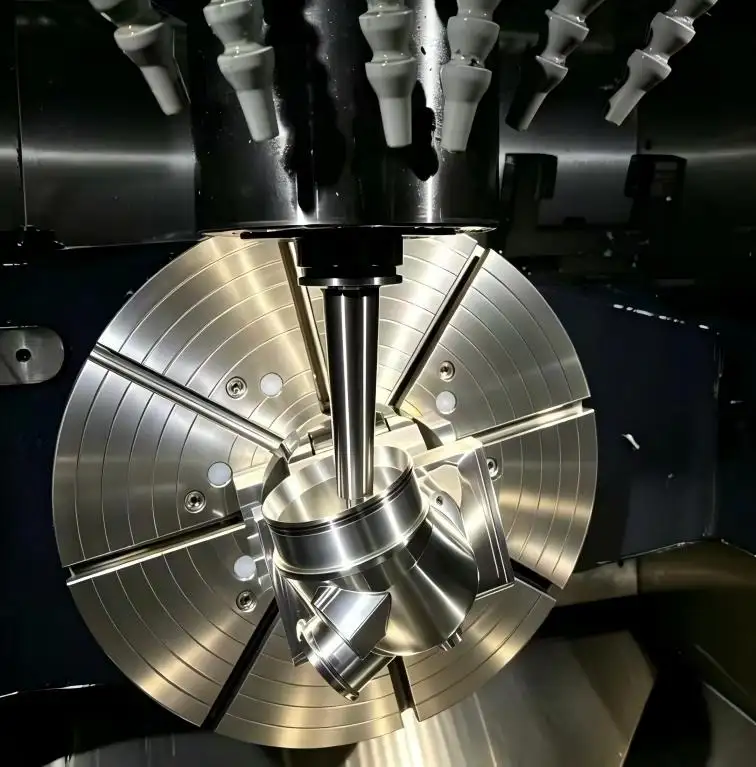
5-axis CNC systems reduce the number of required setups for workpieces. This leads to a reduction of cumulative alignment errors and an increase in the accuracy of the positions of complex geometries.
2. Micro-Machining Tool Strategies
Micro-scale end mills and drill bits of size greater than 1 mm employ a minimal and controlled feed rate and step over distance in order to reduce tool deflection and improve stability of form.
3. Thermal Stability Control
Variation in dimension due to thermal expansion is addressed by the controlled use of shop floor space and stabilization of coolant, especially within the context of cycle time and operations of high precision.
4. Vibration-Controlled Fixturing
Micro-chatter is a problem for the machining of many components. This is especially the case for components that are thin walled, have a high aspect ratio, and are manufactured using a fixture that has been custom designed to incorporate a damping structure.
5. In-Process Measurement and Feedback
Systems which allow the continuous updating of tool offsets and on-machine measurement and tool wear compensation are supporting the new goal of batch-to-batch machining.
Material Behavior in Medical Precision Machining
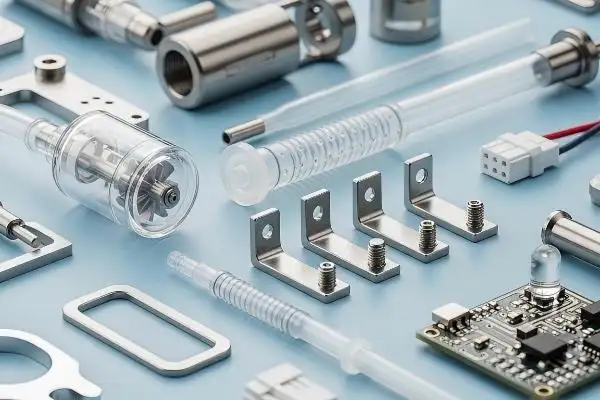
The machining of medical-grade materials demands the ability to predict and control machining conditions in order to maintain the required tolerances.
1. Titanium Grade 5 (Ti6Al4V)
It has high biocompatible strength and is commonly used in implants. It has a low thermal conductive capacity and requires work-hardened, stiff setups with coated tools to control dimensions.
2. 316L Stainless Steel
It is prevalent in surgeons' tools and in surgical systems. It requires cutting with a balance of and optimal control over chip removal and cooling to avoid edge formation on the surface of the material.
3. PEEK (Polyether Ether Ketone)
It is used in many medical component designs such as skeletal and structural implants. It requires careful control of the machining process to avoid thermal expansion and deformation of the material.
4. Cobalt-Chrome Alloys
Used in wear-intensive joint applications. High hardness demands rigid machine systems and carefully optimized tool paths.
Production Environment and Quality Assurance
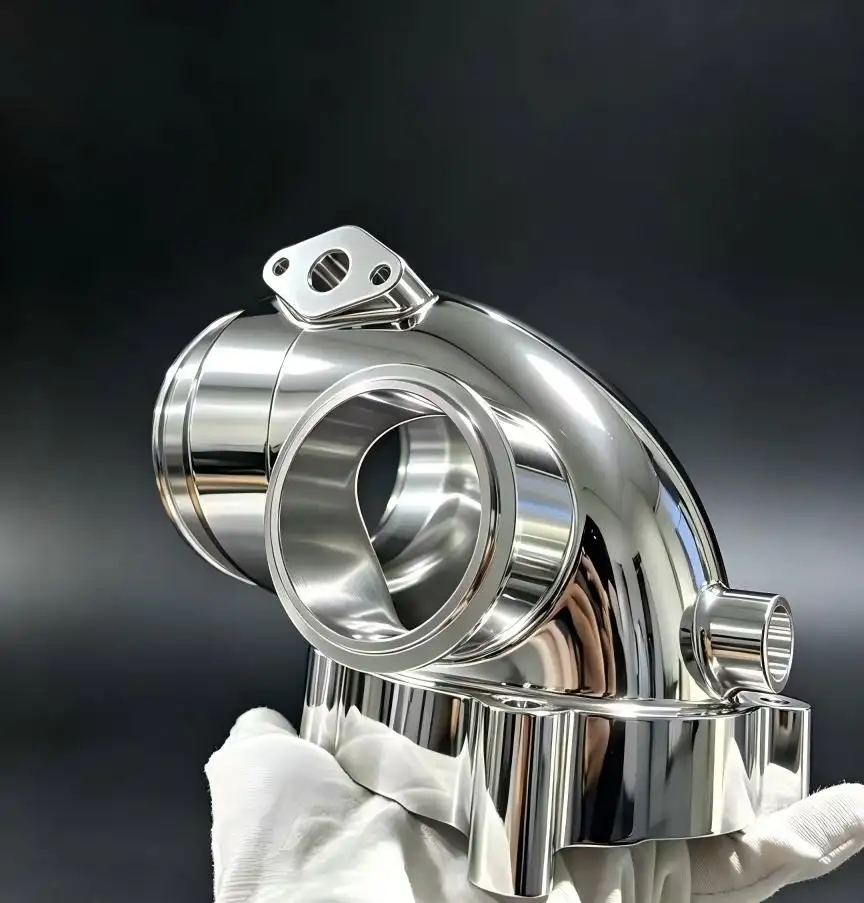
In medical manufacturing, precision alone is not sufficient—environmental control and traceability are equally critical.
1. Controlled Manufacturing Conditions
Components intended for invasive or implantable use are processed under controlled clean manufacturing environments (commonly ISO Class 7–8 depending on application). KT operates under ISO 13485-aligned quality systems.
2. Surface Finishing Technologies
•Electropolishing: enhances surface finish and eliminates micro-burrs.
•Passivation: rebuilds stainless steel components' protective corrosion-resistant oxide layer.
3. Inspection and Traceability
Every batch is dimensionally inspected with CMM and optical metrology systems. Complete material traceability (heat lot, process flow, inspection history) is ensured for compliance.
From Prototype Development to Volume Production
Scaling is a challenge to sustain the required process capability. Hence, process validation is planned formally.
1. Design for Manufacturability (DFM)
Early design reviews enable the identification of features that challenge the stability of the intended manufacturing tolerances and allow for refinements in design to minimize such features.
2. Prototype Validation of Production-Intent set-ups
For prototypes, batch production is carried out using the same production tools and machine set-ups to allow for the production process to be easily transferred.
3. Scaled-Up Manufacturing Under Control
Once a process is validated, to control the process in production, work instructions are developed to standardize the process and control charts are employed to maintain the same process capability.
Representative Medical Component Machining Applications
| Component type | Critical Tolerance Zone | Typical Material | Key Processes |
| Bone screw | Thread pitch ±0.005mm | Titanium Grade 5 | Micro turning, passivation |
| Spinal implant surface | ±0.01mm surface fit | PEEK / Titanium | 5-axis milling, electropolishing |
| Ventilator valve spool | ±0.005mm diameter | 316L Stainless Steel | Precision grinding, clean assembly |
| Surgical instrument handle | ±0.02mm contour | 316L Stainless Steel | CNC, polishing |
| MRI structural component | ±0.01mm flatness | Aluminum / Titanium | 5-axis machining, anodizing |
| Centrifuge rotor | ±0.005mm balance-critical zone | Titanium/ Stainless Steel | Turning, dynamic balancing |
Engineering Perspective: Precision as an Integrated System
Achieving ±0.005mm machining capabilities for medical devices is not the result of a single breakthrough technology; rather, it is the synthesis of multiple highly controlled sub-systems: machine and tooling stability, environmental control, and measurement feedback loops.
At KT, we have built a medical precision machining capability to support a system-level approach for early-stage prototypes to production within defined quality control ranges.
KT focuses on precision as an integrated system, rather than a singular target. We emphasize repeatable manufacturability, and regulatory-ready process documentation to ensure consistent performance of components in the harshest of clinical environments. Please contact our engineering team to discuss your medical and precision needs.
FAQs
Q1: What is the tolerance level in medical machining that KT can achieve?
Part geometry and material dependent, generally around ±0.005mm.
Q2: What materials are typically used in medical machining?
Commonly titanium, 316L stainless steel, PEEK, and cobalt-chrome alloys are used.
Q3: Is KT certified to manufacture medical devices?
Yes. KT has ISO 13485 certification.
Q4: How is dimensional accuracy achieved in production?
Dimensional accuracy is achieved through the use of CNC, thermal stabilization, and inspection during the machining process.
Q5: Can KT handle both prototyping and high volume production?
Yes, KT can handle both high volume production and low volume production.
Talk to the Manufacturer, Not a Middleman
Resources & Insights
-
 Industry Insights
CNC Machining Robotic Parts: How GD&T Controls Robot Assembly Accuracy
2026-09-24By KT Engineering -
 Industry Insights
Hardware Stamping Springback Control for High-Strength Steel Parts
2026-09-24By KT Engineering -
 Industry Insights
Spring Stamping Fatigue Life: How Geometry, Material and Edge Quality Affect Cycle Life
2026-09-24By KT Engineering -
 Industry Insights
Mechanical Automation Parts for Robot End Effectors and Positioning Accuracy
2026-09-23By KT Engineering