Contact Us
  Home /
 3D printing vs die casting: which process is best for complex parts?


Table of Contents

There are several techniques that can be used to manufacture complex parts in modern manufacturing, and sometimes two stand out as the most popular – 3D printing and die casting. Both processes can produce complex shapes however, have very different costs, production rates, materials available, precision, and scalability.
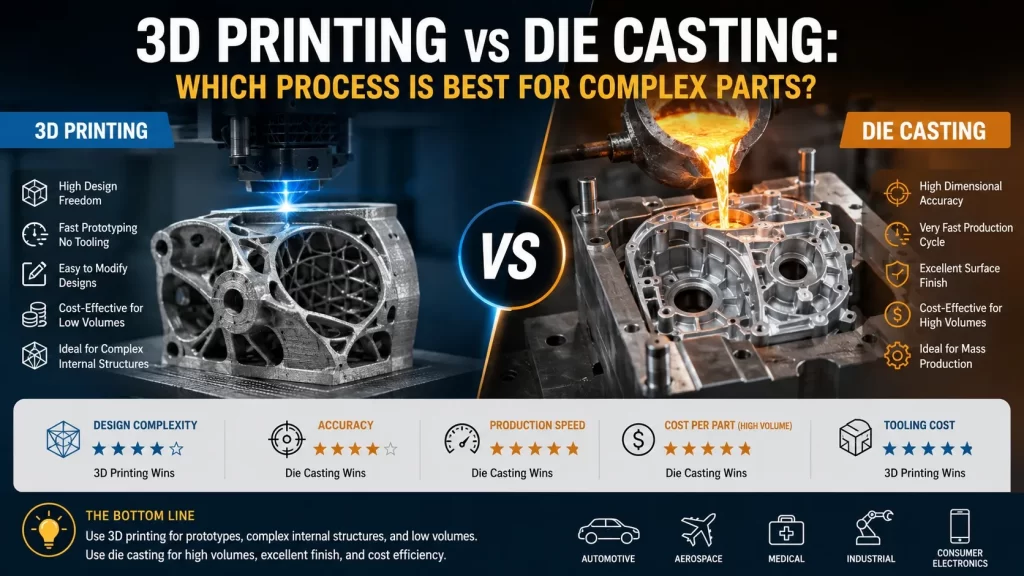
When creating a new product or choosing a manufacturing process for more complex metal components, it is important to know the pros and cons of each process. In this guide we're going to explain the difference between 3D printing and die casting so that you can decide which one is right for your project.
What Is 3D Printing?
also referred to as Additive Manufacturing, 3D printing creates components layer by layer directly from a digital CAD model. It is an additive manufacturing process as opposed to subtractive manufacturing.
There are several common 3D printing methods used to make metals:
- Direct Metal Laser Sintering (DMLS)
- Selective Laser Melting (SLM)
- Binder Jetting
- Electron Beam Melting (EBM)
Plastic parts are commonly produced using:
- FDM (Fused Deposition Modeling)
- SLA (Stereolithography)
- SLS (Selective Laser Sintering)
3D printing is perfect for prototypes, custom products and low volume production—no tooling is needed.
What Is Die Casting?
Die casting is a technique to extrude molten metal into a hardened steel mould at extremely high pressure. Once cooled, the product is ejected from the mold.
Commonly used materials for making die cast include:
- Aluminum alloys
- Zinc alloys
- Magnesium alloys
The process delivers:
- High dimensional accuracy
- Excellent surface finish
- Fast production cycles
- Outstanding repeatability
The cost of tooling is relatively high, but die casting is extremely cost effective in medium- to high-volume production.
Comparing 3D Printing and Die Casting for Complex Parts
1. Design Freedom
One of the best things about 3D printing is that there are no restrictions when it comes to designing.
It makes it possible for manufacturers to make:
- Internal cooling channels
- Honeycomb structures
- Lightweight lattice designs
- Organic geometries
- Consolidated assemblies
A number of these characteristics are not feasible, or very costly, to produce by a die casting method.
Although die casting can be used to create complex parts, it's essential that the process be considered for the following aspects:
- Draft angles
- Parting lines
- Mold release
- Uniform wall thickness
Winner: 3D Printing
2. Dimensional Accuracy
The dimensional consistency of die casting is very good, particularly in large volume production.
Typical tolerances:
Die Casting
- ±0.05–0.10 mm
Metal 3D Printing
- ±0.10–0.30 mm
- Additional machining often required
If identical parts must be produced thousands of times, die casting generally provides better repeatability.
Winner: Die Casting
3. Surface Finish
Typically, die-cast parts can be finished with a smooth surface and they are ready for painting, powder coating or anodizing.
Parts produced with the 3D printing technology typically have the following characteristics:
- Layer lines
- Rough textures
- Support marks
Additional finishing processes may include:
- CNC machining
- Sand blasting
- Polishing
- Heat treatment
Winner: Die Casting
4. Production Speed
The answer depends on production quantity.
Low Volume
For prototypes or batches under 100 pieces:
3D printing is significantly faster because no tooling is required.
Lead time:
- 1–5 days
High Volume
After tooling is completed, die casting can manufacture hundreds or even thousands of parts every day.
Typical cycle time:
- 20–90 seconds per part
Winner
- Prototype: 3D Printing
- Mass Production: Die Casting
5. Tooling Costs
This is one of the largest differences.
3D Printing
- No molds required
- Minimal setup costs
- Fast design changes
Die Casting
Requires custom steel molds that may cost:
- $5,000
- $20,000
- $100,000+
depending on part complexity.
If only a few hundred parts are needed, tooling costs can dominate the project budget.
Winner: 3D Printing
6. Cost Per Part
As production volume increases, die casting becomes dramatically more economical.
Example:
100 parts
- 3D Printing: Lower total cost
- Die Casting: Tooling too expensive
10,000 parts
- 3D Printing: High cost per unit
- Die Casting: Very low cost per unit
100,000 parts
- Die casting often reduces unit costs by more than 70%.
Winner: Die Casting for large production.
7. Material Performance
Both technologies support high-performance metals.
Common 3D printing materials:
- Stainless steel
- Titanium
- Inconel
- Aluminum
- Tool steel
Common die casting materials:
- Aluminum ADC12
- A380 aluminum
- Zinc Zamak
- Magnesium AZ91D
Die-cast aluminum generally provides excellent mechanical properties and durability for automotive and industrial applications.
Which Process Produces More Complex Parts?
Complexity isn't only about geometry—it also includes manufacturability.
Choose 3D Printing When:
- Internal channels are required
- Weight reduction is critical
- Parts need customization
- Design changes are frequent
- Assembly consolidation is desired
- Production volume is low
Examples include:
- Aerospace brackets
- Medical implants
- Robotics components
- Custom tooling
- Prototype housings
Choose Die Casting When:
- Complex external shapes are required
- Production exceeds several thousand units
- Excellent cosmetic appearance matters
- Tight tolerances are required
- Cost efficiency is a priority
Typical applications include:
- Automotive transmission housings
- LED lighting fixtures
- Consumer electronics enclosures
- Power tool housings
- Industrial machinery components
Hybrid Manufacturing: Combining Both Technologies
Many manufacturers now combine both technologies for faster product development.
A typical workflow includes:
- Design the component in CAD.
- Produce prototypes using 3D printing.
- Test fit, function, and performance.
- Optimize the design.
- Manufacture production tooling.
- Begin high-volume die casting.
This approach reduces development time while minimizing tooling risks.
Industries That Benefit from Each Process
3D Printing
- Aerospace
- Medical devices
- Defense
- Research and development
- Custom manufacturing
- Rapid prototyping
Die Casting
- Automotive
- Consumer electronics
- Telecommunications
- Household appliances
- Industrial equipment
- Renewable energy
Key Differences at a Glance
| Feature | 3D Printing | Die Casting |
|---|---|---|
| Tooling Required | No | Yes |
| Initial Investment | Low | High |
| Unit Cost (High Volume) | High | Low |
| Design Freedom | Excellent | Good |
| Internal Structures | Excellent | Limited |
| Surface Finish | Fair | Excellent |
| Production Speed | Slow | Very Fast |
| Best Production Volume | 1–500 units | 5,000+ units |
| Design Changes | Easy | Expensive |
| Repeatability | Good | Excellent |
Final Verdict
Therefore 3D printing versus die casting: which of these is better for complex parts?
This will be determined by what you are producing.
For very complex shapes, quick prototyping, design flexibility and low volume production 3D printing is the better option. It is essential for innovation and product development due to its capability for creating internal features, lightweight structures, and custom-designed components.
For high volume production of complex metal components of consistent quality, superior surface finish and with low unit costs per component, however, the die casting process is industry standard. The initial tooling costs are more expensive, but it offers outstanding value for mass production.
Many manufacturers are using both technologies successfully: 3D printing to validate and refine designs before large quantities are produced by die casting. You can tailor the manufacturing process to fit your design, budget and production volume, to optimise performance, minimise costs and speed time to market.
Talk to the Manufacturer, Not a Middleman
Resources & Insights
-
 Hide blog post
CNC Machining Robotic Parts: How GD&T Controls Robot Assembly Accuracy
2026-09-24By KT Engineering -
 Hide blog post
Hardware Stamping Springback Control for High-Strength Steel Parts
2026-09-24By KT Engineering -
 Hide blog post
Spring Stamping Fatigue Life: How Geometry, Material and Edge Quality Affect Cycle Life
2026-09-24By KT Engineering -
 Hide blog post
Mechanical Automation Parts for Robot End Effectors and Positioning Accuracy
2026-09-23By KT Engineering