Contact Us
  Home /
 How do I choose between CNC machining, injection molding, and 3D printing?


Table of Contents
- Understanding the Three Manufacturing Methods
- Key Factors to Consider When Choosing a Process
- When Should You Choose CNC Machining?
- When Should You Choose Injection Molding?
- When Should You Choose 3D Printing?
- Hybrid Manufacturing Strategy (Best Practice)
- Cost Comparison Overview
- Final Decision Guide
- Conclusion

One of the most critical decisions in product development and manufacturing is the choice between CNC machining, injection molding and 3D printing. These processes each have their own benefits with regard to cost, speed, precision, scalability, and material availability. The best option will vary based on the volume of production, the complexity of the design, budget, and time constraints.
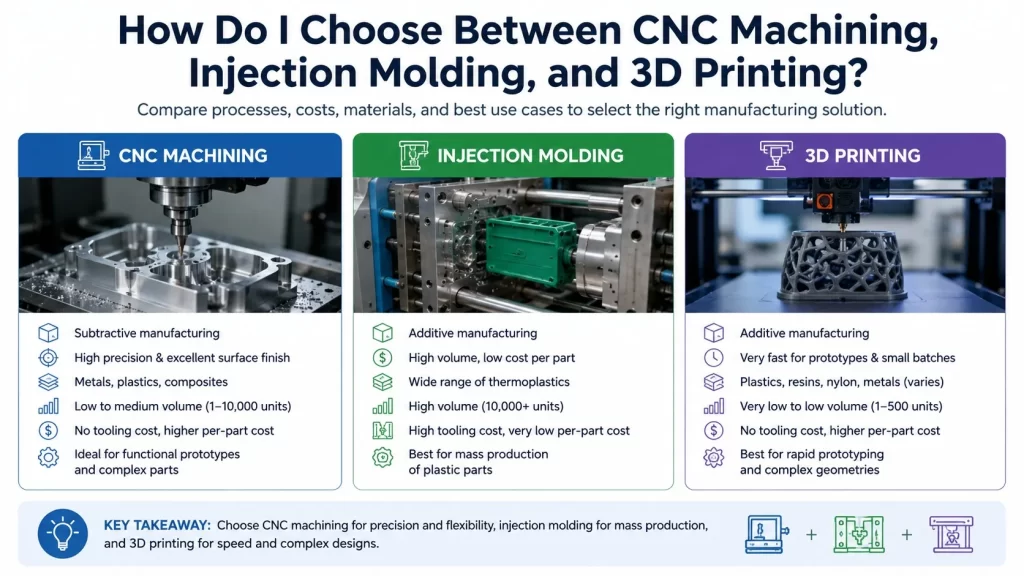
Let's dive into the differences and assist you in choosing the right option for your project!
Understanding the Three Manufacturing Methods
However, before making any comparisons, it is necessary to know the function of each process.
CNC Machining
CNC machining is one of subtraction manufacturing techniques. It employs computer controlled cutting tools to cut material from a solid block of metal, plastic or composite material to shape the part.
It is utilized in a wide range of sectors including aerospace, automotive, industrial equipment, and medical components, where precision is crucial.
Injection Molding
Injection molding is the process of which plastic pellets are melted, and the melted plastic is poured into a steel or aluminum mold. When it cools, the part becomes solidified in the final shape.
It is suitable for the production of plastic components such as consumer products, containers and housings in high volumes.
3D Printing
3D printing is a type of additive manufacturing that involves creating a part from layer-by-layer printing using a digital model. Highly versatile and commonly used for prototyping and custom pieces.
Common technologies used are FDM, SLA, and SLS.
Key Factors to Consider When Choosing a Process
1. Production Volume
- Low volume (1–100 units): 3D printing or CNC machining
- Medium volume (100–10,000 units): CNC machining or low-volume injection molding
- High volume (10,000+ units): Injection molding
At volume, the costs of the mold are distributed over thousands of parts, making injection molding more economical. For smaller quantities, CNC machining and 3D printing are more suitable options.
2. Cost Structure
Each process has a very different cost model:
- CNC machining: No tooling cost, but higher per-part cost
- Injection molding: High upfront mold cost, but very low per-part cost
- 3D printing: Low setup cost, but relatively high cost per unit
CNC or 3D printing is often more economical if you are looking for a prototype or low volume. Injection molding is a winner over time when scaling production.
3. Design Complexity
- 3D printing: Best for complex geometries, internal channels, and organic shapes
- CNC machining: Good for precision parts but limited by tool access
- Injection molding: Requires draft angles and uniform wall thickness
3D printing is typically the more suitable method for highly complicated prototypes, and injection molding has more design limitations.
4. Material Options
- CNC machining: Metals (aluminum, steel, titanium), plastics, composites
- Injection molding: Wide range of thermoplastics (ABS, PP, PC, nylon)
- 3D printing: Limited but expanding range (resins, nylon, PLA, carbon fiber composites)
When strength is a prerequisite, CNC machining is generally the best choice. Injection molding is used for mass-produced plastic parts.
5. Speed and Lead Time
- 3D printing: Fastest for prototypes (hours to days)
- CNC machining: Moderate speed (days to weeks depending on complexity)
- Injection molding: Slowest initial setup (weeks for tooling), but fastest production once ready
For rapid product development, 3D printing is often unmatched.
6. Precision and Surface Finish
- CNC machining: Highest precision and best surface finish
- Injection molding: Good consistency but depends on mold quality
- 3D printing: Improving, but still less precise in most cases
For tight tolerances (±0.01 mm), CNC machining is usually preferred.
When Should You Choose CNC Machining?
Choose CNC machining if:
- You need high precision metal or plastic parts
- You are producing low to medium volumes
- You want strong mechanical performance
- You are developing engineering-grade prototypes
Typical applications include engine components, brackets, enclosures, and medical devices.
When Should You Choose Injection Molding?
Choose Injection molding if:
- You need large-scale production
- You are manufacturing plastic consumer products
- You want the lowest cost per unit at scale
- You have a stable, finalized design
Common products include phone cases, packaging, automotive interiors, and household goods.
When Should You Choose 3D Printing?
Choose 3D printing if:
- You need rapid prototyping
- You require complex or customized designs
- You are producing very small batches
- You want to test designs before mass production
It is widely used in product development, medical modeling, and custom tooling.
Hybrid Manufacturing Strategy (Best Practice)
In modern manufacturing, companies rarely rely on just one process. A hybrid approach is common:
- 3D printing → early-stage prototyping
- CNC machining → functional testing and engineering validation
- Injection molding → final mass production
This workflow reduces risk, improves design quality, and shortens time to market.
Cost Comparison Overview
| Process | Tooling Cost | Per Unit Cost | Best Volume | Speed |
|---|---|---|---|---|
| CNC machining | Low | Medium–High | Low–Medium | Medium |
| Injection molding | High | Very Low | High | Slow setup, fast production |
| 3D printing | Very Low | High | Very Low | Very Fast |
Final Decision Guide
To simplify your decision:
- Choose CNC machining if you need precision and flexibility
- Choose injection molding if you need mass production and low cost per unit
- Choose 3D printing if you need speed, prototyping, or customization
The best manufacturing method is not universal—it depends entirely on your project goals.
Conclusion
CNC machining, injection molding, and 3D printing are all distinct processes that can be used to create parts.CNC machining, injection molding and 3D printing are all unique manufacturing processes that can be employed to make parts. Determine the production volume, material requirements, design complexity, and cost to decide on the most effective manufacturing technique for your application.
In many instances, the most effective utilization of all three technologies is at various stages of development.
Talk to the Manufacturer, Not a Middleman
Resources & Insights
-
 Hide blog post
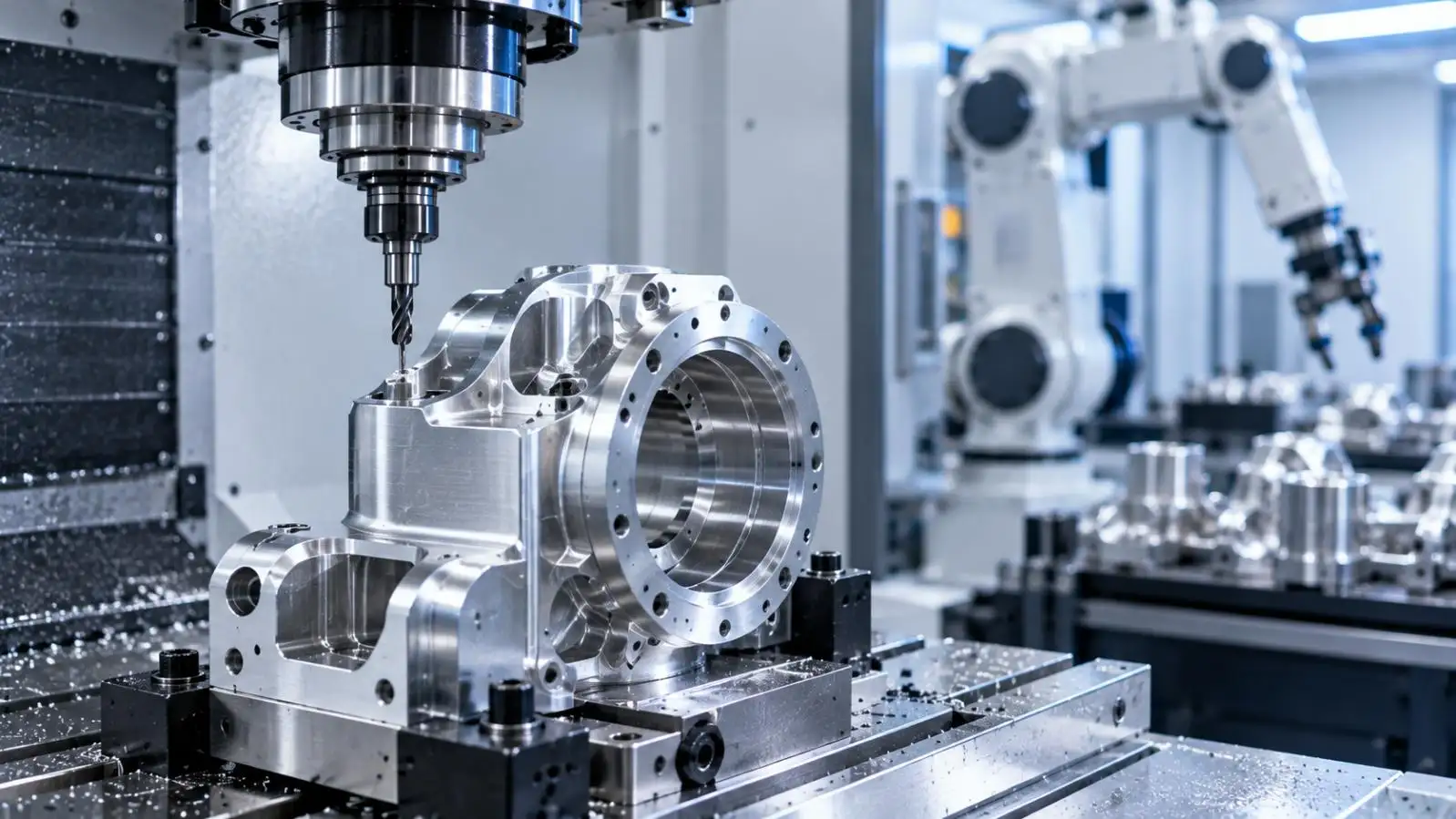
CNC Machining Robotic Parts: How GD&T Controls Robot Assembly Accuracy
2026-09-24By KT Engineering -
 Hide blog post
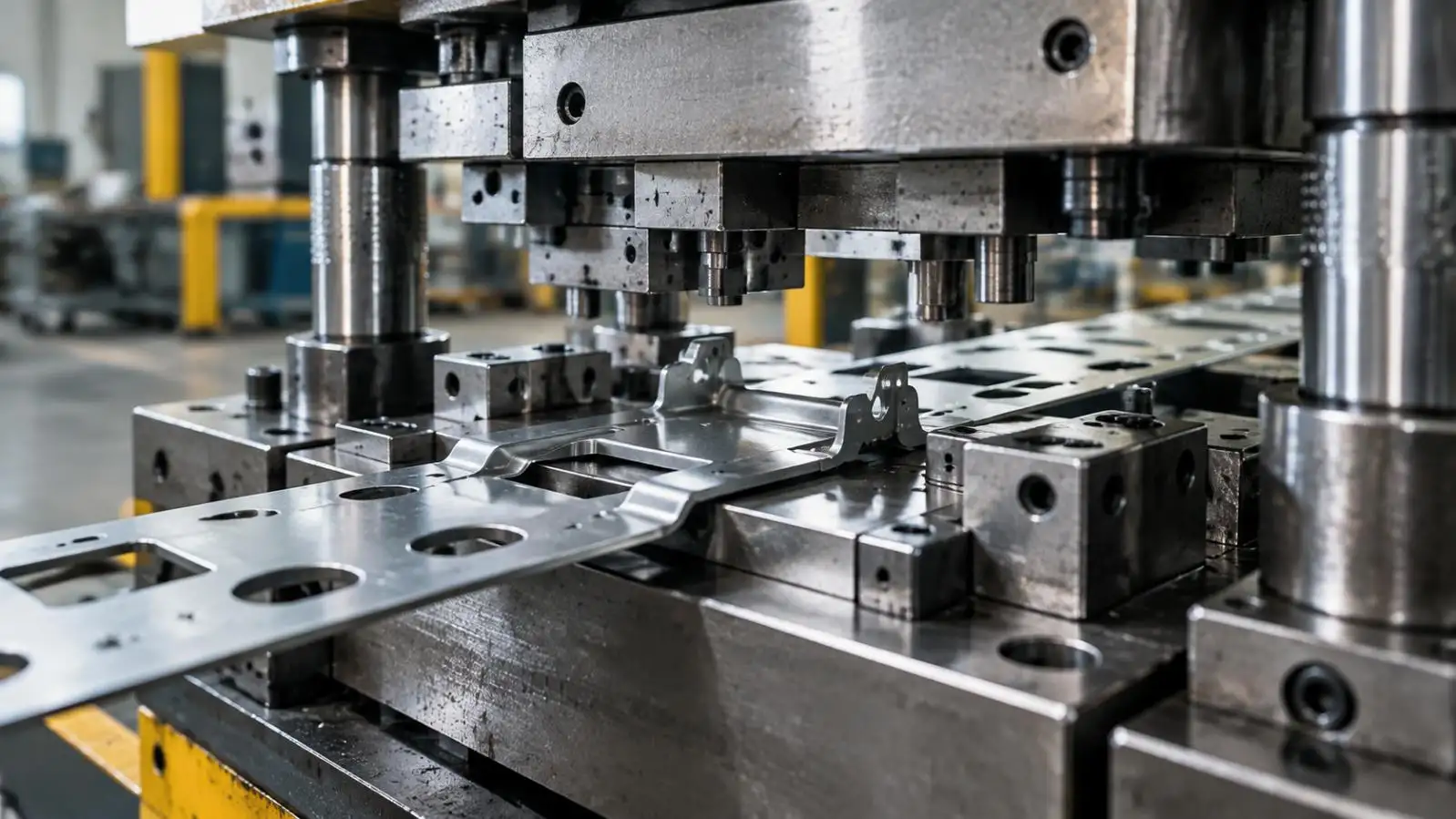
Hardware Stamping Springback Control for High-Strength Steel Parts
2026-09-24By KT Engineering -
 Hide blog post
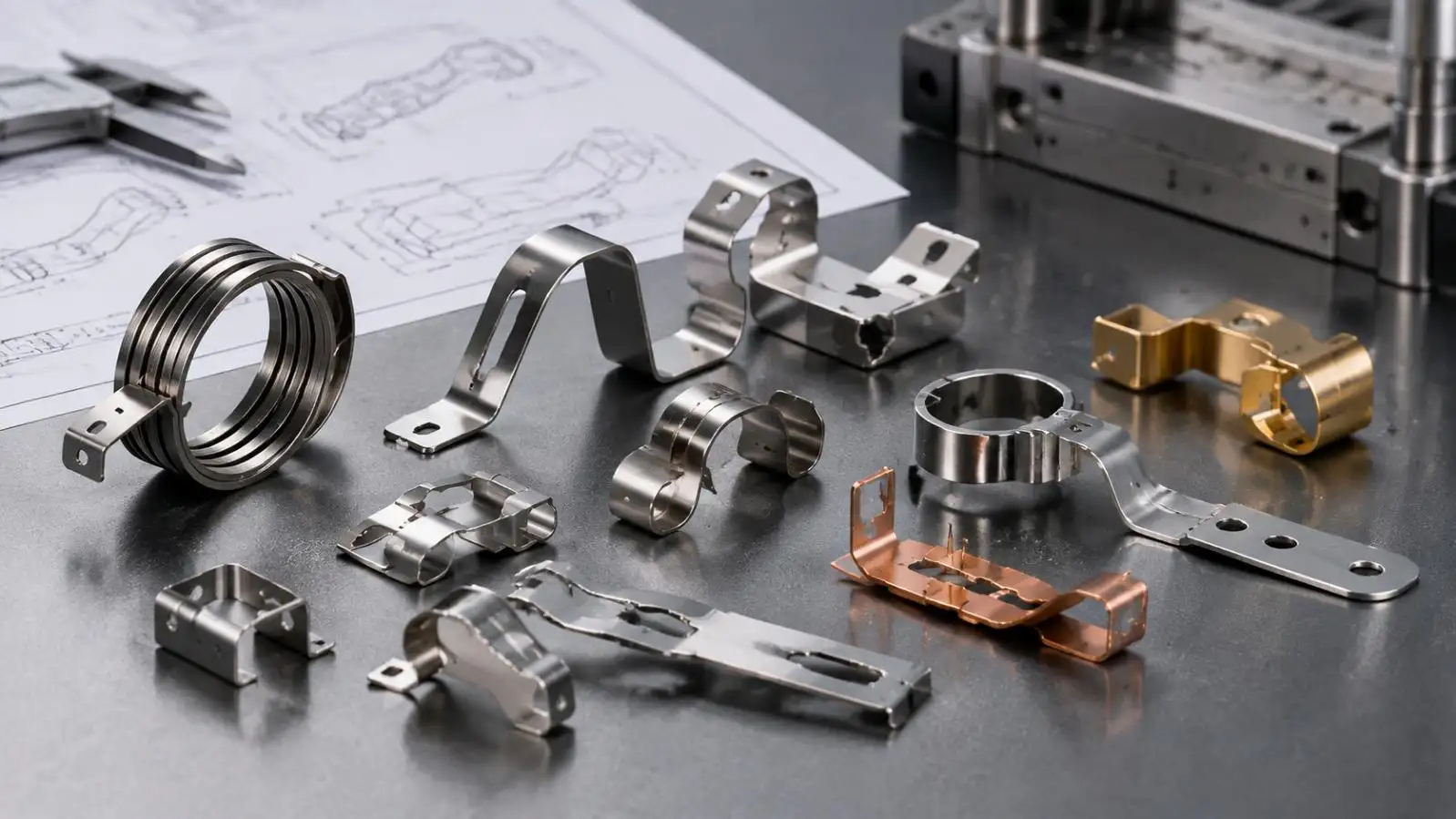
Spring Stamping Fatigue Life: How Geometry, Material and Edge Quality Affect Cycle Life
2026-09-24By KT Engineering -
 Hide blog post
Mechanical Automation Parts for Robot End Effectors and Positioning Accuracy
2026-09-23By KT Engineering