Contact Us
  Home /
 what is a cnc machine


Table of Contents
- What Is a CNC Machine?
- How Does a CNC Machine Work?
- Main Components of a CNC Machine
- Types of CNC Machines
- Advantages of CNC Machines
- Industries That Use CNC Machines
- CNC Machining vs Manual Machining
- Common Materials Used in CNC Machining
- Why Businesses Choose CNC Machining
- Future Trends in CNC Manufacturing
- Conclusion

Few technologies have revolutionized manufacturing as dramatically as CNC machining, and it is used for speed, precision and consistency. From making aerospace parts to automotive components and medical devices to custom prototypes, CNC machines are essential for delivering unmatched accuracy and repeatability.
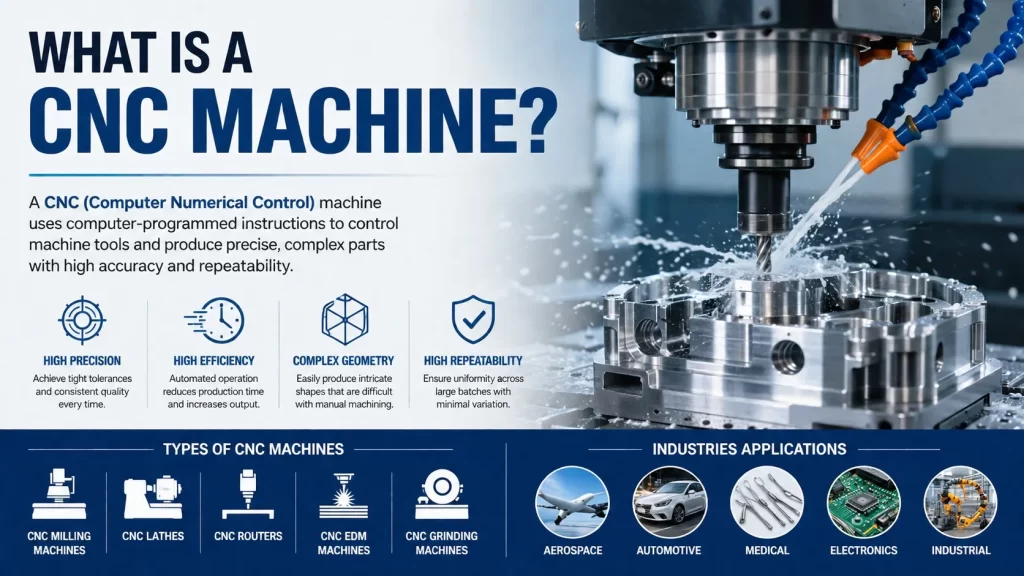
But how does a CNC machine work, what is it, and why is it the backbone of today's manufacturing industry?
This guide discusses all the facts about CNC machines, their working principle, benefits, types of CNC machines, application of CNC machines, and the benefits of CNC machining services to businesses.
What Is a CNC Machine?
The CNC machine, a computer-controlled manufacturing machine, is an automatic manufacturing process that operates cutting tools and machines based on computer instructions. Unlike manual manufacturing, CNC machines perform the task as programmed to ensure parts are manufactured with high accuracy and repeatability.
The CNC process starts with a virtual CAD (Computer-Aided Design) drawing. To produce the instructions that tell the machine what to do, the design is translated into a language that can be understood by a computer, called CAM software, which typically turns out to be G-code. These instructions are used to control all movements of the cutting tools and allow complex machining processes with minimum human involvement.
How Does a CNC Machine Work?
Although different CNC machines perform different operations, the basic workflow remains similar.
1. Product Design
Engineers create a 2D or 3D model using CAD software.
2. CAM Programming
The design is converted into G-code, which tells the machine:
- Cutting paths
- Tool selection
- Feed rates
- Spindle speeds
- Cutting depth
- Machine movements
3. Machine Setup
The operator attaches the proper cutting tools and holds the material ready to be cut.
4. Automated Machining
The CNC controller reads the program and precisely controls the motor, axes and tooling to remove material.
5. Inspection
All finished parts are checked for dimensions to ensure tolerance acceptance for shipping or assembly.
CNC machining is digitally controlled, which enables the production of repeatable, identical parts with incredible repeatability.
Main Components of a CNC Machine
CNC machines are made up of multiple systems that are connected together.
CNC Controller
The machine that reads the G-code and controls the machine.
Machine Bed
Gives a solid base to limit vibration during machining.
Spindle
Operates high-speed cutting tools.
Tool Changer
Switches tools automatically during the operation to speed up the production process.
Drive Motors
Precisely move the machine on various axes.
Workholding System
Securely holds the material while machining.
Cooling System
Diminishes the heat and prolongs the useful life of the cutting tool.
Types of CNC Machines
Different manufacturing requirements call for different CNC equipment.
CNC Milling Machines
CNC milling removes material using rotating cutting tools.
Ideal for:
- Precision metal parts
- Plastic components
- Complex geometries
- Multi-sided machining
Modern machining centers often feature 3-axis, 4-axis, or 5-axis capabilities for increasingly complex components.
CNC Lathes
Lathes rotate the workpiece while stationary cutting tools shape cylindrical parts.
Common applications include:
- Shafts
- Bushings
- Fasteners
- Medical implants
- Automotive components
CNC Routers
Routers are widely used for machining:
- Wood
- Plastic
- Foam
- Aluminum
- Composite materials
They're popular in furniture manufacturing, signage, and cabinetry.
CNC EDM Machines
Electrical Discharge Machining (EDM) removes material using electrical sparks rather than traditional cutting tools.
EDM is ideal for:
- Hardened steel
- Precision molds
- Intricate cavities
- Tight internal corners
CNC Grinding Machines
Grinding machines provide extremely smooth finishes and ultra-tight dimensional accuracy.
Applications include:
- Bearings
- Aerospace components
- Medical instruments
Advantages of CNC Machines
Exceptional Precision
Many CNC machines achieve tolerances within microns, making them suitable for industries where precision is critical.
High Repeatability
Thousands of identical components can be produced without variation.
This consistency is essential for mass production.
Faster Production
Automation dramatically reduces machining time compared to manual methods.
Machines can often run continuously with minimal supervision.
Reduced Human Error
Because movements are computer controlled, production errors caused by manual operation are minimized.
Complex Geometry
Modern multi-axis CNC machines easily manufacture parts that would be nearly impossible using conventional machining.
Material Flexibility
CNC machines can process numerous materials, including:
- Aluminum
- Steel
- Stainless steel
- Titanium
- Brass
- Copper
- Plastics
- Engineering polymers
- Composites
Better Surface Finish
Advanced tooling and optimized toolpaths create smooth surfaces, reducing secondary finishing operations.
Industries That Use CNC Machines
Virtually every manufacturing sector depends on CNC machining.
Aerospace
Aircraft components demand exceptional precision and lightweight materials.
Typical parts include:
- Engine components
- Structural brackets
- Turbine parts
Automotive
Automotive manufacturers use CNC machining for:
- Engine blocks
- Transmission housings
- Suspension components
- Prototype parts
Medical
Medical devices require precise tolerances and biocompatible materials.
Examples include:
- Surgical tools
- Orthopedic implants
- Dental equipment
Electronics
CNC machining produces precision housings and heat sinks for:
- Consumer electronics
- Telecommunications equipment
- Semiconductor manufacturing
Industrial Equipment
Factories rely on CNC machining for:
- Machine components
- Custom tooling
- Automation equipment
- Production fixtures
CNC Machining vs Manual Machining
| Feature | CNC Machining | Manual Machining |
|---|---|---|
| Accuracy | Extremely High | Operator Dependent |
| Speed | Fast | Slower |
| Repeatability | Excellent | Limited |
| Labor Cost | Lower for Production | Higher |
| Complex Parts | Easy | Difficult |
| Automation | Yes | No |
For prototypes and production alike, CNC machining generally offers superior efficiency, precision, and scalability.
Common Materials Used in CNC Machining
Manufacturers select materials based on strength, weight, corrosion resistance, and application requirements.
Popular materials include:
Metals
- Aluminum
- Stainless Steel
- Carbon Steel
- Brass
- Copper
- Titanium
Plastics
- ABS
- Nylon
- PEEK
- Delrin (Acetal)
- Polycarbonate
- PTFE
These materials need certain tooling and machining parameters for each material to obtain the optimal results.
Why Businesses Choose CNC Machining
CNC technology is still a worthwhile investment for manufacturers all over the world, as it provides measurable benefits to the business.
Key advantages include:
- Faster product development
- Lower production costs
- Consistent quality
- Reduced material waste
- Scalable manufacturing
- Shorter lead times
- High production efficiency
- Improved customer satisfaction
CNC machining can be used to manufacture 1 prototype or thousands of production parts, and the results are also repeatable and reliable.
Future Trends in CNC Manufacturing
With the development of Industry 4.0, CNC machining is now more intelligent.
Emerging technologies include:
- AI-assisted machining optimization
- IoT-enabled machine monitoring
- Predictive maintenance
- Digital twins
- Automated quality inspection
- Robotic material handling
- Cloud-based production management
These innovations are aimed at optimizing machine utilization, minimizing downtimes and further enhancing manufacturing efficiency.
Conclusion
The combination of computer automation with high precision machining has revolutionized the modern manufacturing industry with the use of CNC machines. CNC technology is used in a wide range of industries, including aerospace, automotive, medical, and consumer electronics, to manufacture parts with greater precision and consistency than traditional machining processes and at a much quicker pace.
CNC machining will continue to play a crucial role in production for businesses aiming to enhance quality, efficiency, and competitiveness, especially in an increasingly automated and technology-driven manufacturing landscape. From rapid prototyping to custom components and high-volume production, investing in CNC machining ensures precision, scalability, and long-term manufacturing success.
Talk to the Manufacturer, Not a Middleman
Resources & Insights
-
 Hide blog post
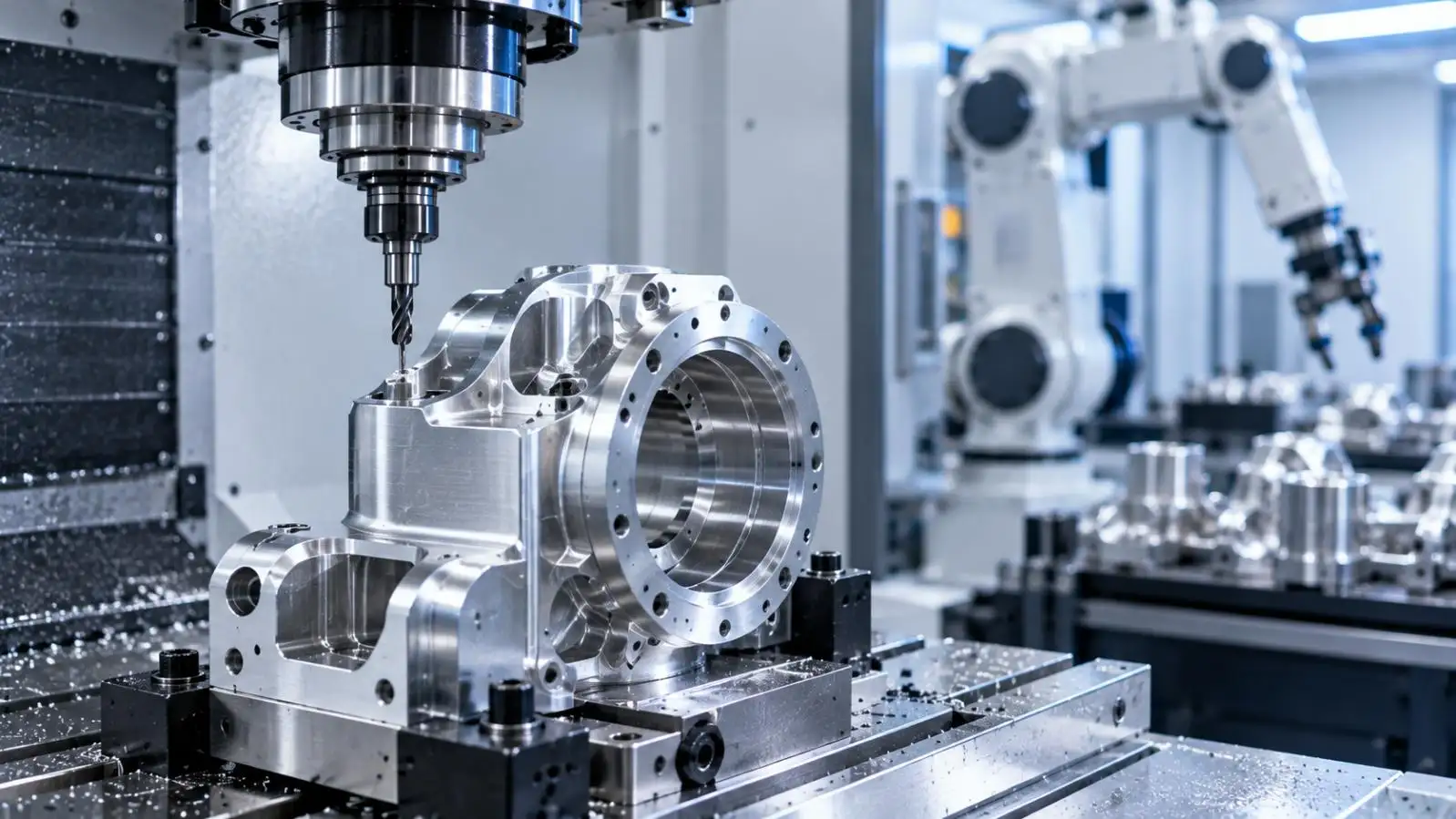
CNC Machining Robotic Parts: How GD&T Controls Robot Assembly Accuracy
2026-09-24By KT Engineering -
 Hide blog post
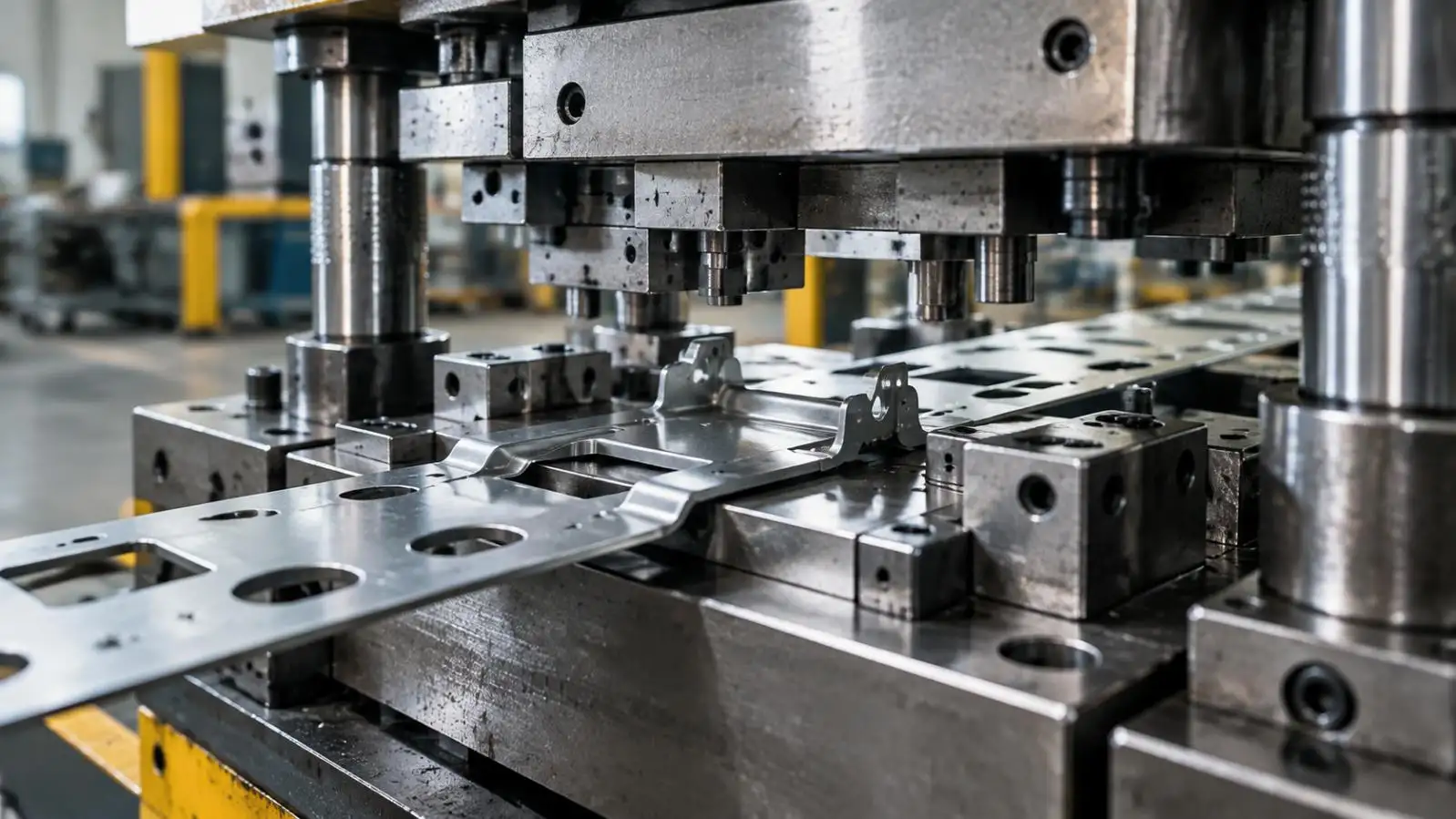
Hardware Stamping Springback Control for High-Strength Steel Parts
2026-09-24By KT Engineering -
 Hide blog post
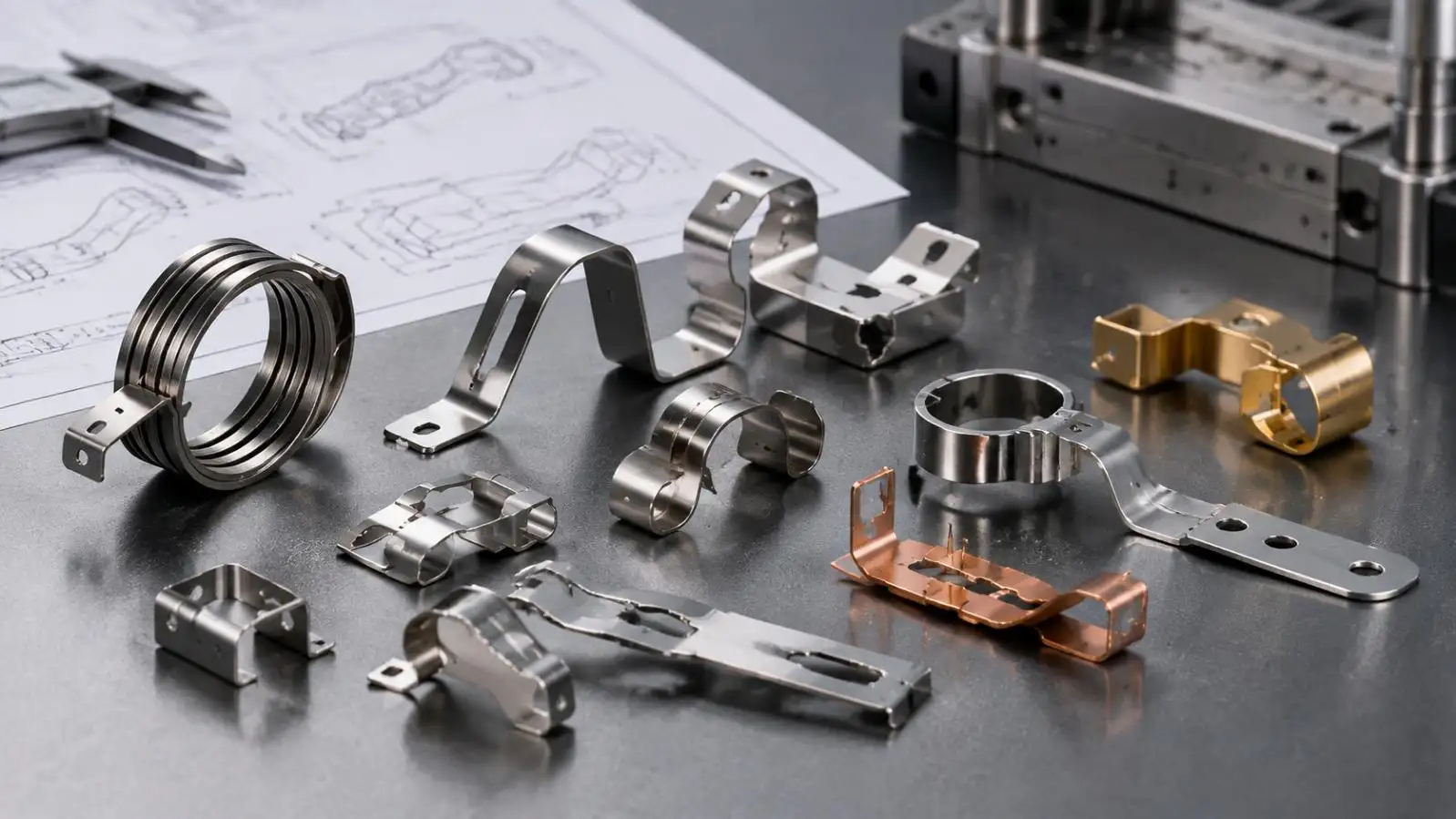
Spring Stamping Fatigue Life: How Geometry, Material and Edge Quality Affect Cycle Life
2026-09-24By KT Engineering -
 Hide blog post
Mechanical Automation Parts for Robot End Effectors and Positioning Accuracy
2026-09-23By KT Engineering