Contact Us
  Home /
 cnc machine tools


Table of Contents

CNC machine tools are the basis of modern manufacturing. These computer-controlled machines are used in a wide variety of industries, from aerospace and automotive manufacturing to medical devices and consumer electronics, to provide the precision, speed, and repeatability required by today's manufacturing world. With the ongoing trend of manufacturing embracing automation and digital production, knowledge of the various CNC machine tools has become vital to the careers of engineers, manufacturers and procurement professionals.
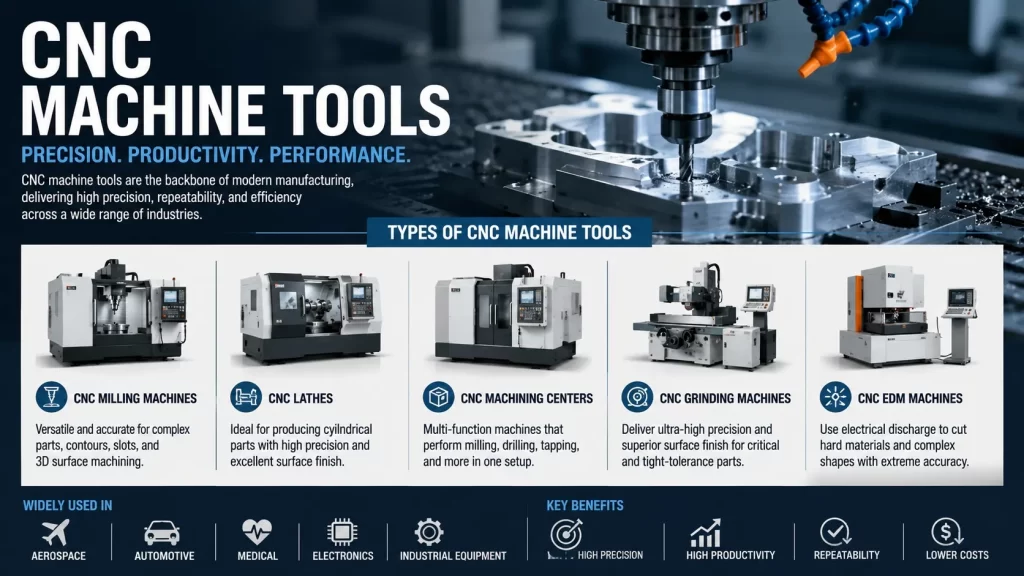
The choice of CNC machine tool is directly related to the quality of products, production efficiency, and operating costs, whether for a new production line or ordering machine tools for machining.
This guide provides an overview of the most common types of CNC machine tools, their uses, benefits, and considerations before investing.
What Are CNC Machine Tools?
CNC (Computer Numerical Control) machine tools are automation manufacturing systems driven by pre-programmed software to perform cutting, drilling, milling, turning, grinding, and shaping operations. Unlike traditional manual machines, CNC machines operate with a high degree of accuracy and precision, which enables the production of complex components with greater consistency.
The modern CNC machine integrates the following:
- CAD/CAM software
- CNC controllers
- Servo motors
- Precision ball screws
- Automatic tool changers
- High-speed spindles
- Intelligent monitoring systems
These technologies work together to reduce human error and increase productivity and repeatability. CNC machining is known for its ability to manufacture parts with precision using computer-controlled tool movements.
Main Types of CNC Machine Tools
1. CNC Milling Machines
CNC milling machine is one of the most versatile machine tools available. They remove material with rotating cutting tools, the work piece is stationary or they motion it along multiple axis.
Typical applications include:
- Mold manufacturing
- Precision brackets
- Medical implants
- Aerospace components
- Mechanical housings
Advantages
- Excellent dimensional accuracy
- Complex 3D machining
- High productivity
- Suitable for prototype and production runs
Today, many modern machining centers are actually equipped with automatic tool changers, thereby decreasing downtime and also increasing manufacturing efficiency.
2. CNC Lathes
CNC Lathes move a workpiece and a stationary cutting tool forms the material.
They can be used to make cylindrical components like:
- Shafts
- Bushings
- Valves
- Fasteners
- Hydraulic fittings
Benefits
- Fast production speed
- Outstanding concentricity
- Excellent surface finish
- Lower machining cost for round parts
CNC turning centers can perform more than one operation during one set up in high volume production.
3. CNC Machining Centers
Machining centers are machines that integrate the milling, drilling, tapping, boring and reaming operations.
Common configurations include:
- Vertical Machining Centers (VMC)
- Horizontal Machining Centers (HMC)
- 5-Axis Machining Centers
Why They're Popular
- Multiple operations without repositioning
- Improved machining accuracy
- Reduced labor requirements
- Higher production throughput
These machines are commonly used in automotive, aerospace, defense, and industrial equipment manufacturing.
4. CNC Grinding Machines
Grinding machines are capable of producing very close tolerances and extremely smooth surface finishes with the abrasive wheels.
Applications include:
- Bearing components
- Precision molds
- Cutting tools
- Engine parts
Grinding is frequently the last finishing operation following milling or turning.
5. CNC EDM Machines
Electrical Discharge Machining (EDM) is a process that utilizes electrical sparks to remove material rather than cutting tools.
EDM is very good at machining:
- Hardened steel
- Titanium
- Carbide
- Intricate mold cavities
- Precision dies
Wire EDM is particularly suitable for making complex internal shapes that can not be obtained by means of conventional cutting tools.
Industries That Rely on CNC Machine Tools
CNC machining is used in nearly all the manufacturing industries.
Aerospace
Aircraft parts need to be light and be made to micro-level tolerances. Structural brackets, engine components and landing gear components are made on CNC machines.
Automotive
CNC is used in the automotive industry for engine blocks, transmission cases, suspension components, and prototype development.
Medical
A medical manufacturer uses CNC Machining for:
- Surgical instruments
- Orthopedic implants
- Dental components
- Diagnostic equipment
Precision and repeatability are critical for patient safety.
Electronics
CNC components made of aluminum are used for miniaturized electronic apparatus, housing, connectors, heat sinks and custom enclosures.
Industrial Equipment
CNC machine tool manufacturers are integral to the production of pumps, valves, robotics and automation systems, and are key to their ability to create long-lasting, high quality parts.
Key Components of a CNC Machine Tool
If you understand how machines are built, you will have a better idea of the quality of an equipment.
Important components include:
CNC Controller
The controller interprets the G-code instructions and controls the movement of the machine with great accuracy.
Spindle
Spindle spins cutting tools at designed speeds. The better the spindle performance the better the machining quality and shorter cycle time.
Tool Magazine
Multiple setup of machining operations, and minimum manual intervention by operators are achieved by automatic tool changers.
Linear Guideways
The quality of the guideways increases positioning accuracy and reduces vibration.
Ball Screws
Precision ball screws convert rotary movement to linear movement with accurate precision, providing smooth operation.
Servo Motors
For complex machining tasks, the servo system is capable of providing precise positioning and dynamic motion control.
How to Choose the Right CNC Machine Tool
Choosing the right machine is more than just about the cost.
Take into account the following factors:
Material Type
Various kinds of machines are needed for various materials.
Examples include:
- Aluminum
- Stainless steel
- Carbon steel
- Brass
- Titanium
- Engineering plastics
More rigid machine structure and higher spindle power is needed for harder material.
Part Complexity
Simple 2 axis turning may only involve the use of a CNC lathe; complex aerospace parts may require simultaneous 5 axis turning.
Production Volume
The machine choice depends on the quantity of production.
Flexible machining centers are useful in low production volumes, compared to automation or fully dedicated production cells in high production volumes.
Precision Requirements
Some industries need tolerances as tight as ±0.005 mm (or less) such as aerospace and medical manufacturing.
The rigidity of the machine, its thermal stability and controller parameters become more relevant.
Budget
Investment should consider:
- Machine purchase cost
- Tooling expenses
- Maintenance
- Software
- Operator training
- Long-term operating costs
The lowest initial cost machine does not necessarily have lowest lifetime cost per part.
Emerging Trends in CNC Machine Tools
The technology of manufacturing continues to change at a fast-paced rate.
Current trends include:
Smart Manufacturing
The Industrial Internet of Things (IIoT) platform facilitates real-time production monitoring through increased connectivity of machines.
AI-Assisted Machining
Artificial Intelligence enables intelligent process control, optimizes toolpath, and predicts maintenance and improves machining efficiencies.
Automation
Labor cost is cut and productivity is boosted with the use of robotic loading systems, pallet changers, and automated inspection.
Multi-Axis Machining
Five-axis machining is becoming more and more common due to fewer setups and greater accuracy for complex parts.
Sustainable Manufacturing
In order to minimize the environmental impact, manufacturers are implementing energy-efficient machines and optimized coolant systems, as well as material saving measures.
Best Practices for Maximizing CNC Machine Performance
To achieve consistent machining quality:
- Schedule preventive maintenance.
- Replace worn cutting tools promptly.
- Use appropriate cutting parameters.
- Calibrate machines regularly.
- Train operators continuously.
- Monitor spindle health and vibration.
- Maintain coolant quality.
- Verify programs before production.
These practices help extend machine life while reducing downtime and scrap rates.
Conclusion
The CNC machine tools have revolutionized industrial manufacturing with their superior accuracy, repeatability, and productivity in various industries. From manufacturing a single prototype to millions of production parts, the choice of machine will depend on the material, complexity of the component, production quantity and the required quality of the parts produced.
With the further development of automation, artificial intelligence, and smart manufacturing, CNC machine tools will be more intelligent, efficient, and connected. Companies that prioritize the proper equipment and machining techniques will be more equipped to enhance product quality, reduce lead times, and maintain a competitive edge in the fast-paced global market.
The first step for manufacturers and sourcing professionals to make informed production decisions and eventually manufacturing success is to understand the strengths of each CNC machine tool.
- PREV: what is a cnc machine
- NEXT: cnc laser cutting machine
Talk to the Manufacturer, Not a Middleman
Resources & Insights
-
 News
NewsCNC Machining Robotic Parts: How GD&T Controls Robot Assembly Accuracy
2026-09-24By KT Engineering -
 News
NewsHardware Stamping Springback Control for High-Strength Steel Parts
2026-09-24By KT Engineering -
 News
NewsSpring Stamping Fatigue Life: How Geometry, Material and Edge Quality Affect Cycle Life
2026-09-24By KT Engineering -
 News
NewsMechanical Automation Parts for Robot End Effectors and Positioning Accuracy
2026-09-23By KT Engineering