Contact Us
  Home /
 cnc laser cutting machine


Table of Contents
- What Is a CNC Laser Cutter?
- How CNC Fiber Laser Cutting Machines Work
- Key Benefits of CNC Laser Cutters
- Main Applications of CNC Laser Cutters
- Types of CNC Laser Cutting Machines
- CNC Laser Cutter Price Range
- Key Features to Look for When Buying a CNC Laser Cutter
- Why Fiber Laser Technology Is Dominating the Market
- CNC Laser Cutter for Small Businesses vs Industrial Use
- Maintenance and Operating Tips
- Conclusion

One of the most sought-after solutions in today's metal fabrication industry is a CNC laser cutter for sale. Whether you are the owner of a small workshop, prototype lab or large scale manufacturing facility, CNC fiber laser cutting machines can provide high precision, high speed production and low operating costs, which cannot be achieved by conventional processing methods.
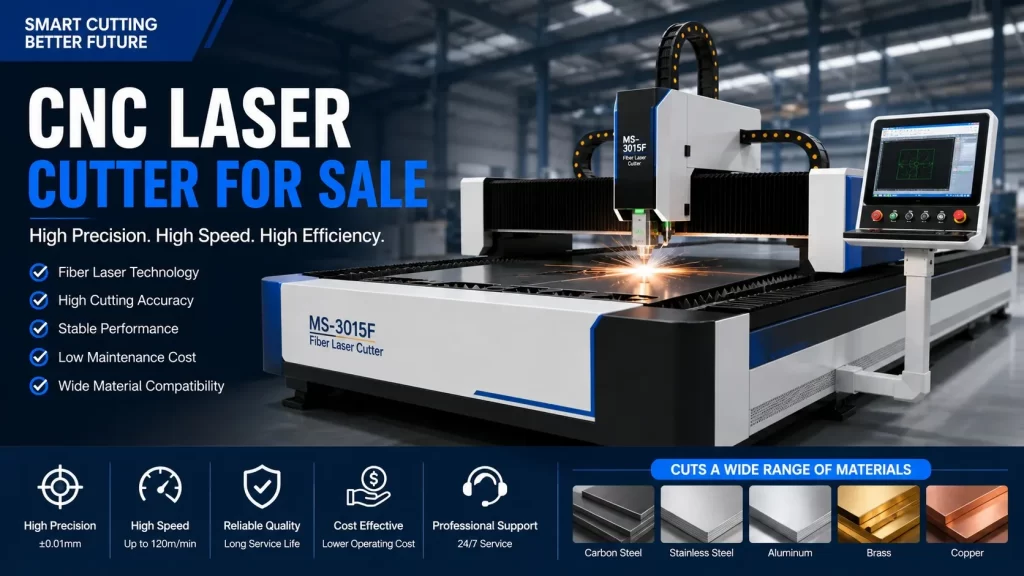
CNC laser cutting technology is widely used in various fields today, including automotive, aerospace, electronics, sheet metal manufacturing, and custom signage.CNC laser cutting technology is widely used in fields such as automotive, aerospace, electronics, sheet metal manufacturing, and custom signage today for its accuracy and scalability.
This is a guide on what a CNC laser cutter is, its advantages, uses, essential characteristics, costs, and picking the right CNC laser cutter for your company.
What Is a CNC Laser Cutter?
The CNC laser cutter is a machine that cuts, engraves or shapes metal and non-metal materials using a high-power laser beam, and is controlled by computer.
CNC is Computer Numerical Control – that is, the machine follows the instructions that have been programmed into it and works with extreme accuracy.
The majority of the modern industrial systems are based on the use of fiber lasers that offer the following:
- Higher energy efficiency
- Faster cutting speeds
- Lower maintenance costs
- Better precision for metals like steel, aluminum, brass, and copper
These machines are commonly used in industrial manufacturing settings where precision and repeatability are paramount.
How CNC Fiber Laser Cutting Machines Work
A CNC laser cutter works through a combination of software, motion control, and laser technology:
- Design Input (CAD/CAM Software)
The cutting design is created using CAD software and converted into machine-readable instructions. - CNC Control System
The CNC controller processes the instructions and guides the cutting path. - Fiber Laser Source
A high-powered laser beam is generated and focused onto the material surface. - Cutting Process
The laser melts or vaporizes the material while assist gas (oxygen or nitrogen) removes debris. - Precision Output
The machine produces clean, accurate cuts with minimal post-processing.
Key Benefits of CNC Laser Cutters
1. High Precision and Accuracy
CNC laser cutters can achieve extremely tight tolerances, making them ideal for industrial components and detailed designs.
2. Faster Production Speed
Compared with traditional milling or plasma cutting, fiber lasers significantly improve cutting efficiency.
3. Low Operating Cost
No need for frequent tool changes or consumable cutting tools, reducing long-term expenses.
4. Wide Material Compatibility
CNC laser cutting machines can process:
- Carbon steel
- Stainless steel
- Aluminum
- Brass
- Copper
- Galvanized sheets
5. Minimal Maintenance
Fiber laser systems have fewer moving parts and no mirror alignment issues, resulting in lower maintenance requirements.
Main Applications of CNC Laser Cutters
CNC laser cutting machines are widely used in multiple industries:
- Automotive manufacturing parts
- Aerospace precision components
- Industrial machinery fabrication
- Sheet metal processing
- Electrical enclosures
- Advertising signage and metal artwork
- Kitchen equipment production
- Construction hardware
Their versatility makes them a core tool in modern manufacturing.
Types of CNC Laser Cutting Machines
When searching for a CNC laser cutter for sale, you will typically find several machine types:
1. Fiber Laser Cutting Machine
Best for metal cutting applications. High speed and high efficiency.
2. CO₂ Laser Cutting Machine
More suitable for non-metal materials like wood, acrylic, leather, and plastics.
3. Hybrid Laser Systems
Combine cutting, welding, and cleaning functions in one platform for advanced fabrication needs.
CNC Laser Cutter Price Range
The cost of a CNC laser cutter varies depending on power, size, and configuration:
- Entry-level machines: $7,000 – $20,000
- Mid-range industrial machines: $30,000 – $80,000
- High-power industrial systems: $80,000 – $150,000+
For example, industrial fiber laser cutting systems commonly used in sheet metal production can exceed $70,000 depending on laser power and automation features.
Higher wattage (3000W–6000W) machines provide faster cutting speeds and thicker material processing capability.
Key Features to Look for When Buying a CNC Laser Cutter
When selecting a CNC laser cutter for sale, consider the following specifications:
1. Laser Power (Wattage)
- 1500W: Thin sheet metal
- 3000W: Medium thickness steel
- 6000W+: Heavy industrial cutting
2. Cutting Bed Size
Common sizes include:
- 3015 (3000mm x 1500mm)
- 4020 (4000mm x 2000mm)
3. CNC Control System
Popular systems include BOCHU FSCUT and other advanced controllers for smooth operation.
4. Automation Options
- Automatic loading/unloading
- Rotary tube cutting systems
- Smart nesting software
5. Cooling System
Industrial machines require water chillers for stable laser performance.
Why Fiber Laser Technology Is Dominating the Market
Fiber laser cutting technology has rapidly replaced older CO₂ systems in metal fabrication due to:
- Higher electrical efficiency
- Faster beam transmission
- Longer lifespan
- Better cutting quality for reflective metals
This makes fiber laser systems the preferred choice for modern CNC machining workshops.
CNC Laser Cutter for Small Businesses vs Industrial Use
Small Business Use
- Lower power machines (800W–1500W)
- Compact footprint
- Ideal for custom parts, signage, and prototypes
Industrial Use
- High-power systems (3000W–6000W+)
- Automated production lines
- High-volume sheet metal fabrication
Choosing the right configuration depends on production scale and material thickness requirements.
Maintenance and Operating Tips
To maximize machine lifespan and performance:
- Regularly clean lens and cutting head
- Maintain stable cooling water temperature
- Use clean compressed assist gas
- Update CNC software periodically
- Inspect guide rails and motion systems
Maintenance will help to maintain the cutting quality and minimize downtime.
Conclusion
When you invest in a CNC laser cutter for sale, you're investing in an incredibly strong machine that will benefit your manufacturing or fabrication company for a long time. Fiber laser cutting machines are indispensable machines in modern industry, with the advantages of high precision, high speed, and low operating cost.
As a small workshop or a large-scale manufacturer, choose the right CNC laser cutter to be able to effectively improve production efficiency, product quality and productivity.
When you're thinking of investing in new metal fabrication equipment, then you have one of the most reliable and future-proof options on hand: A fiber laser CNC cutting machine.
- PREV: cnc machine tools
- NEXT: cnc plasma cutting machine
Talk to the Manufacturer, Not a Middleman
Resources & Insights
-
 Hide blog post
CNC Machining Robotic Parts: How GD&T Controls Robot Assembly Accuracy
2026-09-24By KT Engineering -
 Hide blog post
Hardware Stamping Springback Control for High-Strength Steel Parts
2026-09-24By KT Engineering -
 Hide blog post
Spring Stamping Fatigue Life: How Geometry, Material and Edge Quality Affect Cycle Life
2026-09-24By KT Engineering -
 Hide blog post
Mechanical Automation Parts for Robot End Effectors and Positioning Accuracy
2026-09-23By KT Engineering