Contact Us
  Home /
 best 3D printing factory


Table of Contents
- What Is a 3D Printing Factory?
- Key Characteristics of the Best 3D Printing Factory
- Benefits of Working with a Professional 3D Printing Factory
- How to Choose the Best 3D Printing Factory
- Industries That Depend on Leading 3D Printing Factories
- Why Global Companies Prefer Professional 3D Printing Factories
- Future Trends in 3D Printing Manufacturing
- Conclusion

The world of 3D printing continues to revolutionize industries, and finding the best 3D printing factory is now crucial for businesses that are looking for quick prototypes, custom manufacturing and low-volume production. Aerospace and automotive parts, medical devices and consumer electronics are just some of the products that benefit from 3D printing tech to improve lead times, cut expenses, and accelerate innovations.
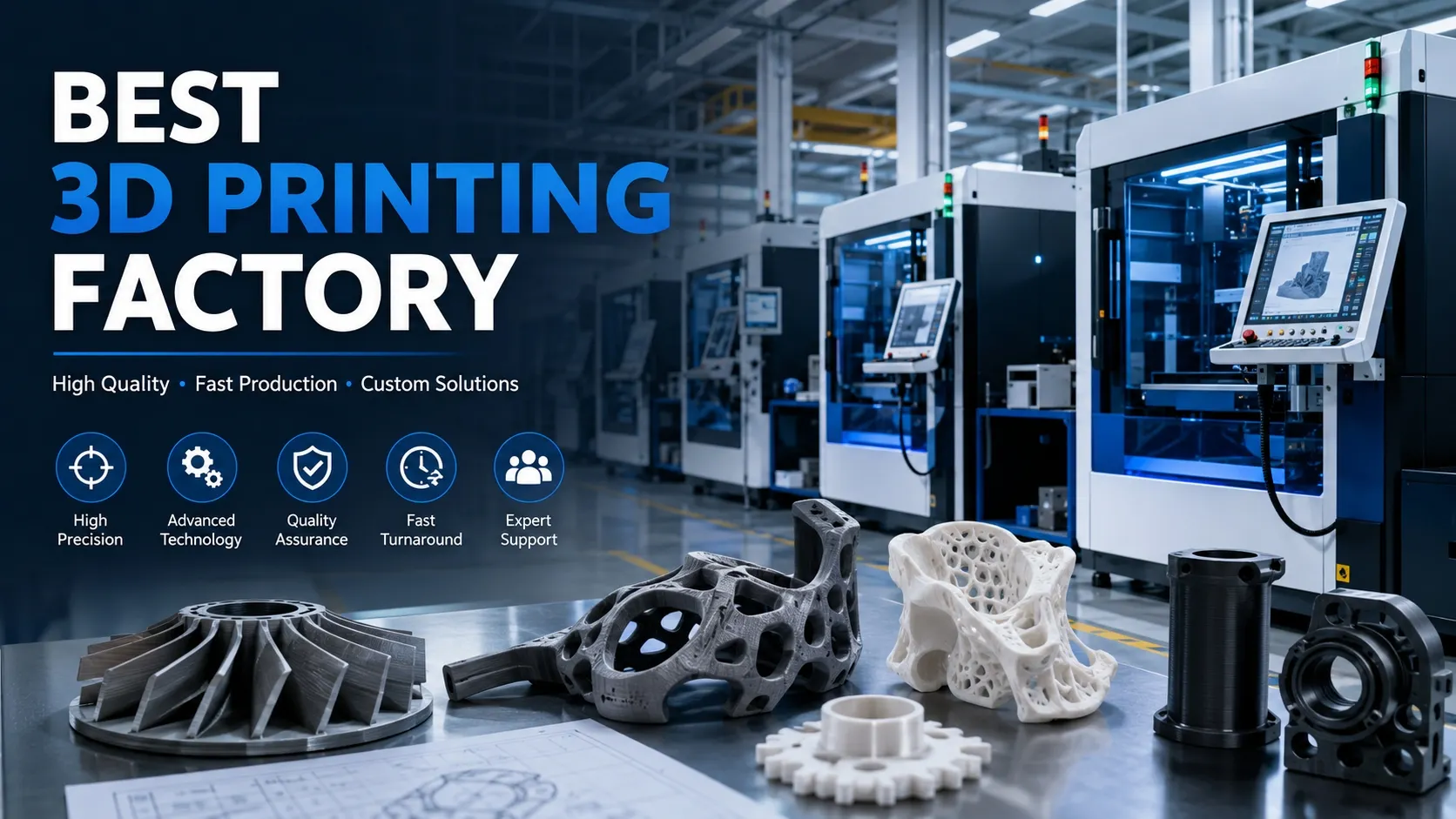
Not every 3D printing factory is capable of providing you the same capabilities, quality and production rate, though. Selecting the appropriate manufactory partner can certainly make a difference in the circle of product creation and the success of your business.
In this guide we will discuss the features of a best-in-class 3D Printing factory, the technology they use and how to screen 3D Printing suppliers for the next project.
What Is a 3D Printing Factory?
A 3D Printing Factory (3PF) is a manufacturing unit, which utilizes 3D printing technologies to break down a CAD file into layers to produce three-dimensional objects. The 3D printing technology is generally less wasteful than other manufacturing processes like CNC or injection molding, and can achieve very complex geometries.
So, a typical modern 3D printing factory will provide you with:
- Rapid prototyping services
- Low-volume production
- Functional testing parts
- Custom manufacturing
- Design optimization support
- Post-processing and finishing services
- Quality inspection and certification
These installations include industries such as aerospace, automotive, healthcare, electronics, robotics, industrial equipment and consumer goods.
Key Characteristics of the Best 3D Printing Factory
1. Advanced Manufacturing Technologies
The more advanced factories employ multiple Additive manufacturing (AM) technologies to cater for a wide range of customer needs.
Common technologies include:
SLA (Stereolithography)
SLA printing provides a wonderful surface finish and extremely good precision, and is suitable for prototypes, medical models, and detailed components.
SLS (Selective Laser Sintering)
SLS produces functional parts with high strength and durability without the need for support materials thanks to its powder-based nylon materials.
FDM (Fused Deposition Modeling)
The benefits of FDM for prototyping and function testing is one of its best attributes that's also the most cost-effective.
MJF (Multi Jet Fusion)
The mechanical properties, consistency and production efficiencies are excellent.
Metal 3D Printing
Advanced factories offer metal additive manufacturing using:
- DMLS
- SLM
- Binder Jetting
These technologies are widely used for aerospace, medical, and industrial applications.
2. Extensive Material Selection
A reliable 3D printing factory should provide a broad range of materials, including:
Plastics
- ABS
- PLA
- Nylon
- PETG
- TPU
- Polycarbonate
Engineering Materials
- Carbon fiber reinforced polymers
- Glass-filled nylon
- High-temperature resins
Metals
- Stainless steel
- Aluminum
- Titanium
- Inconel
- Tool steel
The availability of multiple materials allows engineers to select the optimal solution for performance and cost requirements.
3. Strong Quality Control Systems
Quality assurance separates leading manufacturers from average suppliers.
The best 3D printing factories implement:
- ISO 9001 certification
- Material traceability
- Dimensional inspection
- Mechanical testing
- Surface quality verification
- Process validation
Many factories also provide detailed inspection reports and certificates of conformity upon request.
Benefits of Working with a Professional 3D Printing Factory
Faster Product Development
Traditional tooling can take weeks or months. A professional 3D printing factory can produce prototypes within days, enabling faster design iterations and shorter development cycles.
Lower Manufacturing Costs
Additive manufacturing cuts up-front costs when manufacturing a prototype or Just-In-Time low-volume production runs, compared to the expense of setting up the tool.
Design Freedom
Molding heavy components and structures with multiple internal channels or latticeworks is not always possible.
With 3D printing, engineers can improve designs for:
- Weight reduction
- Improved performance
- Material efficiency
- Functional integration
Customization at Scale
One of the biggest advantages of additive manufacturing is mass customization. Each part can be modified without changing tooling or increasing production complexity.
This is especially valuable for:
- Medical implants
- Consumer products
- Automotive components
- Industrial equipment
How to Choose the Best 3D Printing Factory
Evaluate Technical Capabilities
Before selecting a supplier, review their:
- Available technologies
- Material portfolio
- Machine capacity
- Production scalability
A factory with multiple technologies can recommend the best manufacturing method for your project.
Review Industry Experience
When it comes to complex manufacturing needs, experience is important.
Find out if there are factory prototypes in your trade that have been executed and succeeded in your industry such as aerospace, healthcare, automotive or electronics.
Ask for case studies/exemplars of the same project.
Assess Quality Certifications
Quality certifications demonstrate a factory's commitment to consistent production standards.
Important certifications include:
- ISO 9001
- ISO 13485 (medical)
- AS9100 (aerospace)
Certified facilities generally provide greater reliability and process control.
Check Lead Times
Fast turnaround is one of the primary advantages of 3D printing.
Ask suppliers about:
- Prototype lead times
- Production capacity
- Emergency manufacturing options
- Shipping capabilities
The best factories combine speed with consistent quality.
Compare Pricing Transparently
While cost is important, the lowest quote is not always the best value.
Evaluate:
- Material quality
- Dimensional accuracy
- Surface finish
- Post-processing options
- Engineering support
A slightly higher-priced supplier may deliver superior results and reduce costly redesigns.
Industries That Depend on Leading 3D Printing Factories
Aerospace
Aerospace manufacturers use 3D printing for lightweight components, tooling, and complex assemblies that improve fuel efficiency and performance.
Automotive
Automotive companies leverage additive manufacturing for rapid prototyping, custom fixtures, and low-volume production parts.
Medical Devices
Medical manufacturers produce:
- Surgical guides
- Orthopedic implants
- Dental models
- Prosthetics
The ability to create patient-specific solutions makes 3D printing highly valuable in healthcare.
Consumer Electronics
Electronics companies use additive manufacturing to accelerate product development and test new designs before mass production.
Industrial Equipment
Manufacturers utilize 3D printing for spare parts, tooling, and customized industrial components.
Why Global Companies Prefer Professional 3D Printing Factories
Global manufacturers increasingly partner with specialized 3D printing factories because they offer:
- Faster market entry
- Reduced development costs
- Flexible production volumes
- Access to advanced materials
- Engineering expertise
- Reliable quality management
These advantages help companies stay competitive in rapidly changing markets.
Future Trends in 3D Printing Manufacturing
The additive manufacturing world is in constant movement and development.
Emerging trends include:
- AI-driven design optimization
- Automated post-processing
- Large-format 3D printing
- Sustainable manufacturing materials
- High-speed production systems
- Increased adoption of metal additive manufacturing
With the advancement of technology, 3D printing factories will help more and more in replacing the conventional manufacturing method in various fields.
Conclusion
Choosing a good 3D printing factory is the most important factor to create high quality prototypes and manufactured products. The perfect manufacturing partner combines cutting edge printing techniques, a range of materials, quality control standards and engineering knowhow.
From the creation of a new product to the production of custom components or the scaling up of low volume manufacturing, working with a professional 3D printer factory can positively impact product performance, cost and speed of innovation.
When comparing technical capabilities, certifications, industry experience, and production capacity, companies can locate a dependable 3D printing supplier that they will be able to rely on for sustained development and manufacture success.
- PREV: best die casting factory
- NEXT: best metal stamping factory
Talk to the Manufacturer, Not a Middleman
Resources & Insights
-
 Hide blog post
CNC Machining Robotic Parts: How GD&T Controls Robot Assembly Accuracy
2026-09-24By KT Engineering -
 Hide blog post
Hardware Stamping Springback Control for High-Strength Steel Parts
2026-09-24By KT Engineering -
 Hide blog post
Spring Stamping Fatigue Life: How Geometry, Material and Edge Quality Affect Cycle Life
2026-09-24By KT Engineering -
 Hide blog post
Mechanical Automation Parts for Robot End Effectors and Positioning Accuracy
2026-09-23By KT Engineering